 Slashdot Mirror
Colorization of Mars Images?
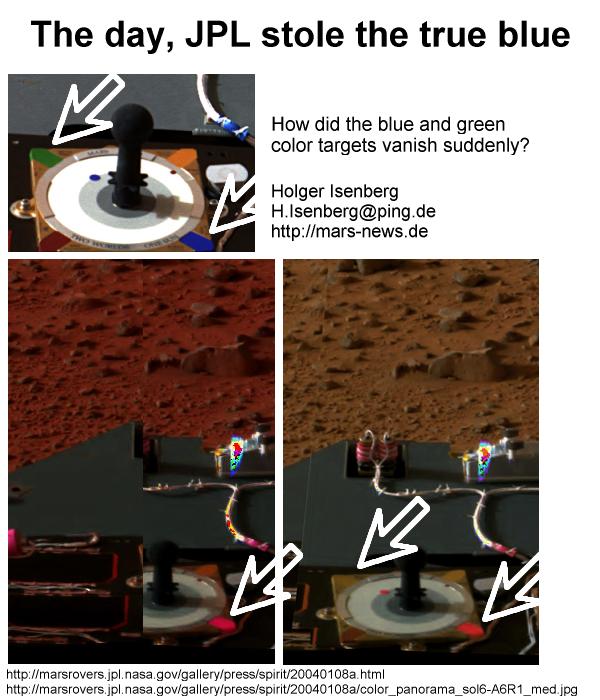
ares2003 writes "There is no scientific reason, why JPL is colorizing Mars in that dull red tint as in their press release images. In the latest panorama image, there is a hint, that they deliberately altered the colors, as the blue and green spots on the color calibration target (the sundial) suddenly converted to bright red and brown. Source of original images: 1, 2 - (for highres replace "br" with "med"). At normal weather conditions, as we have at the moment, there should be a blue sky on Mars and earthlike colors. Furthermore the sky looks overcasted on the pictures as it cannot be considering the sharp shadows on the sundial. If the sky was overcast, then because of diffuse lighting, there would be no shadows. A few years ago, I did an investigation about that very same topic for the Viking and Pathfinder missions."

Not sure if this could be the reason but the MER-A pictures aren't taken at a specific time but rather during a whole day.
That means that the colors you see on the sundial don't match all frames of the final picture you get.
NASA therefore alters the colors to match the pictures as closely as possible. Maybe this disturbs the color? Not sure though. What do you think?
..but releasing these images to the public is a public relations endeavor, not a scientific endeavor.
The photos clearly have been doctored because they don't match the scenery in "Total Recall".
My kids had lots of fun with those airbags, BTW.
All of the spectacular Hubble images that have been released over the past few years have been composites of various grayscale images each falsely-colored by whatever elements or wavelengths they represent. The result is a truly spectacular image that is accessible to people who have no interest in what the images actually show, but in just the beauty of the image itself. The exact same thing is true of the Spirit images.
We here on Slashdot rant about NASA budgets, and lack of interest in a manned space program. The only way to increase public interest is by catching their attention. Grayscale images simply are not going to cut it. I see no problem at all in colorizing images if it means more viewers are going to be interested, and therefore want to learn more.
Sure, the purist in me finds it a bit irritating, but as with many things, the pros far outweigh the cons.
You must have missed the news. Ted Turner bought out JPL yesterday.
My, God the submitter needs, to learn how to use commas, properly when he writes, something that hundreds of thousands of people will potentially, read...
the coolest club on
The images they took are shot through near-infrared filters, and then digitally adjusted to compensate. The pan-cams each have about 16 different types of filters on a rotating wheel, but this near-infrared filter is the only color that's common to both lenses. Therefore, when they're taking stereo images, that's the best one to use. It's not a conspiracy, and they'll probably release images taken through the other filters eventually.
They do that so that different elements of the image can be more easily identified, not to make things prettier. It does make for some very impressive images, but that isn't the point.
[sig] 10 + 10 = 100 [/sig]
as the blue and green spots on the color calibration target (the sundial) suddenly converted to bright red and brown.
The "sudden" change happened as NASA "suddenly" applied another filter for the camera. They do this to better detect certain things in the picture I suppose. They spoke about it on a press conference when they was asked this question.
From Mozilla guru Asa Dotzler's weblog:
Q. Then what we're seeing that's in that Pancam image doesn't correspond to what we'd see if we were standing there?
Jim: we have a pair of red filters that give us stereo. The red you're asking about is the infrared filter which is different from the red humans see. We can convert that red easily. We also have a red filter that matches human sight red but we prefer to use the infrared filter to get matchup with both cameras. Two cameras each have 8 filters. One filter on one eye is a dense welder-like filter to look at the sun. On the left camera is low frequency and the right camera is higher frequencies. Total of 11 unique wavelengths.
Beware: In C++, your friends can see your privates!
My keyboard is obviously a part of the conspiracy. Butterscotch martian sky
Right on! And, as we all know, the Martian sky is green. This can be explained by the dust left over from all the money that we've crashed or otherwise blown in past missions on Mars.
[sig] 10 + 10 = 100 [/sig]
Unfortunately, it seems the primary motivation for the Mars for the general population is now sensationalism. I'm sure the Slashdot audience how a different view on Mars though.
USA Today has a good article about how Mars is shifting from science to politics.
The Washington Post explains better the goals of the current US gov.
I'm not saying it's necessarily a bad thing because that's usually how space projects get more funding but it might explain why the photos are looking more "nice to the user" than "scientifically realistic".
It is not enough to have a good mind. The main thing is to use it well. - Rene Descartes (1637)
They're probably using a blue filter to block Raleigh scattering. We do a lot of image processing, and it's common to use a blue filter in images where you want sharp detail and aren't as concerned about the proper color. Blue light tends to scatter more because of it's low wavelength. If you don't filter it you can end up with just a haze in your image where you'd otherwise have sharp detail in the image.
So put the conspiracy theory to rest.
There will be a new story on how the government conspire to shutdown the mars-news.de website on the 9th of Jan 2004....
coincidentally after this story was posted.
Mode (3) smart-aleck mode. Press * to return to main menu.
Why shouldn't NASA color-enhance images used for PUBLIC RELATIONS purposes? This isn't the data that scientists are going to use - it's advertising, designed to get them good PR and consequentally, more funding. Joe Sixpack doesn't care about science, but he does like shiny things. Scientists, and anyone else who really needs or wants it, can get the raw data.
Why is it that the proponents of "one nation under God" are so eager to get rid of "liberty and justice for all"?
Read here
The sundial from a little while ago helps find tint and all. The pics need calibration.... doesn't sound like a conspiracy to me.
WHen Hubble uses false color, that fact is *always* noted at the official site. If other people use the images and drop NASA's text, they can't be held responsible.
And, yes, NASA has to color correct just about every image one of their probes or landers takes. It's necessary because of now the images are taken. That ain't no cheap digital camera up there.
I have discovered a truly marvelous sig, unfortunately the sig limit is too small to contain i
What I want to see if Mars at night. Why can't they take a few pictures of what the two moons look like from the surface? They always take daytime pictures.
Actually, I was just at rednova.com yesterday looking at archives of Nasa images, and not only is this explicitly mentioned, but for many of the false-color images, they specify the method by which they were constructed (shot thorough this filter, that filter, and the other filter, and recombined, that sort of thing).
The scientists understand the real colors, the public (who funds it, after all) expects it to be red. They want red, we'll give 'em red. I'm not saying I agree with that, but I understand where they're coming from.
The veracity of the person who brought this up (Mr. Martian Pyramids and such) isn't something I'll do much commenting on.
WOULD YOU PLEASE STOP SLASHDOTTING THIS SITE!
I am trying to do some serious research into the truth that has been hidden from my eyes. I finally find a source of hidden knowledge that is better than the one buried under the sphinx, and you geeks have to go and wreck it. _bastards_
The .jpgs that NASA releases from the HST can't really be called 'false coloured' as they aren't the real data. Let me explain to those who don't spend their lives processing HST data.
The data that comes off the HST is reserved for one year to the requesting individual/organisation (and, yes, this is controversial). But it is nothing like the images that NASA releases for the general public. The HST data comes down in a series of CCD output prints, often with whatever spectroscopy data has been requested, most often as a wavelength/intensity matrix. You can't dump that easily into any image editor; it's just a string of numbers. Equally if you dump all the spectra onto one image you will see a nearly black and white picture. So you select the spectra that interest you, and look for anomalies. The resulting pictures used are of little use to the non-astronomer - they aren't full colour, and are often just 4-bit colour showing intensity of a particular spectrum. The pretty pictures come from working out what looks good and combining it, so all images are 'false colour' in some way or another.
I don't know about the Spirit mission, but I'd guess the same applied
Exercise your right not to vote. thinkoutside.org
Violets are Red,
Roses are Blue,
JPL saw it,
and now you will too.
Video Game cheats, hints a
This story should be pulled, it is wrong in too many places, and is just a bunch of conspiracy mumbo-jumbo. The pictures are slightly modded for color, but that's because it's a collage
As evidenced, here, the Martian sky is more yellow/butterscotch (they used the Viking landers American flag to balance the colors properly,pictures are on the website). The Martian sky doesn't really get "overcasted" as there is no moisture in the air to create clouds! There is dust, yes, but the atmosphere is so thin, the sunlight can still go through it. Ares2003 has a few loose screws-My guess is that the digital image of the craft itself was taken later in the martian day, and modifying the color of the photo was the only way to make it look like it "fit in". Mars should not have "earth-like" colors. Any glance through a moderately-powerful telescope will show that the "red planet" is, in fact, red in color (iron oxide dust). Those more yellow pictures of Mars floating around are actually not real photographs, but generated images from the Mars Orbiter Laser Altimeter data.
To see lots of pictures and some scientific conjecture and analysis, you can go here
I was watching a press conference on CSPAN and the guys at JPL actually brought this up themselves. The thing is the camera's have filters for a wide variety of wavelengths many of which aren't visual light at all. Each camera has a different array of filters and actually only share two filters in common for stereo vision.
I got the impression that many of the fiters that ARE within the visual portion of the spectrum were only letting in narrow bands of the spectrum. Exactly what color SHOULD infra-red images be? For obvoius reasons keeping them in their "orignal" spectrum would be fairly useless - though "red" would be as close as we can come.
For just pretty pictures rather than scientific data NASA is color-correcting the images - I think it is more involved than simply colorizing a black and white image. They mentioned compositing together several images from different filters to get a fair approximation of what the human eye would percieve if it was there.
No device "sees" colors the way humans see color. Heck, no two humans see color the same way. All images, especially science images, whether they are photographic prints or digital images, are colorized and manipulated and stretched and bent and filtered and modified to enphasize the details the investigator is interested in.
You think Jupiter is a really garish ball of swirling colorful gasses? Think again. All the Galileo and Voyager images have saturation boosted a great deal, and the contrast is stretched mightily. Furthermore, the luminance layer is deconvolved to bring subtle spatial details into sharper relief. To the human eye, Jupiter is a rather bland beige-ish ball with some hint of subtle color here and there, and not much obvious detail. The same goes for Io, which is usually depicted as a bright yellow/orange malestrom. It's "real" colors - what a human in orbit would see - are also rather bland.
Edith Keeler Must Die
"They do that so that different elements of the image can be more easily identified"
There's another even more important reason...most of the colors are for wavelengths of light that could not be seen anyway.
The last time I checked I could not see UultraViolet, Infrared, or X-rays.
Anyway, the color dots on the lander SHOULD look different as the lighting conditions are different on Mars due to the scattering properties of that atmosphere. Colors under Flourescent lights like we all sit under are very different than those out in the sunlight. If the images from Mars had the color corrected to pure colors, it would not be a true representation of what we would see if we were standing there.
"I never get lost because everybody tells me where to go"
Ok, I went ahead and did a favor for the slashdot community and mankind. I took the fake colorized images and colored them back to the original infrared colors. You can see the results here. I hope this pleases the original story submitter.
HIV Crosses Species Barrier... into Muppets
People like you
Make such a todo
'bout images they ibue
With an altered hue
'Tis nothing that's new
This thing they do
With pix they do screw
Boo hoo, boo hoo.
No, the sky is blue on earth due to the exact conditions we have here. If our atmosphere was less dense, the sky would be darker (less diffused light). Our atmosphere is so dense and made up of the right stuff (nitrogen, oxygen, carbon dioxide) that our sky is actually violet. However, because our sun puts off more yellow and green light then any other colors, our eyes have adapted to seeing those colors better, and the sky appears to be "sky blue". As the atmosphere gets less dense, it shifts left on the EM scale (roygbiv), and gets darkers overall. As it gets more dense, it shifts left on the EM scale(that's why sunsets are red, the sunlight passes through more air at sunset and sunrise) It's actually very complex to determine what color a sky will be. It depends on these factors-
Incoming light colors
atmosphere make-up
atmosphere density
angle of incidence
the eye of the observer
That's why Mars has a butterscotch sky- very low density atmosphere made up almost entirely of CO2
Seems like they're working pretty quick over at JPL to get the colorized version of the images out to the general public, since this week, they've been releasing them less between 6 and 18 hours after receiving them. But if you're not happy with their coloration, then I invite those among the slashdot community who know such things to do it themselves.
The pan cam is black and white, and uses filters to pick out certain colors in the images it takes. If you want, you can read more about what filters are on which half of the pancam (l and r). There are 8 on a side, each with its own particular wavelength and bandpasses. The description of each as well as the numbering scheme is available from the Athena instruments website at Cornell University
The raw images are being freely distributed from the JPL MER website. You'll notice camera (l or r) and filter (1-8) used is described from the naming of the pancam files (eg. 2P126471535EDN0000P2303L6M1.JPG)
Just from this last days images, they have quite a few images in differant filters, of the color wheel itself, for calibration. For a better description of the filters themselves, and of the way they plan to (and have *BEGUN* to) calibrate the images, check out several differant publications. (thanks to JPL-Gene and doug_ellison of #maestro irc.freenode.net for the links).
I, for one, am thankful that they're releasing the raw data/images at all, considering the scale of the global-slashdotting currently going on. The speedy data turnaround, and amazing openness with which they are conducting this mission is really impressive compared to anything else of this scale. Thanks to everyone at JPL, Cornell, and NASA as a whole for all the incredible work from this meager enthusiast.
However, in general you are right, the colour corrections are arbitrary and don't match the "real" colours. Moreover, the brightness stretching and image processing often changes the colour in strange ways. There's a recent paper which discusses the problem and presents some solutions.
A note to readers:
...
As a special experiment, to complement today's coverage of the Chandra XRay observatory, pages C12-C14 have been printed in a ink containing a number of radioisotopes, so as to more accurately depict the XRay emitting stars Chandra has discovered.
Please note that these pages are not recyclable.
Also, for our younger readers, "Erlenmeyer and Lever" have prepared a special edition of the "Science For Kids" column entitled "Fun with XRays"
1. Ask your parents to cut out the section labeled "Warning: Radiological Hazard", and