 Slashdot Mirror
Chandra Provides Support For Dark Energy
starannihilator writes "The Chandra X-Ray Observatory has provided new evidence supporting the existence of dark energy, the force causing the acceleration of universal expansion. The new findings support the theory that the universe will expand forever, provided there is enough dark matter. CNN and Newsday are running the story, originally reported by NASA. Chandra's site has some good images and information on the three galaxies clusters studied (Abell 2029, MS2137.3-2353, and MS1137.5+6625)."
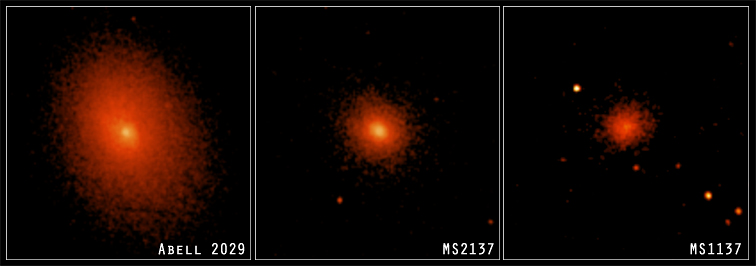
Maybe someone can explain... But when the CNN article states that the universe is "accelerating", does that mean it's really accelerating? I thought it was decided that the universe's expansion was expanding at the speed of light. So, I would assume that by accelerating they mean growing bigger and not actually accelerating faster than the speed of light. Unless, this Dark Matter is something that can bend the known laws of physics and travel faster than the speed of light?
Hmmm.
Gravitation is a shadowing effect. (Yes, all the formulae still work, except when you get out towards the edges of space)
--Mike--
A guy I know that works at SLAC as an astrophysicist theorized it's not something that's expanding the universe, it's nothing. He was referring to a possible 'vacuum of space' that is pulling the matter and energy into the...uh, nothingness I guess.
Apparently the astrophysics bunch had evidence about the expanding universe already, I think this helps corroborate other evidence.
But I guess we'll never know for sure until it happens, so I guess we'll have to wait and see.
"Who are you?" "No one of consequence." "I must know." "Get used to disappointment."
Does anyone else think that the cutting edge of physics is starting to resemble Ptolemy's system of astronomy? With all this 'dark' energy, and 'dark' matter, it's beginning to look like a lot of hand-waving.
Increasingly complex adjustments (e.g. epicycles) were made to Ptolemy's system to explain the observed motions of the heavenly bodies. Then along comes Copernicus and tells us that we've been looking at it inside out all along, things are simple after all, we just have to adjust our viewpoint.
I think physics is overdue another Copernicus.
i always hear about the expanding, but what exactly are we expanding into?
The original poster has it wrong, more dark matter decreases the expansion of the universe as one would expect, dark energy does the opposite changing the state function of the universe and thus allowing it to expand. IAA astro-physicist
I've seen a few references to a theory of a final "big rip," in which everything (even atoms) are torn apart by the expansionistic force.
Would this apply to black holes, as well? If black holes aren't ripped apart, would they continue to provide areas of gravity strong enough that particles in the vicinity don't undergo the rip?
--When you buy proprietary software, you don't get better software. What you get is the right to complain about it.
I should point out here that it's also been theorized that the center is in fact pulling things back in - but this is an old theory, that hasn't gotten much press lately.
The accelleration of the expansion is about the inner layers of the universe accelerating to match (more closely) the speed of the outer edge.
So, it's not really acceleration beyond the speed of light, but an accelleration of the slower contents within the universe.
Think of an empty baloon in a centrafuge. The heat will make the baloon expand, and as the spinning keeps moving, the inside air will press harder against the sides - causing more heat and more expansion. The air that's not at the outside is going to "catch up" to the air at the edges.
Of course, this needs to be adjusted to understand that the "balloon" has no outer bounds, isn't going to pop, and has a near infinate amount of matter inside..
Kinetic stupidity has a new brand leader: Allen Zadr.
There was some PBS special a little while back that talked about "string theory" of reality and the possibility that the "Big Bang" was actually a big "collision" between this and another dimmension. The "collision" or interaction between the two different dimmensions not only created tremendous energy but also left some material from the other dimmesion in this one, dark matter. That is why the stuff is invisible with no known origin but somehow detectable. Kind of like the Old Ones.
The names chosen, Dark Matter and Dark Energy reminds me of the 'ether' that space were filled with. I have a feeling that the current theories will go the way of the ether...
Does everything include nothing?
While they are defined differently, I would point out that "dark energy" is often attributed to a great deal of the mass of the universe (second sentance from your link).
And dark matter is defined as this type of mass, but without explicitly mentioning the energy -- Einstein has some theories on that as well -- inherant with any amount of mass.
I'm not saying that these are the same thing, but I would merely say that this distinction isn't made clear by the Wikipedia.
I would be highly interested in hearing a better explanation of why these two concepts are distinct.
Kinetic stupidity has a new brand leader: Allen Zadr.
Why not? Because observations do not support it. Other than that, it's a fine idea!
HCG 50a = 2MASX J11170638+5455016
11h17m06.4s +54d55m02s
I am not certain how this got ranked to 5, but it is a common misconception, so allow me to clarify.
;-)
:-)
When all the stars burn out, space will start collapsing again as energy falls into black holes.
No. This is not how gravity, according to general relativity, works. The curvature of spacetime is, roughly speaking, proportional to its local mass/energy content. In fact, converting things into black holes doesn't change the curvature of spacetime to any substantial degree once you are more than a few Schwarzschild radii away -- Newtonian gravity works just fine in the far-field region. Therefore, as massive stars die out and form black holes, their gravitational field is not substantially affected far from them.
Incidentally, the vast majority of stars will not form black holes, but rather white dwarfs. Just so that you know.
We often toss out a question to the Astronomy 1 students tests their knowledge of this principles. What would happen to the Earth's orbit if the sun could be suddenly replaced by a black hole? Most students answer that the Earth would fall in. (Wrongo! Too many scifi movies.) Answer : the orbit is practically unchanged.
Ponder that, Chemisor.
--Bob
Science, like Nature, must also be tamed, with a view turned towards its preservation.
Photons are normally considered to have zero mass, and to be the smallest possible unit of energy.
Yet, they are also "negative", are they not? That is, they move away from their source.
Yet, if a photon will be absorbed by some types of objects, bounce off of others, and simply pass through others - it must have some sort of mass. Where does a photon go when it's energy is spent?
There must be a near infinate supply of photons that have no energy or are waiting to aquire it. It would seem that these photons - assuming they do have mass, in the same sense that electrons have a larger mass, could explain both, no?
Again, let me clarify - I do not claim to know something, I am requesting feedback and education.
Kinetic stupidity has a new brand leader: Allen Zadr.
is 1689. You can see an awesome picture of it HERE. It's about two billion light years away and one of the most massive objects in the Universe. It's so massive that those blue arcs in the picture are actually galaxies that are being visually warped by the gravity lensing. The amount of matter required to warp space that much is about 99 percent more than we can see in that image.
For every annoying gentoo user, are three even more annoying anti-gentoo crybabies. Take Yosh from #Gimp for example.
Now blow the balloon up a little more such that P0 and P1 are 1mm further apart, and thus P1 and P2 are also 1mm further apart (P0 and P2 are 2mm further apart). Then (D=distance, dD=change in distance):
dD01/D01 = 1mm/10mm=0.1
dD12/D12 = 1mm/10mm=0.1
dD02/D02 = 2mm/20mm=0.1
i.e., dD/D = constant. Since the dD occured over the same time for the two distances, you can also write this as
(dD/dt)/D = V/D = constant = K
(This is the Hubble equation, where K=H.)
So, in theory, you could blow up a balloon such that two points are moving faster than c relative to each other (V=c=D*K). Let's see how to do this. The distance between any two points on the surface is D = r*Q (r=balloon radius, Q = angle between the points in radians which stays constant as the balloon expands). The change in distance over time is
dD/dt = V = dr/dt*Q.
The furthest two points can get apart is Q=pi (opposite points on the balloon), hence the fastest relative velocity will be between these points. Let V = c and solve:
dr/dt = V/Q = c/pi
In other words, if the radius of the balloon was expanding at a rate of just under 1/3 the speed of light, two points on the balloon would be moving relative to each other at the speed of light. (This would not only take a lot of air, but the rate of air required would go up with the cube of the radius, so you'd want to do this when the radius is very small.)
Applying this 2D analogy to the 3D universe, it doesn't have to be expanding at the speed of light for two distant points to be moving greater than c relative to each other. But it does have to be expanding above a certain rate to achieve this. If it's expanding slower than this critical rate, no two points can be moving faster than light relative to each other. If it's expanding faster, they can. Since the expansion seems to be accelerating, it seems inevitable that it will happen at some point if it hasn't already.
We should also be able to figure out if it has already happened or when it will. We know the constant H (from the Hubble equation H = V/D). (It's easy to calculate anyway, given the distance to any star and it's measured relative velocity.) If we know the history of the expansion rate we know how big the universe is, i.e., this furthest distance Dmax between any two points. We can then solve the Hubble equation V = H*Dmax and see if it is less than or greater than c.
By the way, I don't think this violates relativity, it doesn't say anything about the rate of expansion of the universe. I think this falls into the "warp" concept of traveling faster than the speed of light, i.e., if you can locally expand the universe fast enough, it appears you are moving away faster than the speed of light, and vice-versa if you can contract it fast enough locally it appears that you are approaching faster than the speed of light. I could be wrong about that though.
So does anybody have a good,cheap,quick (pick two) primer on Quantum Physics? Something that can explain what we do know, along with the outstanding issues that we don't know?
Kinetic stupidity has a new brand leader: Allen Zadr.
"How can anything possibly go faster than c?"
Tachyons do it all the time. Literally. Just as us tardyons with real rest mass have the speed of light as the upper limit of our velocities and luxons with no rest mass are always moving at the speed of light, tachyons with imaginary rest mass have the speed of light as the lower limit to their velocities.
Nobody's found any yet, but the math says they should be there and nobody's figured out how to disprove them, either.