 Slashdot Mirror
Cassini Alters Path. Phoebe Now In Sight!
Anonymous Explorer writes "This week the Cassini-Huygens
Spacecraft finally entered
the Saturn system and made its first
main-engine burn in five years in preparation of for the Phoebe flyby. This long
journey
has been one filled with much promise and peril. Launched in 1997,
Cassini is expected to have a rendezvous with
the moon Phoebe
on June 11. For those of us who are lazy, that's just a tad under two
weeks away. After the Phoebe flyby, it's on to the ringed planet, with an
anticipated July 1
ground orbit insertion. The ESA's
Huygens probe will descend into the atmosphere of Titan a few months
after Cassini is inserted into orbit. This mission
promises to be
one that brings a very psychedelic and beautiful area of our solar
system into clearer focus. This multinational
mission is one the
most ambitious scientific explorations yet undertaken and promises some
truly otherworldly images in the near future. With 31 moons/natural
satellites thus far discovered orbiting Saturn, there should be a lot
to keep us occupied. Anyone else excited about the journey
to a ringed world? Lets all enjoy this ride. It promises to
be a unique one as much as for the scenery as for the science. Informal
discussion regarding the Cassini-Huygens mission can be found at
#cassini on irc.freenode.net."


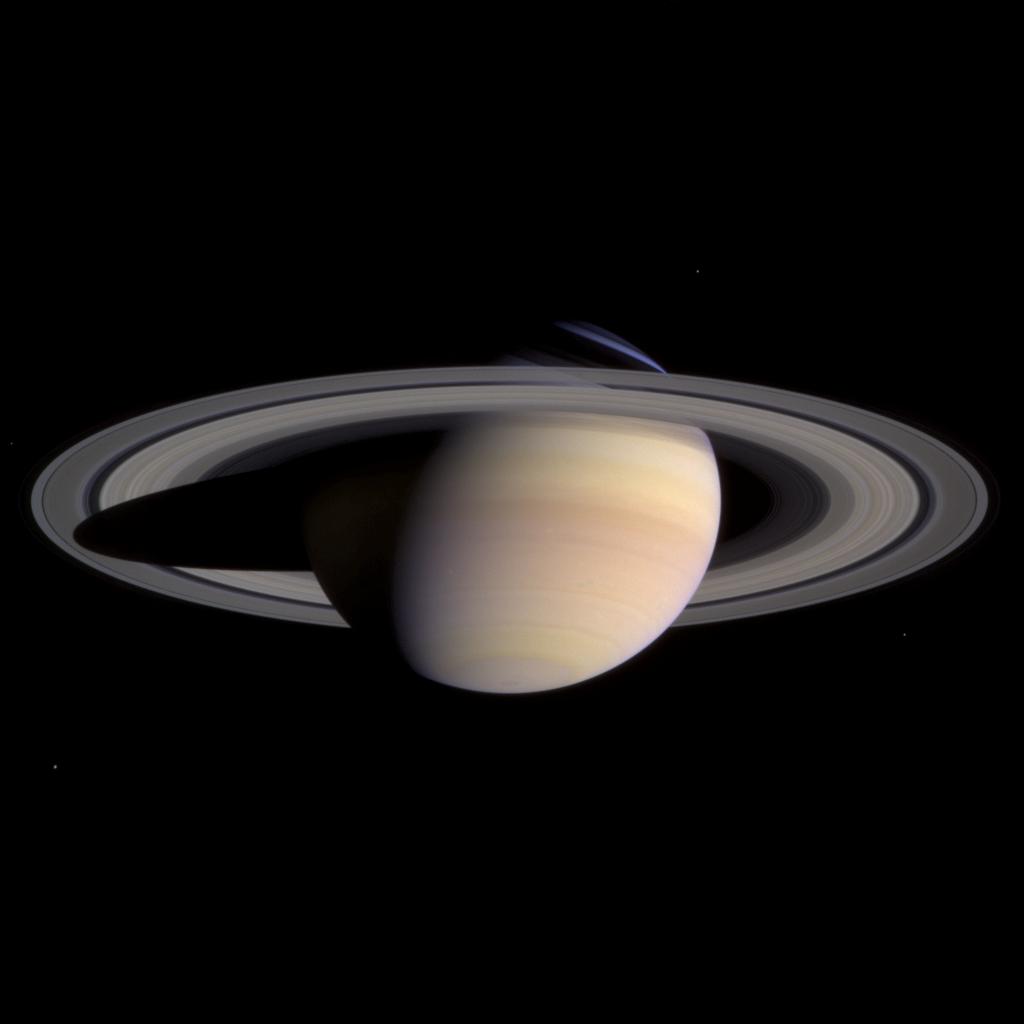
It's gonna be nice to see a photo-intensive orbiting mission to one of the big gas giants. The Galileo orbiter for Jupiter had an antenna problem that greatly reduced the imaging volume.
However, based on Voyager flybys, Saturn's moons are not quite as photogenic as Jupiter's. Titan is covered with a thick feature-poor haze and most of the other moons are too small to have many of the interesting tidally-caused features of the Jupiter moons. But there are still some interesting features on some of the moons.
And, Cassini will drop a probe into Titan's atmosphere that should return some interesting images and data. Titan may have a methane ocean and the Titan probe may possibly land in it and float for a few hours. The ocean may have giant waves because the gravity is so weak compared to Earth, similar to the way that sand-dunes are easier to make on Mars because of the lower gravity there. Things can get taller and weirder under low gravity. It would be the first time liquid could be seen from the surface of another world (aside from the Apollo Tang drippings).
Table-ized A.I.
I think astronomers realize the importance of beauty when trying to get public support. Check out the Hubble Heritage project. The main reason for this project is to take pretty astronomy pictures.
Actually, Cassini will pass through Saturn's rings twice during orbital insertion. Although it will be "driving" through one of the gaps between rings, it will still be going directly through the ring plane.