 Slashdot Mirror
Review: Evil Genius
- Title: Evil Genius
- Developer: Elixir Studios
- Publisher: Vivendi Universal
- Reviewer: Zonk
- Score: 6/10
When loading up Evil Genius for the first time, you'll note that Elixir Studios has learned from past mistakes. The game features a very well crafted tutorial that gets you moving pretty quickly. At important moments the action pauses and full motion video clips of in-game actions are played to illustrate a point. Every basic act in the game, from minion creation to trap setup, is covered by the tutorial movies. While this helps a great deal to understand the basic concepts of the game, the tutorial and glossary quickly outlive their usefulness. The building blocks of the game are explained in detail (almost to the point of annoyance), but where more advanced help would be useful you're left on your own.
The initial experience of Evil Genius will be familiar to anyone who has played Peter Molyneaux's Dungeon Keeper. You utilize a tool to select an area of earth to be excavated. Construction worker minions do the demolitions and then put up finishing touches on a new room. Rooms and corridors make up your hidden base, and each room has a specific purpose. The first room you gain the ability to build is the barracks, which allows you to house and clothe your workers. The more barracks space you have, the more lockers you'll be able to have, and the more minions you can support. A training room with different furniture pieces allows you to transform your construction workers into more specialized forms. A combat dummy trains your construction worker to be a Guard, a lab set up will net you a technician, and a schooldesk will let your humble men be schooled in the ways of social manipulation as a valet. Other room types include a secure vault to house your loot, a security room where minions can monitor your base and interrogate captured snoops, and an opulent office complete with lavish conference table that allows you to host really evil meetings with other supervillains.
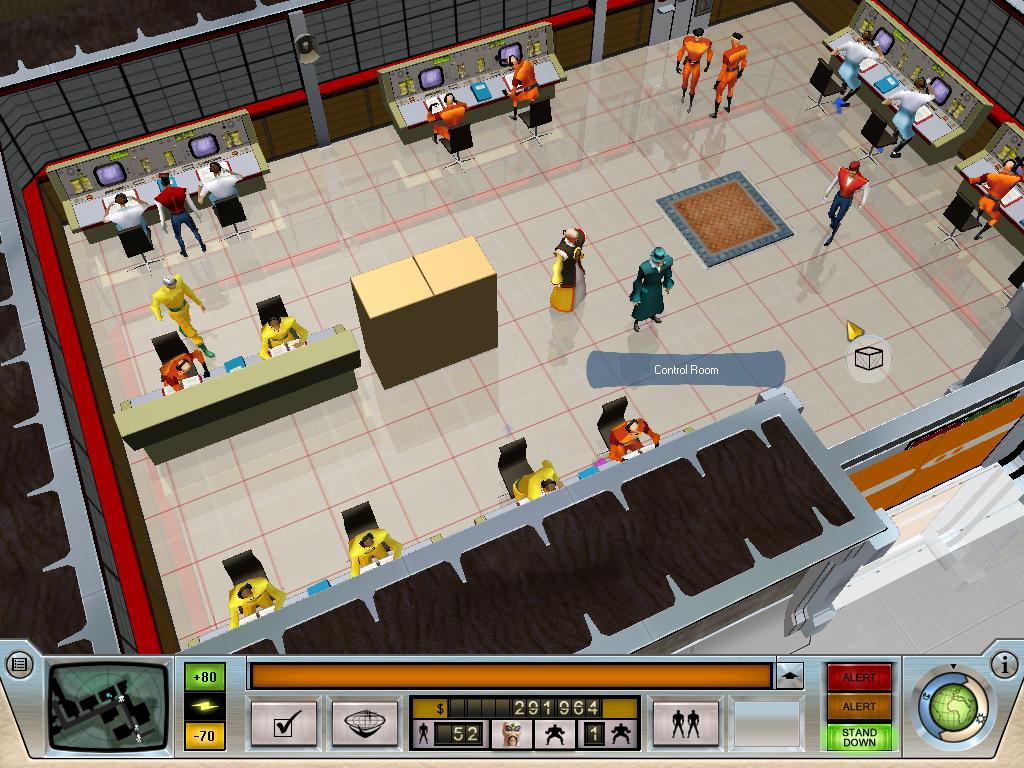
Minions are obtained through a simple requisition interface. You just adjust the number of minions you'd like to have, and at a certain cost over a length of time new minions show up on your deserted island. You have a cap on the number of minions you can control that depends on the number of lockers you have in barracks, similar to farms or supply depots from other RTS games. One nice touch that deviates from the norm is that in order to train a construction worker (the base minion) as another minion type, you must already have control over a minion of that type. The existing minion coaches the next unit in the ways of his trade. Minion types build on one another, so you can have a single minion that advances from a simple worker drone, to a suave valet, to a rich swinging playboy over the course of your game. To obtain additional minion types you must embark on raids into the wider world, kidnapping away a representative of the trade to instruct your workers.
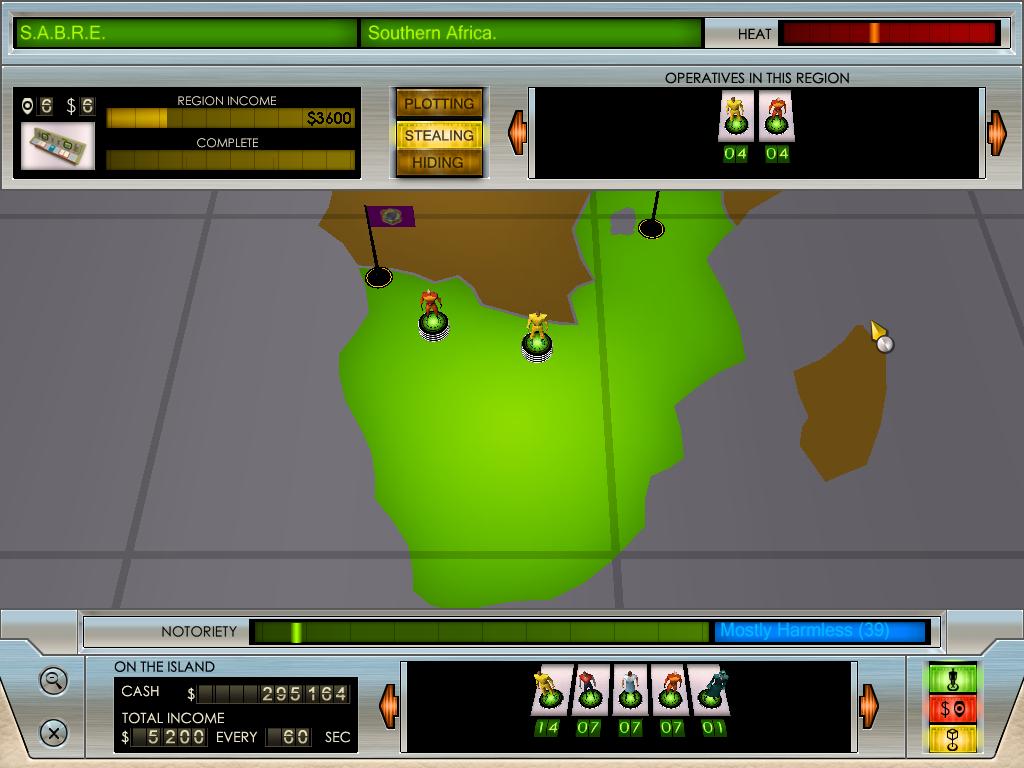
These excursions begin relatively early in the game with simple kidnapping operations, but over time the focus of the game begins to move more and more onto the world stage. Minions are sent out from your island to the nations of the world, and the different minion types have varying effects on their host countries, depending on what you ask of them. Each nation has a simple mode set button. "Steal" will have your minions pulling down cash for you, while "Plot" will have your minions figuring out ways to cause mischief. Strongarm minions like guards and mercs net you more cash, while brainy minions like technicians and scientists are better schemers.
The interplay between minions on the world board and the activity in your base is maintained by a specific type of room: the Control Room. In this room there are control panels which must be staffed by minions at your base. Each area of the world requires a certain number of control panels to be staffed in order to get good intel on the area. Staffing these panels as reliably as possible is a constant battle, because workers are very dumb. There is a punch clock system that allows you to dictate how heavily the room must be staffed, but more often than not I ended up with a control room half filled with dazed, sleep starved minions.
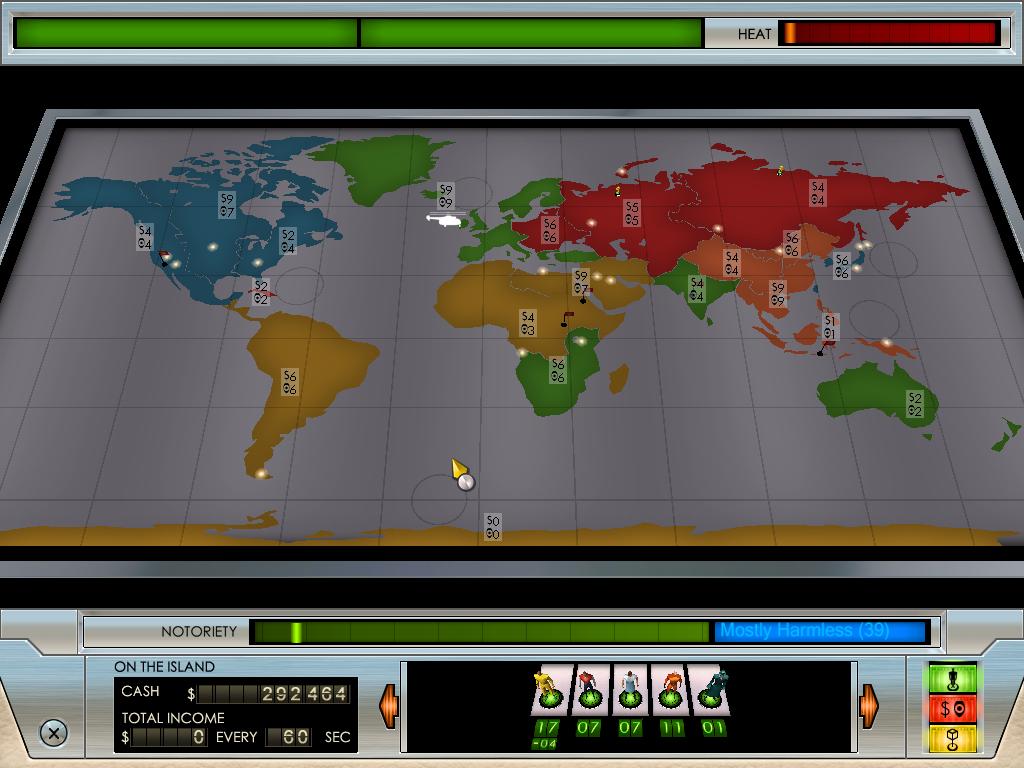
One of the types of intel that the control panels collect is how much "heat" you have in any given part of the world. Any activity in a region will raise the heat level, indicating how visible you are to the forces of justice. The higher the heat, the more likely the forces of justice will come looking for you. This is expressed both on the island through snoopy spies and on the world map with tokens indicating agents actively looking for your minions in their home regions. Eventually the small groups of flunkie agents will be replaced by swat teams, military forces, and finally super-spies who require a base full of minions to take down.
This is the point where the game begins to break down. The strategy elements of the island map are easy to follow, and have easy to understand components like troop training, base building, and trap creation. The hard part comes when you have to keep an eye on your base and at the same time watch a flat, almost 2d world map where your minions are causing trouble. The real goals of the game are accomplished on this map in the form of Acts of Infamy. Plotting minions in a region suss out new acts to be performed, which appear on the world map as little flags. Each Act has minion requirements (4 Workers and a Valet, for example), and a timer. You complete the Act by hitting the Go button, sitting back and hoping. There's no interaction or player skill involved, other than a balance of how much heat you already have in the region vs. how many minions you have on site. The Acts usually take quite a while to perform, though this can be alleviated by bringing along more Technicians. Upon completion, you hear a radio or television broadcast giving backstory to what you've just accomplished.
When they're not participating in Acts of Infamy minions on the world map are constantly at risk from agents. Your role becomes that of a nervous clockwatcher as you zip back and forth every minute or so between the island and the world map. If you don't adopt this habit expect to lose a lot of minions. Notification of the presence of agents is extremely subtle, amounting to the map icon lighting up. Even this indicator is predicated on the Control Room being staffed properly. If you are communications impaired you can return to the world map after a few minutes of base building to find your forces abroad have been decimated. It's incredibly frustrating and very confusing when you first encounter the phenomenon, because the tutorial doesn't give you a good handle on what exactly you're doing wrong.
The half finished thought that is the tutorial system is a constant problem, and an earmark of what is wrong with this game. There just wasn't enough clarity put into the presentation of the game. The gameplay is there (in the form of base building and world map management) and the polish is there (in the form of a rich score and nice graphics), but all of the interfaces could use some clarity. Things will happen in the game, like minions deserting your evil empire, and you're not given nearly enough direction regarding how to resolve the issue. It took me a good fifteen minutes of digging to find out how to raise a minion's loyalty. Even then, the way to go about it (demonstrating your evilness to the minions via torture and loot) is cumbersome and difficult to go about on regular basis.
In the end the intriguing potential of this game is put to waste by the cumbersome interface and unclear goals. The gorgeous graphics of the island map and base building portions of the game are squandered, because most of the action in the game happens on a boring 2D world map. Much of this 2D time is spent waiting while your minions invisibly complete tasks, making your role supervisory in nature and kinda boring.
If the Dungeon Keeper style of game is gaming perfection for you and you don't mind sitting around a lot while the game plays for you, this will be your perfect game. Otherwise, I can't recommend this game for anyone other than a hardcore strategy gamer or a troubled youth with a Dr. Evil complex.
Not played it myself, but my roomie thinks its a great game. One downside, and its a very annoying one, is that you need to micromanage, and there's no way of setting up 'macros' to respond to condition changes in the game. Ie, you're in for a LOT Of button clicking.
:)
I had the same issue with Transport Tycoon all those years ago. Fantastic Game, great cheezy jazz music... the one really annoying downside is that you need to MANUALLY return your vehicles to depot and replace them when they get old and tired. Lots of clicking, especially if you play well beyond the intended length in the game
What about Dungeon Keeper?
In the demo, I found myself leaving the base on "Red Alert" so that the minions would be armed, and kill agents on sight. I never quite figured out what the drawback of that would be, surely there is one?
-Zipwow
I don't know which is more depressing, that 2/3 didn't care enough to vote, or that 1/2 of those that did are crazy.
It's quite humorous and the tag system had potential as a fairly effective way of controlling things without having to worry about the nity-grity of "you there, minion, go here, confuse this investigator". Sadly, minions still act far too stupidly to the tags, like 5 valets going to confuse 1 guy, and even when they do confuse them, they often just leave them standing around in your base to just recover. Henchmen are nice, but their nasty nack of running into super agents and getting killed without you being any the wiser is really annoying. Lastly, the build system needed some little tweaks here and there to removed frustration (like, if I want to move an object, it should be removed from the collision detection with itself, rooms should be easily expandable or changed to a different type, outdoor structures should be demolishable).
I seriously agree on the disappointing world scheming interface. It's really dull to sit there watching a dark green circle turn slowly bright green to indicate your progress and not much else. Most often, even when you succeed, you get the same generic news clip that you got for pretty much all the other infamy acts in that region which although humorous the first time, quickly loses it's impact.
Overall, not a game I'd recommend buying.
In the full game, you can set up security systems and traps to defend your base automatically, taking a lot of the micromanagement out of it.
Traps: These are entirely automatic. An enemy agent triggers the trap (by stepping on a pressure tile, interrupting a laser beam, or passing a motion sensor), the trap activates, and the enemy is killed or weakened, depending on your choice of trap. However, your own minions will accidentally activate the traps if they aren't paying close enough attention - i.e. if you haven't built enough staff rooms or placed enough loot to keep them alert.
Security systems: These require you to tag enemies before they'll work, but they're much more effective. You set up a security desk, which is linked to a network of cameras and loudspeakers. (You can have separate networks for different areas of your base.) When the desk is staffed, the security system will notice any tagged enemy who enters the range of the cameras, and use the loudspeakers to alert anyone within earshot. Any minions who hear the alert will rush to the enemy's location and deal with him.
Tagging agents for the security system isn't too much work. You just have to click around the minimap every few minutes looking for red dots. If you have doors on your base, you'll get an audio alert whenever someone breaks in, in case you forgot to tag them.
Visual IRC: Fast. Powerful. Free.
I like it. I don't care enough about gaming to frequent any gaming specific site, but I do still like to play a good game the rare times the are made. If once in a blue moon a good game with geek appeal gets released, /. will probably be the only way I hear about it.
"Mwahahaha" is an insane or overexcited laugh, also usable by good guys.
"Muhuhahaha" (also "Buhuhahaha") connotes pure evil and is not usable by those of pure heart.