 Slashdot Mirror
Review: World of Warcraft
- Title: World of Warcraft
- Developer: Blizzard Entertainment
- Publisher: Vivendi Universal Games
- Reviewer: Zonk
- Score: 10/10
That said, in the interests of disclosure I should state that I've been playing the game since the first round of Beta invitations in March of this year. I've seen the good and the bad as the game's final form took shape, and I've rode all of them out with a high degree of satisfaction. Before I was snagged to be an editor here, I wrote for a site dedicated to Massively Multiplayer games. I've played over a dozen of them, and I follow Massive gaming news with an intense personal interest. As you read my review, keep my level of commitment to the game and the genre in mind.
Character creation is a straightforward process. Once your account is created and you're into the game proper, your first choice is going to be what server to play on. Currently the game has been released to North America, South Korea, and Australia. The rest of the world is officially on hold as the European launch of the game moves forward. If you have associates in the Old World who you plan on playing with, be aware that Blizzard's current plan is to enforce continental segregation. Apart from what continent you're on, Blizzard has recognized that the "flyover states" are more than just places you see in movies when a plot has to reference a train accident. Servers are available in the four time zones represented on the North American continent. They have also taken the step of classifying servers into different rules-sets. The normal rules-set only allows Player vs. Player (PvP) combat on a voluntary basis. PvP servers also exist which allow any player to attack any other player, a no-holds barred environment between the two major factions. Finally, there are roleplaying (RP) servers, essentially "normal" servers with extra GM support to provide an atmosphere conducive to roleplaying. There are only a few RP servers, but there are more than enough Normal and PvP servers to go around. Deciding between the two is literally this simple: Do you plan on participating in Player Vs. Player combat on a regular basis? If the answer is yes, you know where to go.
Once you're on a server, you have a number of choices to make. There are currently eight races available to choose from, and each race has between three and five character classes open to them. On one side you have the members of the Alliance. Brought together by the Humans, the Alliance represents the forces of the Human nation of Stormwind, the Dwarven nation of Ironforge, the Night Elf nation of Darnassus, and the remains of the Gnomish civilization. Primarily based on the continent of Azeroth, the forces of "good" face down their enemy among the Horde across a vast sea. The races of the Horde, primarily based on the continent of Kalimdor, represent the tenuous group brought together under the leadership of the Orcs. The Horde represents the Orcs of Orgrimmar, the Tauren of Thunder Bluff, the Undead followers of Sylvanas Windrunner located in the Undercity below Lordaeron, and the jungle Trolls who have allied themselves with the Orcish chieftain Thrall. Character classes are broken down to fit with established racial history (Night Elves can't be mages because their history is littered with magical disasters) and fantasy tropes (Dwarves can't be mages because they can't).
The actual character classes presented in the game cover all of the fantasy basics, with each class actually having a useful role to play in a group. There are only nine available, but the lack of extreme diversification means that each class can really live into the role they have to play within the game. The standards are all available: The combat machine is the Warrior, the long distance spellcaster is the Mage, the stealthy high damage character is the Rogue, and the healer is the Priest. There are a few multipurpose classes you'll likely recognize from other games. The Paladin (an Alliance-only class) combines combat abilities with healing and backup resurrection duties. The Warlock is a dark caster that has spells but primarily relies on summoned entities to fight and interact with his enemies. Because it's Blizzard, there are also a few classes that may have titles you're familiar with, but have a very different flavour to them. The Druid is the "nature" version of the Paladin, with spellcasting and combat abilities, but their primary role is to become group glue. Druids have the ability to take on various animal forms, enabling them to take on the roles of combat-intensive classes if needed. Their bear form is a nice fill-in for a Warrior, while the jungle cat slashes and claws like a rogue. Shaman (a Horde-only class) are elemental based spellcasters, tapping into the four aspects of the wilderness to produce unique effects within range of their totems. Finally, the Hunter is a crack shot with bows, thrown axes, and guns (yes, guns). Hunters have the ability to train animals from the wilds to be their companions, with everything from bears and wolves to crocodiles and velociraptors being available as pets.
Once you've gotten your race, class, and name picked out, you're introduced to your race's struggle within the World of Warcraft through a brief panning shot inside the game engine. The camera pans over most of the starting area you'll be exploring and a voiceover intones a brief backstory of the problems facing your race.

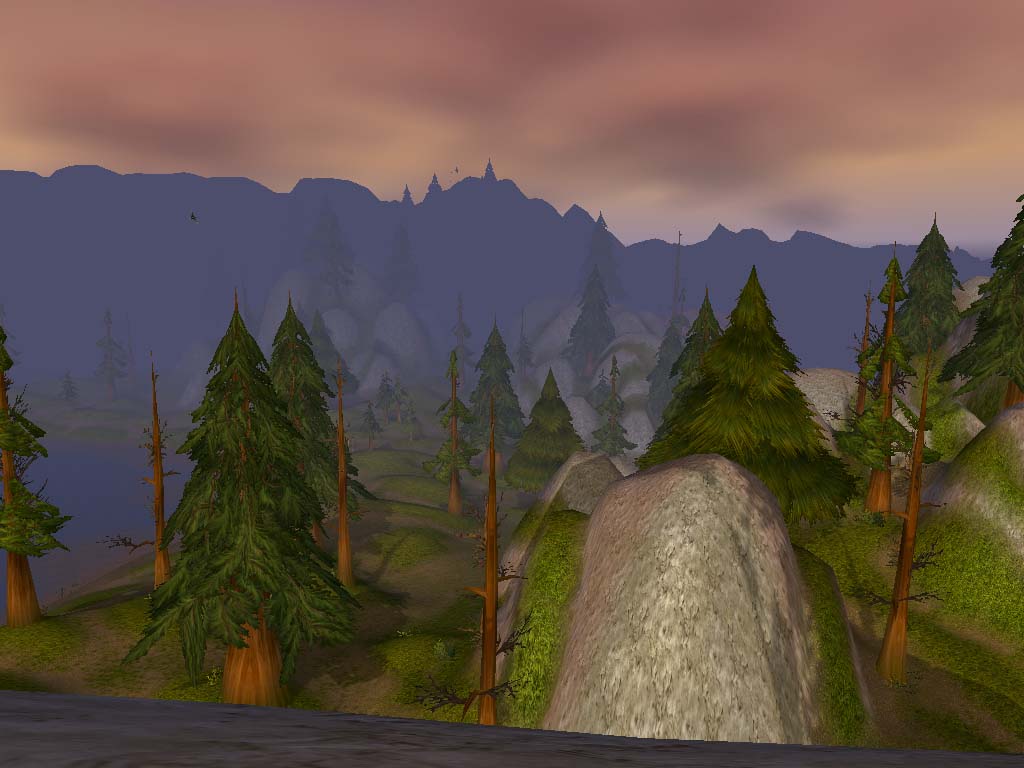
When it comes to advanced graphics technology, World of Warcraft is not the top dog. If you want to give your graphics card a workout, the normal settings on World of Warcraft aren't going to fulfill your needs. The upshot of this is that the game scales amazingly well. 256 megs of ram and a GeForce 2 really will run this game well enough to have an excellent gameplay experience. The visual presentation of the game actually takes advantage of this. As you can see from the screenshots, World of Warcraft is a stunning place to explore. Instead of aiming for a hyper-realistic approach Blizzard has actually accentuated the unreality of the gameworld, endowing the Night Elves with long pointed ears, the Gnomes with large, limpid eyes, and the Undead with horrible clawlike manipulators. Characters have an almost anime quality, while beasts and monsters wear new interpretations that accentuate their most vivid characters. Moving through the landscape is more like walking through a painting than playing a game. Particularly picturesque landscapes such as the snowy Dwarven home of Dun Morogh or the sweltering jungle of Stranglethorn Vale require real pauses to stop and drink them in.
The visual quality of the world and the introductory voiceover at your character's creation begins the process of drawing you into the game world, a task which World of Warcraft does more meticulously than any other Massive game I've had the opportunity to play. Each race faces specific challenges, bourn out by the quests you receive immediately upon entering the game world. Non-Player Characters (NPCs) with quests for you appear with a yellow exclamation point above their heads, and speaking with them prompts a short vocal interaction and the possibility to add a quest to your log. Each quest is a miniature story unto itself, just waiting for you to carry it through to completion. Quest goals are clearly marked, as are the rewards you will receive from completing the quest. All quests have an experience reward (making questing an integral part of level advancement), but the rewards displayed include the amount of coin you'll receive and any items. Many quests give you the option of choosing your reward from among a few different items, allowing you to customize your character's loot set from NPC quests. Beyond simply providing you an impetus for getting out into the world, these quests are the hook that allows you to stop being just some person wandering around killing monsters and allows you to actually become a hero. From the start, you're participating in events that are keeping your fellow countrymen safe and secure. Beyond just simple "go here and kill the thingie" quests, there are endless opportunities to become involved in the lives of your people. Here, you take a note to an important official notifying him of how a pest eradication campaign goes, while there you collect the pieces necessary for a powerful potion. Your actions have consequences as well, as the NPCs begin to treat you with greater and greater respect (and remember you when you return to them), allowing you deeper into their lives and into the story of the world around you. In some places, questing even pays off in lucrative gains as vendors offer you discounts because of your service to their cause.
Beyond the ways that you interact directly with the world, Azeroth does it's own thing quite well without you. Guardsman patrol the streets of the major cities, keeping the populace safe (and answering any questions that wayward adventurers might have). Children are at play in houses or gardens, and hilarious conversations play out between the folks wandering through the avenues of the racial strongholds. Far from a static world on which you leave your mark, the World of Warcraft is a place littered with it's own history and peopled by individuals with motivations and stories.

This inclusive experience extends beyond just the visuals and the storyline. World of Warcraft has the richest sound environment I've yet experienced in a MMOG. Music, often the most frustrating aspect of a Massive game's soundtrack, is incredibly well produced and judiciously used. There is no "combat music". When you enter combat the only sounds you'll experience are the harsh clash of weaponry and armor. Musical scores are cued based on location, with each city and wilderness area having their own themes. The music isn't constantly on at a consistent volume. Swelling music announces your arrival at a new area, and then fades back into the background to allow you to enjoy the music without overwhelming you with it. In the spare manner in which it's used, the musical score completes the atmosphere that World of Warcraft attempts to create.
Sound effects are also well tended to. Weapon noises and spell effects are very satisfying, with grunts and clashes making combatants incredibly aware of the danger they're in. Tiny audio clues also keep a player aware of his surroundings. Tiny "clinks" announce personal messages from fellow players, and an small explosion of sound announces your arrival at a higher level. Beyond the normal text and animated emotes common to many games, Blizzard has also included voice emotes. The emotes, which are combinations of animations and voices that get across a particular emotion, are very similar to the clicky-conversations you can have with your units in Warcraft III. I especially like the male Dwarf's flirt emotes.
Beyond the game's excellent presentation, Blizzard's reputation for making intuitive game interfaces is upheld. A simple quick-launch bar is available at the foot of the screen, with numerous other bars available with a combination of the shift and middle mouse buttons. Right clicking is the default "do stuff" button, and the action taken changes in context to what you're clicking on. Items are easy to examine, as each features a small portrait next to it's name. This portrait, when moused over, displays a popup detailing the statistics associated with the item. Simple color coding indicates the rarity of the item (green for magic, purple for rares, etc.), and the display lists a level requirement. Every item has a level requirement, which a character has to meet or exceed in order to equip or use the item. Items which are not useable by your race or class have portraits tinged with red. This intuitive interface extends to quests and tradeskills as well. The quest log displays all the information given out by the originating NPC and color codes quests based on the difficulty of the quest in relation to your character's level.
Tradeskills are often the red headed stepchildren of a Massive game because of poor documentation and a high barrier to entry. WoW's approach to tradeskilling allows even the most casual player to get involved, and ensures that every crafter knows where they stand as regards possible crafted items. Each character is allowed to train in two tradeskills, which are called professions. Some options, such as Tailoring and Enchanting are viable thanks to specialized equipment or scavenged goods. Others, such as Herbalism and Blacksmithing, have a counterpart "gathering" Profession that allows materials to be collected from the environment. Mining allows a character to obtain ore, which can be melted down via Blacksmithing for use in Arms and Armor. Training in a Profession is as simple as finding a trainer and saying "sign me up". You are then presented with a list of recipes that you currently have access to. Each recipe has a materials requirement for completion. To create an item, you have to have the required materials present in your inventory, and then hit the "create" button while a recipe is selected. There is no margin for error here. Every attempt to create an item using a recipe is successful. As you create items your skill in your chosen Profession goes up. Recipes are color coded (like items and quests), and as your skill goes up recipes begin to become relatively "easier". Once you've created your hundredth tunic, you've got it cold. As such, new recipes become available for purchase from the trainer, allowing you access to better and more challenging items. Skills without gathering requirements are extremely easy to get into, and even Blacksmithing only requires that you keep an eye out once in a while for a mineral deposit. The Mining Profession even provides you with an ability that makes mineral deposits show up on your local mini-map.
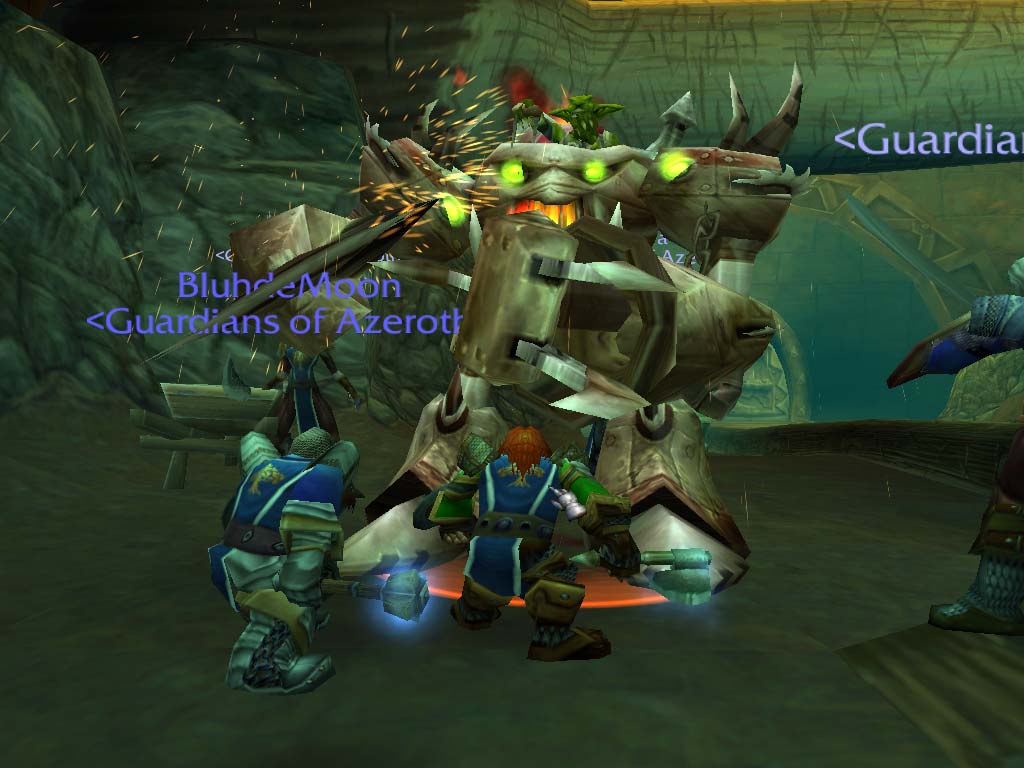
This is, of course, a Roleplaying Game and RPGs are nothing if not fighting intensive. Combat has been as carefully considered as all other elements of the game. The most striking thing about the combat is the interactivity. Combat is a very fluid experience in World of Warcraft. Every class has abilities and spells that allow it to contribute to a fight, with the typical Massive Gaming roles (such as the Tank and the Healer) being filled by overlapping classes. Grouping casually is not a cause for worry, and almost any combination of classes can form a valid hunting party. The actual act of combat follows many other games' patterns. You activate an "autoattack" mode, where your character swings his or her weapon or weapons as often as she can every few seconds. The difference is that, unless you utilize the abilities at your disposal you're likely to lose in a fight between yourself and an enemy of equal level. Constant use of spells and abilities to keep your opponent on their toes is required to ensure that a fight goes your way, and finding the rhythm to your class's combat style is one of the most engaging parts of the game. And if you die?
You don't lose experience. I'm going to say that again, because it's so important. You don't lose experience when you die. There's no debt, there's no recriminations, nothing. You reappear as a ghost in the nearest graveyard to the point where you died, with the world outlined in white and a spooky soundscape playing around you. You just jog back to your body and click the button that says "Resurrect". You reappear with about 75% of your health and mana intact, and go on from there. Many characters can just hop right back into combat. If you're in a group, a friendly Priest or Paladin can raise you on the spot. If you don't want to jog back to your body or don't have a Priest in your pocket, you can speak to an NPC located in each graveyard and resurrect in the graveyard. You're penalized for taking this option by reducing the durability of your items by 25%. Items with reduced durability eventually stop working and must be repaired, so taking the easy way out costs you money but no experience. You will never be penalized experience for your death.
With a good group at your back and a level head, you can tear through levels at a brisk pace. Character advancement in World of Warcraft is anything but a grind. And if you die, who cares? A minor annoyance, and you're back into the thick of things. Leveling up is anything but a chore with the combination of enjoyable combat and risk free death. In fact combining the experience you get from combat with the XP received from questing, and you'll regularly find yourself honestly surprised when you gain a level. And leveling up is definitely enjoyable. In addition to improving your basic attributes, at even levels you're given access to new abilities or spells. These are trained up by speaking to a class trainer. At the trainer you will be given a list of the abilities available for you to learn, with two or three new abilities opening up every other level. Every ability has a monetary cost associated with it, but once you have a new ability or spell in your hands it's incredibly satisfying to try them out. Once you reach level ten you'll begin working on your Talents, as well. Talents are how you take your character and really make him your own. As opposed to being just another Mage or Warrior, you're given three "trees" in which to allocate Talent points. The three trees each correspond to a facet of your character class. Each new level starting at ten allows you access to a Talent point. As opposed to the instant gratification of Abilities, Talents allow you to specialize your character over time. Mages, for example, can choose to specialize in Fire or Frost spells, and their talents allow them to reduce casting time, improve damage, and generally tweak their relationship with a chosen field of abilities. Warriors, in turn, can focus on defensive, offensive, or weapon skills.
Combat, questing, graphics, backstory, and game design are what bring a player to a Massive game. What keeps him there is the community. While the actual community you find yourself in is highly variable (there's a reason the ESRB sticker says "Game Experience May Change During Online Play") the tools Blizzard has provided for getting into the community around you are very robust. The game has a very versatile "/who" command, allowing you to see the level, name, class, and group status of everyone around you. Finding folks who might be interested in grouping is a snap, and contact ing them is as well. There is a flexible chat system that allows players to congregate as they desire based on their interests. Guilds, always an important aspect of an online game, get a great deal of respect from the Blizzard developers. A charter is required to begin a Guild, ensuring that one person Guilds don't clutter up the Guild namespace. Once the Guild has been formed, a permanent chat channel is formed that connects every member of the group. Guild members that want to show their pride can purchase a tabard, which go into an equipment slot that isn't used for anything else. The Guild leader decides on the tabard design, and every tabard bears the same color and design. Guild pride is something these designers understood. Beyond simple communication, mercantile exchange is promoted through Auction Houses. These locations (one per continent), allow players to put items up for sale and reap monetary rewards through the in-game mail system. Filling an equipment hole that quests haven't taken care of yet is easy and convenient.
World of Warcraft, then, is a remarkable achievement. It has both depth and breadth, allowing old hands at online games to feel right at home while inviting new players into the genre. The game's backstory is easily accessible via the questing system, and the interactive combat system ensures that you're never bored while exploring the vast world you inhabit. Beautiful done graphics combine with a carefully constructed soundscape to transport you to another place. From a game design standpoint World of Warcraft is an accomplishment to be proud of. In my mind, though, what pushes this game from a nine to a ten are the little things. The Blizzard polish that resulted in the endlessly clickable strategy game units has expressed itself as a world that always has something new to reveal to the curious player. Books lie on desks, waiting to be opened and their stories read. Crystal balls allow you to peer beyond a Wizards tower across half a continent. A woman in a shop asks you to deliver a sewing kit to her son. Someone else needs your help convincing a tavern-keep to carry his brew. Blizzard has somehow found the happy medium between an online world and an online game, and the results are satisfying beyond measure. Every gamer who is tired of shooting zombies or killing rats deserves to try this game. I highly recommend it to every gamer, every MMOG player, and everyone who's ever picked up a fantasy book and gone "I wonder what I would do in their shoes?" World of Warcraft is your chance to find out.
sorry, with their subscription fee at around 150 bucks a year, I'll just keep playing archaic games that don't require subscription fees.
"No one is more miserable than the person who wills everything and can do nothing." -Emperor Claudius 10 BC - AD 54
This review pretty much sums it up.
;)
The only things I'd add is that, based on my experience with the original Diablo (admittedly not an MMORPG per-se), Ultima Online, and Everquest this is by far the most fun game to play.
For instance, level advancement doesn't feel like a root canal gone horribly wrong (like it did in Everquest). One of the really clever things Blizzard did with the UI was make the "XP bar" take up about 90% of the width of your screen, so no matter how little XP you receive for an action, you can see it advance. The one little trick alone goes a long way to easing the frustration in other games, such as UO where you would practice a skill forever to get it to move 0.1 points, or in EQ where you could fight for hours without your XP bar moving by a single pixel (in EQ the XP bar was maybe 5% of the width of your screen).
The UI is more intuitive than others I've used, but I still found myself lost on a few occasions and that caused extreme frustration. If you turn off the tutorial pop-ups (which can be annoying), you'll have to hunt around to get the right screen for things like trade skills (professions). I certainly didn't expect to find them in my spellbook!
The quest system in this game is OUTSTANDING!!! I cannot believe the sheer volume of quests, and the thought that was put into them. None of the quests feel like after-thoughts and they all seem very natural to the flow of the game. Just when you start wondering how long until your next level up, you return to town and complete a few quests and BAM, next level!
The pace of the game is quite fast in other areas, too. Combat is very fast and furious, perhaps a bit too fast for my taste. I tend to like being deliberate in my actions, and since I don't have the nano-second twitch abilities of a console gamer, it takes me a little time to deliver the right sequence of skill uses (especially on a laptop keyboard). My wife also has trouble keeping up in combat because she's not used fast-paced computer games.
I will point out that this is the first MMORPG that she's ever been remotely interested in. She detested EQ and refused to play it, but she's been drawn right into WoW even so far as to pursue her in-game professions with great gusto. So fellow geeks, there is hope yet that your SO might join you in your addiction
Someone is WRONG on the Internet!
Don't forget the higher level quests take you into contested lands where players from the Alliance/Horde not only pvp each other openly, but compete to finish the quests that use the same components.
Well. I am playing a 10 day trial I got off my friend, who is wholey addicted to it, and it is very nice. I am not sure whether I can afford both time and money wise to get into it though. But as far as MMO's go, it is probably by far the finest yet.
Lineage 2 is not a good MMO to judge others by, and I'm fairly tempted to say the same of Galaxies, though maybe it's just a matter of taste. My friend and I spent a good few months playing AC2, but stopped when we pretty much hit a level cap and had other things to do anyway. However, we both have several characters on WoW, as it is actually fun to try out all the variations. They are all, well, variant.
Basically, out of all the MMO's I've played (AC2, FFXI, Lineage 2, DaoC, Eve Online, Neocron and Anarchy) WoW is the one I would choose to play. It has all the best features of the others, done better.
If you have a friend who bought the CE, see if you can get the 10 day free trial from them and check it out.
" but is it a GREAT game in the LONG term?" Not particularly. After a week or so, you'll be tired of the fact that every single character o fany race looks pretty much the same - the environments, while pretty, all have an eerie sort of 'sameness' to them. About this time, you'll also discover that beneath the pretty cartoon graphics, the game itself is pretty hollow and lacking. There's really little to do beyond the same quests you've been doing for dozens of levels, and you don't even get to the semi-nifty instanced dungeons until you've reached a fairly high level, so until then, it's often like pulling teeth performing the most basic of tasks thanks to camping. No, the game itself has absolutely no long-term staying power, but then, what MMO does? All MMOs are, honestly, pretty piss poor games, what makes or breaks any MMO is the people. I've met some -really- great people on the RP servers that I have a blast playing with, both for the most part? The quality of the WoW player base seems to be slightly below that of EQ -- one of the worst I've found in an MMO yet. As with any MMO, having good people to play with is what makes the game fun, not the game itself. It's a shame that the majority of the game is geared towards solo play.
My biggest complaint, not just with WoW but most new MMORPGS, is that it requires minimal skill to play. You either fight at your level or you get slaughtered. You can't run into a mob 5 levels above you (solo) and survive easily (by running away).. The reason why this doesn't bother me as much in WoW is that you get most of your experience from quests.. There is so much content for a game just released that you don't notice some of these issues. I also find that its difficult to powerlevel in WoW because of the way mobs spawn and there doesn't seem to be a bonus with grouping. ie, I can probably gain more xp running around the wild solo than in a group.
On that note, you can solo alot of this game besides the scattered quest. And it appears to be relatively easy to find a group working on the same one.
Back to skill tho, the thing I liked about AC that I haven't seen in MMORPGS since was that you could put yourself into seemingly impossible situations and surivive. Sometimes you'd gamble and die repeatedly but there would be times that you would survive by the skin of your teeth. I can't count how many times i've recalled out with 1hp left keeping the mobs busy so my friends could escape. Unfortunately i'm a geek and can't properly describe the feelings you experience but I haven't felt the same in other mmorpgs. They are too dumbed down.
In AC you knew the levels and some info on the mob (depending on your skills) but that didn't mean much. You could go against a mob 20 levels above you and easily wipe the floor with it, while another mob around your level would kick your butt. None of this color coded mob crap. You had to know the mobs weaknesses to attacks.. Some were nearly invulnerable to certain types. You had to prep for your adventures.. If you knew you were going to run into mob x, y and z you'd prep different than mob a, b and c. While in other mmorpgs it doesn't seem to matter.
Maybe AC was too arcade like... You could play it safe but if you wanted to push the edge the fun factor was amazing. Maybe this style of game didn't do well because it required a slight twitch factor. Maybe it was bad timing or MS's lack of marketing (did they have any?)
But back to WoW, it is the first MMORPG i've played in 3 years that I have really enjoyed. It doesn't feel like a level grind like most of them. Even tho the quests are the same type, collection, delivery, they do toss in the scattered twist which keeps you on your toes. I personaly give it a 9/10 and forsee myself playing this for awhile.
"Thanks to the remote control I have the attention span of a gerbil."
Take one of the other replies to your post:
So...WoW has a level cap and some variation but, honestly, not THAT much difference to keep people sick of the level grind coming back. Same as happened in AC2...
So what - in the LONG run - will keep people playing? Probably nothing. The lasting community part of the MMO genre is not needed, as long as there is fresh blood (subscribers) to keep the revenue stream going.
I believe your lament - beyond the "this is just same as the other games but newer" part - is that the lasting aspect of the game is missing. Something that keeps people playing a game - beyond the level grind - will require a shift in paradigm from the current genre. EQ popularized the level grind and was quite successful, so that is what will be emulated. UO, with the quick "level up" but no "endgame" is the opposite - it became a graphical chatroom. Some game that can remove the tedious nature of the EQ-like games, while providing substantial character variation in a meaningful and beneficial manner, that has fun and rewarding content for a player at any stage of advancement is probably the holy grail of MMO designs.
I've played EQ for four years, played StarWars Galaxies for a year and a half, and played EQ2 beta.
WoW has a major advantage over all of the above games because of one thing. Blizzard understands math and statistics. Blizzard has mastered the RTS genre which requires a very high compentency of math. You cannot balance 3+ diverse teams in a RTS game without a solid understanding of statistics, non-transitive statistics, and stong skills in mathematics.
In WoW, every aspect of character ablities and spells have the Blizzard touch. They just feel right. They don't feel overpowered or underpowered. The enemies that you face are perfectly balanced for their level. Unlike EQ or SWG where you could easily run into a lower level enemy that would completely wipe the floor with you.
Other game makers seem to play darts with their games. Try something random, see if it works and tweak it if needed. Blizzard obviously has a very strong mathematical foundation for their game. There's nothing complex. The formulas just work and the game just feels right.
This alone is why I think WoW has a very bright future.
The #1 complaint of the non-mmorpg freaks out there is that these games are tough on the casual player. WoW helps because of the number of small, quick quests (no 8-18 hour camping sessions for an item drop) with decent rewards. WoW is also better than many MMORPGS out there because of the mild death penalty. EQ1 is brutal with xp loss. EQ2 is slightly less brutal with the debt system. WoW is very nice. And that's great for the casual player.
.... a hero. All MMORPGS are "cities of heroes". And there's no way for individuals to change the world without the world running out of quests or alienating and diminishing the role of 99.9% of the users. The only way I can see to do it is remember how heroes are created in the first place. By this I mean in table top RPGs, which can have the richest NPC population thanks to a dedicated GM, and in real life.
#2 complaint is heroism...and that's the big one. In Morrowind, you are the hero. In a MMORPG, you are
Examine: TableTopRPG (TTRPG) - the heroes are made by doing amazing things in the midst of greater problems. This is hardest to do in MMORPGS. A GM in a TTRPG has to worry about a group of say, 5-8 players. A GM in a MMORPG has to worry about a group of maybe 2500 players, probably more. Daunting. GM run events will either have to be many (uniqeness problem) or huge (management issues). Kudos to whomever figures out how.
Now, in real life, a hero is someone who is admired by many for a great deed -- and usually the great deed benefits many. This is missing in single player RPGs (sure you're saving the world, but why should you care about them? they arent real!) and in MMORPGS (how can the owners let so much ride on a player, when people are paying?) But if they could figure out a way to have random people at random times save groups of other people, they would be heroes.
Asheron's Call with the ponzischeme system tried to make the people at top to be world altering heroes. It didn't work, since it was also a hybridized guild system, among other things.
The only way I can imagine people feeling like heroes, and being recognized as such is a "quest" that is some sort of battle between the (WoW example) Horde and Alliance, where the winner gains some sort of advantage over the loser (permanent, perhaps control of a zone or city? not sure exactly). There would be (GM run) "turning points" in the battle, where players would have the opportunity to influence the outcome one way or the other, through success or failure. Perhaps rescuing a captured NPC from instantly zonewarps all high level PCs from the zone (of the opposing force). I dunno. But that's all I can come up with.
My question...how do you pronounce "MMORPG"???!
Moo.
Amen. Mod Parent Up!
I posted this in an earlier story, I'm gonna cut and paste it because it's even more apropos here. There is NO reason to give WoW 10/10 unless you don't care a whit about PvP, which to my mind is the only real draw MMORPGs have over IRL.
Folks are talking a lot about WoW's upcoming release, and rightly so. It really is going to be the big beasty game it's been promised to be.
But to counter the WoW love I'm seeing I'd like to offer some thoughts on the game's quality for a particular segment of the market: the PvPer.
Caveats: I'm an ex-Clan Lord, ex-Shadowbane player. I enjoy questing and other PvE-type activities for the social aspects, but to put it simply I find playing against the computer damned unsatisfying, fairly quickly. Of course I know serious PvP isn't for everyone, but for those of us who aren't willing to bother unless there's a human on the other side to challenge us with player (NOT character) skill, strategy and quick thinking, there's no substitute.
Executive Summary of my thoughts on WoW PvP: Not Ready for Prime Time, but Lots of Potential. The game is so clearly built around a PvE/questing model its deficiencies in PvP really stand out. However, the engine is robust and looks great, even on sub-standard hardware like mine. I think the problems for PvP posed by a largely PvE game are overcomable, but it's going to take some very significant ruleset/mechanics changes before it's worth it.
Specific problems:
- PvP is Meaningless. It's basically a multi-person duel with no stakes involved. You don't lose anything but a couple of minutes - or less - spent respawning; no loot, little damage to your gear, no money, no experience, NOTHING. There's no recognition for a PvP kill, no death list, no guild/race/area messages about who's kicking who's ass. You can't loot a corpse, you can sit and stare at it until the player decides to respawn, when you can kill them again with no consequences for either of you. Yay.
- Any sort of operational tactics are pointless, because you can't hold territory or ground unless you round up all your enemies, they kindly allow you to kill them all in the same place, and you corpse-camp them. Otherwise they can just rez for free, rapidly, regroup and attack. Everything's a running battle with no center, no topographical advantage, no flanks, no nothing, just a mess.
- All classes are the same speed unmounted. This is ridiculous, and it makes finishing kills a joke if your main damage route is melee. You need potions/gear to move faster, which brings me to my next point.
- The game is dependent on items. This is so Everquest-y it's not even funny. Whether you're skilled or not matters far less than the items you have equipped and, therefore, the time you spent farming to get them (or for the money to buy them at auction). This SUCKS. Some augmentation by items is fine, but this game is ALL about items. And level. Which also sucks. Skill and strategy anticipation is a very distant consideration.
In the brief time I was playing I had a several Horde players complain (this is through their Alliance alts and buddies) that I was exploiting because they for some reason couldn't cast when they wanted to. I was just using the rogue attack Kick; when they looked it up (if they bothered) they complained that it's too powerful to use against players. Come oooonnnnn. In that same vein people were screaming bloody murder and shouting to GMs anytime Horde players mounted a raid. This was on a "PVP SERVER."
Brief aside on player skill v. character skill, cause that's a differentiation that I know a lot of PvE gamers don't make. In general I'm talking about knowledge of your opponent's capabilities, knowledge of your own and the facility to advantageously match yours against his. Facing your enemy with strength in the areas of his weakness, to paraphrase Sun Tzu.
- The group mechanics are rudimentary. Max players in a group is not high enough for PvP and there's no way to mo