 Slashdot Mirror
Man Builds 7-foot Grandfather Clock from Lego
Ravalox writes "Eric Harshbarger has built a 7-foot-tall grandfather clock exclusively from Lego. It keeps accurate time and needs no electricity; it needs to be weight reset every 13 hours. Other pictures include the gears, numbers, the face, and the pendulum mechanics."

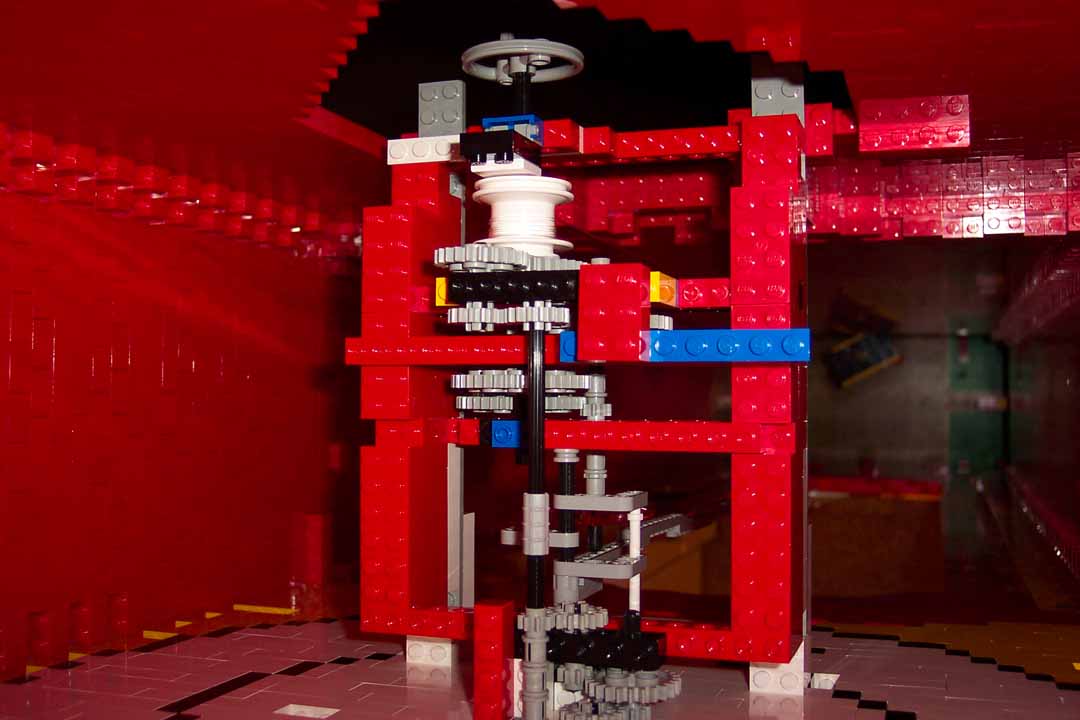


This is the same Eric who built some guy's desk out of LEGO a few years back. He's been talked about on /. before, just check out his portfolio:
l
http://www.ericharshbarger.org/lego/portfolio.htm
He's built clocks before, but I think this is his first working model. Of course, be sure to check out his Tux and BSD Daemon sculptures as well. This guy is a master at LEGO construction, and be sure to look for him in the future.
There is no reasonable defense against an idiot with an agenda
:wq
http://64.233.161.104/search?q=cache:Cs8oaitTLG0J: www.ericharshbarger.org/cgi-bin/photo.cgi%3Fclock_ 5.jpg%2Blego/images/clock+&hl=en
Doesn't guy wrote this know that at the time when a these 6 foot wonders were invented, there WAS NO ELECTRICITY !!. It runs on pure potential energy stored in weights.
The interesting part is that it would be much harder to make a real grandfather clock (like the one at my ancestral home) - because Lego in comparison is easier to build.
But Kudos to the guy - it's not really pointless , it would have helped if this was part of at least a few mechanical engineer's curriculum - not just carnot cycle engines.
Quidquid latine dictum sit, altum videtur
Main
Gears
Numbers
Face
Mechanics
Click here for the good stuff
From my hall of mirrors:
Corel Cache
Internet Archive
Google cache Note - images may not be cached.
Knowledge is how to play a game, intelligence is how to win, wisdom is knowing what game to play.
This is news now?
Eric built his clock almost FIVE YEARS AGO!
Heh. Check it. It was originally done in January 2000 and the weight reset time has been updated last year to be 30 hours.
...yes, he's made a girl out of Legos. Only a mosaic, unfortunately.
I just sucked all the relevant pages through the coral cache, so it should be fine that way. Here's a link.
I find your ideas intriguing and I wish to subscribe to your newsletter.
It's a technic wheel with the tyre removed.
Leo's LEGO has the answer to this particular question .
File under 'M' for 'Manic ranting'
Not quite, but he has built a girl out of lego.
SmylersThe gear ratios just determine that the hour hand makes one revolution for every twelve revolutions of the minute hand. Since one gear tooth pushes another gear on by exactly one tooth, it's a fairly trivial matter to choose appropriate numbers of teeth so this will be the case. What really determines the accuracy of the clock is the pendulum and the escapement. A pendulum always takes the same amount of time to complete a cycle {centre - edge - centre - other edge - back to centre} {Or at least, as long as the amplitude is small wrt the length of the pendulum.} What's more, there is a certain, "obvious" length of pendulum which takes {as near as damn it is to swearing} a certain, "obvious" amount of time to complete half a cycle {edge to opposite edge}.
As the weight falls, its PE is converted to KE and the drum around which its cord is wound rotates. This drives the escapement gear, which hits hard against one or other of the pallets and stops moving. When the pendulum swings to the other extremity, the gear is free to move again; but only for a brief instant, because then the other pallet catches it and stops it, hopefully exactly one tooth on from where it was before. KE is transferred to the pendulum when the escapement is blocked by the pallets, so it keeps swinging.
As long as the escapement gear does move by only one tooth between swings of the pendulum, the hands will move a precise amount per swing of the pendulum. Accuracy will only be lost if there is enough input power to move the escapement gear by two or more teeth between swings {the clock will run fast} or not enough to move the escapement gear by a full tooth between swings {the clock will run slow and the pendulum may stop altogether}. The free-running speed of the escapement gear is determined by friction in the mechanism. The time taken for the pendulum to make one cycle depends only upon the length of the pendulum. This will be affected by thermal expansion, but there is a cunning trick that can be used: a brass rod 1m. long expands about 1.5 times as much as a steel rod of the same length for the same temperature rise. By using three steel rods and two brass rods, joined so that the expansion of the brass works against the expansion of the steel, it is possible to make a pendulum which keeps its length over a wide temperature range.
Improved clock mechanisms use a ratchet driven from the pendulum to turn the hands, and just use the stored PE to top up the pendulum's KE. This means that the mechanism can be wound up without affecting timekeeping, as long as the pendulum has enough stored PE to last out swinging while the clock is being wound.
Je fume. Tu fumes. Nous fûmes!