 Slashdot Mirror
Emily Dickinson - The Game
Chris Hocking went first, and presented a unique approach that would have allowed DS players to actually recreate Emily Dickinson's works by taking on the role of her Muse. His design used a formal language structure which would have distilled down her works into their component parts. These parts, then, would have been strung together into a cohesive whole to actually "write" the poem. The concepts were to have been "mined" from the real world as Emily moved about her daily business, with the player's task being to manipulate her just enough to get what they needed for the poem.

His example was that of an old willow tree, which could have been a point to collect several different concepts such as beauty or strength. Once you had all the necessary components, you'd write them together to complete the poem. As a reward, you'd be treated to a music and video reading of the work you'd completed. He specifically wanted the game to be somewhat open ended, so that the possibility of a sequel could be kept in mind. He also included some rudimentary plans for wireless integration by allowing players to send each other concepts, or to allow a look ahead by viewing another player's completed poem.
Peter Molyneux got up on stage and said "So, I went a bit overboard." He'd come prepared with an actual demo of a game, entitled "The Room". While it wasn't the crowd's favorite design it was definitely impressive. If you'd like to see part of the demo, I have some video available, but in a nutshell the game involves using "virtual clay" to form objects inside spaces based on Dickinson's poems. Once you'd managed to make an object or alter the area to recreate the environment in which she'd written the poem, a line of the poem was read and you could move on to another object. Molyneux stated that he is dyslexic, and not very familiar with poetry, so he wanted to give a hands on feel to what could have otherwise been a pie in the sky idea.

Will Wright's was the final design up for consideration, and was a truly inspired idea. It included such charts as the one to the left, showing the overlap between Emily Dickinson readers and GTA players.
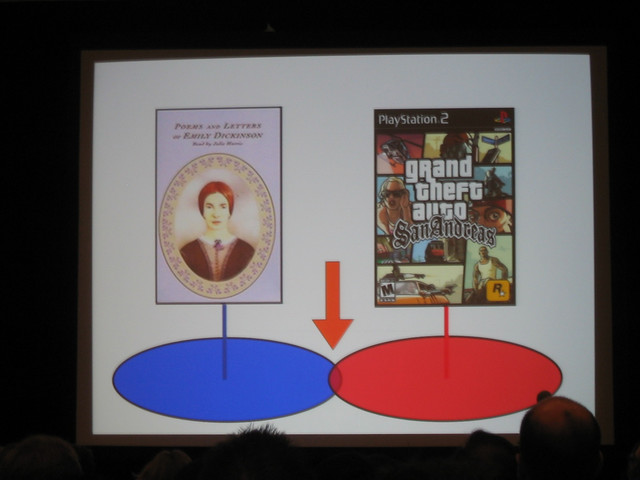

Then he put forth his goals. He wanted to have the mood dependency and portability of a Tamagotchi, the helpful/annoyance of Clippy, and the relationship and creepy aspects of seaman.
What he came up with was USB Emily Dickinson. The game would be a small program bundled with a USB memory drive, which is now a large business and an almost impulse buy. The "Emily" program would sit on the drive, and would occasionally interact with you in order to begin to derive an emotional relationship with you.

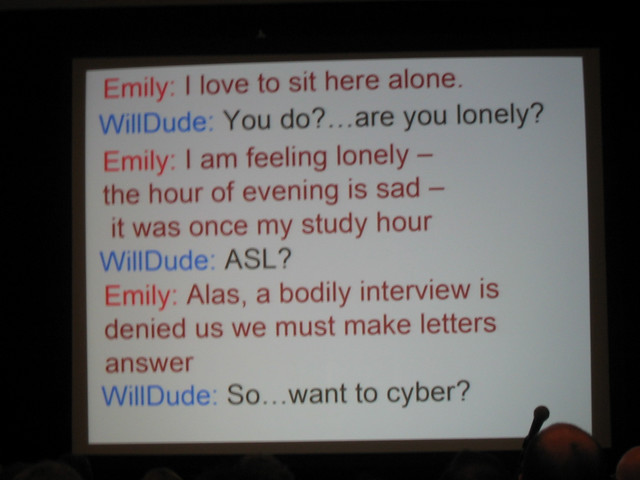
These interactions would include Instant Messaging, email, and interruptions while writing. Over time, the program would develop a model of behavior depending on how you'd interacted with it. Will's thought was that, while you could eventually get her to a stable state it was more likely that she'd become romantically obsessed with you, or suicidally depressive. In the latter case, he said, she would have the option of deleting herself off the USB drive.
To respect the license idea, again, Wright opined that the program could be adapted for any famous figure, and to have many different USB individuals operating on the same computer. If you had enough ports you could even have them interact with each other through natural language generation. Thus, you could slot drives to view a conversation between Marx, Twain, and Homer Simpson. While all of the ideas were stellar, Wright took home the first prize for the second year in a row.
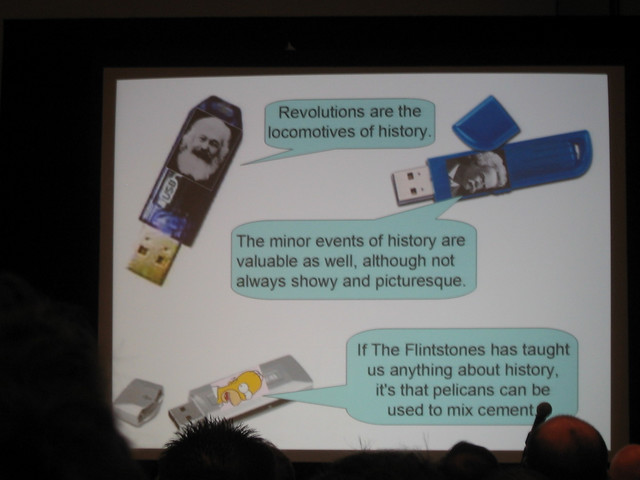
I actually thought the rest better captured the spirit. Wright won by being funny (I had never heard that Simpsons quote before) but not by having the best design. Which is sad, because I actually thought some of the other designs could be quite playable.
God Bless America. Why? Did it sneeze?
Makes me wonder if it was possible to work some stories into these USB personalities. E.g. in one you'd have some AI gone insane and a desaster in some confined area (lab, space station, whatever you prefer) and your goal would be to talk with the AI to find out what happened and perhaps the AI's "feelings" towards you would determine how much of the truth it would reveal or maybe even how many lies it will mix in.
Justice is the sheep getting arrested while an impartial judge declares the vote void.
If you watch the Peter Molyneux video demo, it is actually very impressive.
One thing to note is this:
The user is playing a game in a room, With a chest.
When They open the chest there is a minature room, which they enter. Then that room is connected to the room that had the chest, which has the minature room they were now in.
The left the minature room and re-entered the original room (now minature too?) that had a chest with another minature (minature) room.
Thats cool.
Now I've seen Everything
The idea is to challenge the developers to NOT make games like Halo and GTA. If you hate Halo you should probably be interested in something like this. Obviously it'll never happen, but the goal is to make a game concept that is totally different from everything else out there.
----- Mike Sklens Staff Writer, Planet GameCube.com
The most fun I've ever had with Emily Dickinson poems is trying to find one that you can't sing to the tune of Giligan's Island...
I'll turn into a supernova and burn up everything. Well I'll turn into a black little hole and you'll turn into string.
We'll show "Emily Dickinson Forever". But we can show you the physics engine now.
Sorry.
Keep your friends close.
Keep your enemies in a little jar on your desk.
I look forward to the day when I can have good netsex with an emo Internet girl without the resultant stalking, self-mutilation, and ritual murder. So lonely.
Peter Molyneux's "digital clay" voxel modelling system was pretty damn cool. I can't say I thought his game idea was that good, though; asking a computer to recognize shapes seems like it would lead to a problem like the "guess the verb" problem in bad text adventures, where you know exactly what to do but still spend a long time trying to figure out what phrasing the developer implemented. In this case, though it'd be more like "guess the bit-pattern."
I tried to avoid putting an opinion into the writeup, but IMHO Chris had the idea that was most true to the spirit of the design challenge. His lateral thinking was really excellent to hear described, and in my mind conjured up a game that was part Rez, part DDR, part World of Warcraft's crafting aspect, and part slam dance poetry session. Just sitting in the audience I had a real sense of what he was trying to get across and where he wanted to go with it.
I respect Mr. Molyneux's vision a lot, but from other session writeups I've seen it seems like he made the demo to kill more than just the Emily Dickinson bird. Slapping the Dickinson license into your tech demo is cool and all, but not really in my idea of the challenge's spirit.
Will Wright, I think, half came up with USB Emily just to goof around. Even his goofing around (obviously) is good work, but he seemed almost embarrased to recieve the prize for the competition.