 Slashdot Mirror
In Space No One Can Hear You Sigh
- Title: Mechassault 2: Lone Wolf
- Developer: Day 1 Studios
- Publisher: Microsoft Game Studios
- System: Xbox
- Reviewer: Zonk
- Score: 6/10
At kickoff, MechAssault 2 puts you in the role of a Mechwarrior as he and and his crew find themselves in a hostile situation. You're given the chance to run through a tutorial session while simultaneously repelling a hostile force. This puts you directly into the action, a nice choice. There's no need for plot or motivation before you start blowing things up. Players who have played through the previous title will start to glaze over during the tutorial, though, as the controls are almost exactly identical to those in the original game.
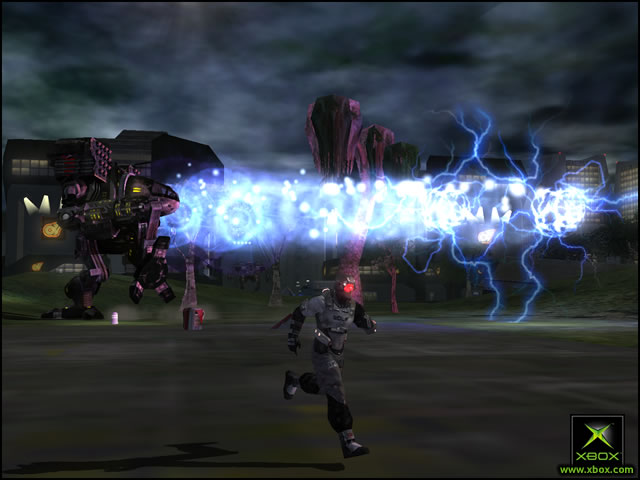
In fact, that statement is the basis of all of the issues with the MechAssault 2 experience. If you've played through the first MechAssault title, you've basically experienced everything that MechAssault 2 has to offer.
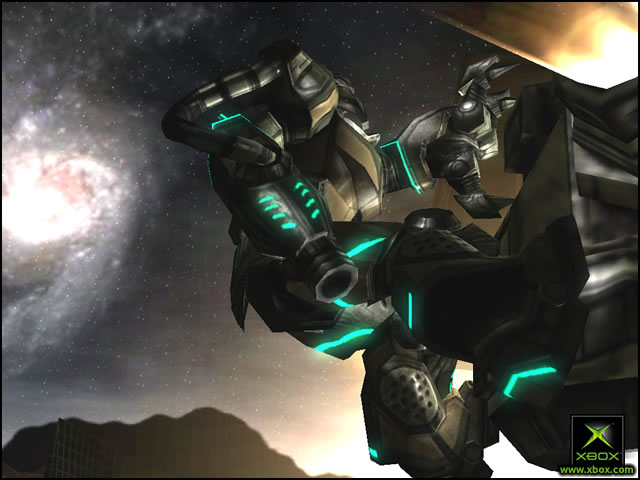
The big difference comes in the form of the the compact "Elemental" style power armor. The tiny mech handles just like the larger constructs, and has some impressive armament for its size, but the big draw of the tiny suit is the ability to "Neurohack" your way into full-sized mechs. Not only is this a potent combat ability, completely disabling a successfully targeted mech, but it allows you to enter and control the hacked mech if you choose. The game mechanic itself is easy to use, requiring you to hit a series of buttons on the controller within a certain period of time. Besides the new power armor, you're also given several opportunities to use more traditional vehicles such as tanks and a VTOL. And, of course, you still have access to the giant robotic walking tanks that typify the Mech genre.
The single-player campaign provides a decent framework both to develop piloting skills and to do some urban renewal with your mech. There's nothing spectacular in the background or composition of the plot, though, and only a few levels after the tutorial ends the gameplay will get repetitive. The Word of Blake opponents, the primary bad guys to the Mechassault 2 tale, eventually all blend into each other and every tank you stamp out of existence begins to look like the last. As in the first game, the backdrop to your rampages is entirely destructible, and even a single stray shot with the high-powered weaponry you utilize near the end of the game can take out a city block or two. The game's musical background consists of licensed songs from bands like Korn. Maybe it's the pen-and-paper purist in me, but I had a hard time associating Korn with Battletech. The rock soundtrack does add to the atmosphere, but recognizable bands seemed to detract from rather than enhance the experience. The story is simply Mechassault 1 with a new coat of paint, and singularly familiar gameplay ensures there are few new experiences to be had for the veteran Mech gamer.
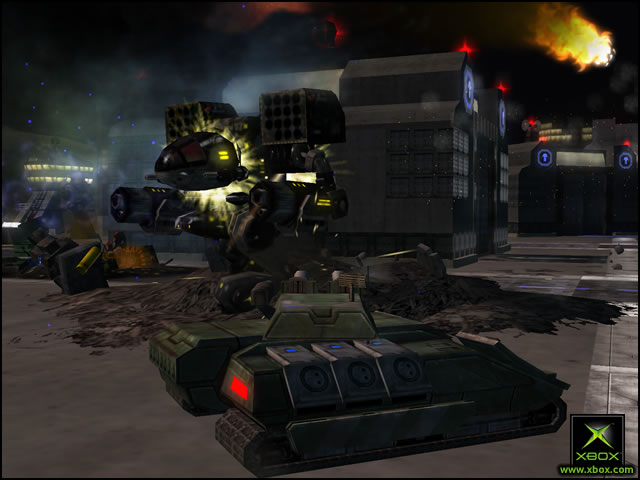
As with Halo, the real reason to play the first MechAssault was the multiplayer capability. MechAssault 2 upholds the original game's tradition of Xbox Live enabled multiplayer carnage. There are several different modes available, with all the types you'd expect, like capture the flag, deathmatch, etc. The designers gave the online game a new twist, though, by incorporating a "conquest" mode: In conquest mode you hook up with one of the houses, the clans of the Inner Sphere, and go on the warpath for your chosen allies, attempting to gain as much territory as possible with the aid of other house members and opposed by other house factions. Unfortunately, the number of players online is rarely sufficient for this kind of play. Satisfied that they'd already played this before, many gamers have long since chewed through this game and resold it to Gamestop for another title.
Mechassault 2 is a competent, but overall unnecessary sequel to the original title. The first game was a completely valid expression of the shoot-em-up mech genre. While the urge to create a sequel to a successful franchise is a logical one, it's hard to see the real need for this game. The action mech genre is a fairly well-developed one, and while the neurohacking gimmick provides some differentiation from other titles, this straightforward license vehicle could have been so much more. I recommend this game to fans of the original title who are looking for more maps to play on, or an action gaming fan who's looking for familiar territory, but unless you go to sleep at night wearing a Mech King crown made of cardboard you can afford to pass on this sequel.
Screenshots are from Microsoft's official MechAssault 2 site, (c)2005 Microsoft Game Studios.
Nexus: The Jupiter Incident is a dramatic name for a game that manages to be a thorough disappointment. That's a real shame, too, because Nexus has a lot of elements that make you want the game to succeed. Visuals and voicework ingratiate the world to you, but the lackluster gameplay makes you wish you hadn't uninstalled Homeworld.
- Title: Nexus: The Jupiter Incident
- Developer: Mithis/HD Interactive
- Publisher: HD Interactive
- System: PC
- Reviewer: Zonk
- Score: 4/10
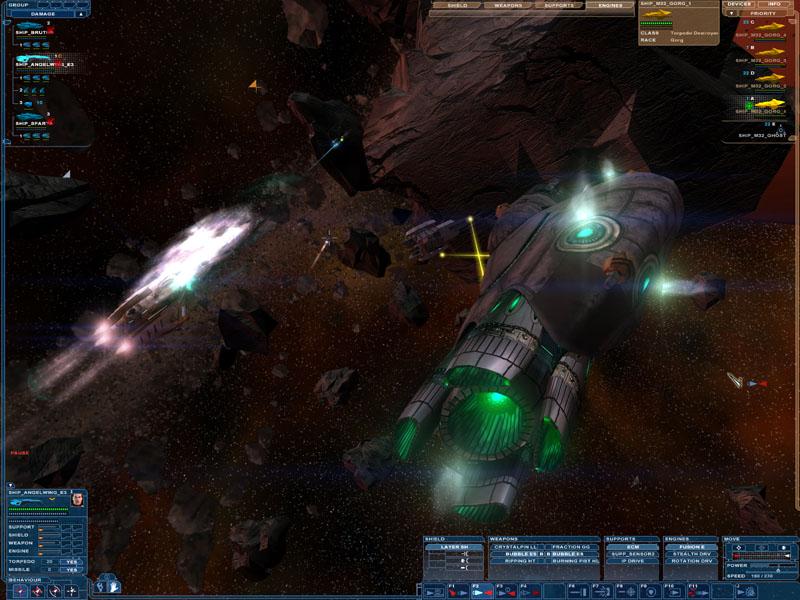
The shooting at least, looks good. Majestic 3D expanses are your playgrounds, with really nice looking ship designs and a slick interface makes play ve. In particular, I appreciated the swept-back designs and utilitarian choices made by the ship designers. I'm getting pretty tired of Star Trek pretty and Star Wars uglytech. The problem comes when you consider the pace and method of the shooting. Nexus has you issuing orders to your forces, which can range from a single vessel to a large fleet. Like many RTS games, you don't control your units directly; You simply give them an instruction and let them go do their thing. Combat breaks down to two choices: Either you instruct your minions to attack the hull of an opposing ship, in the hopes that the crew will flee and the ship will eventually be destroyed, or you order them to attack specific subsystems of the ship. This provides an element of the strategy sometimes missing from so-called RTS titles. What I found most effective was to have ships target the weapon systems of opposing vessels, as they seemed to be some of the most vulnerable components.

At issue here is the pace of combat and the intelligence of your units. Despite ordering my flagship to target a subsystem of a specific enemy vessel, I would often return to my combat unit after handing out some additional orders to find it either hanging dead in space or chasing after another ship entirely. Reaffirming my target of choice seemed to be seemed to be the only way to ensure the battle would go how I intended. Additionally, combat in space, apparently, is deadly. Deadly dull. The weapon systems look nice, and seem to be firing at an acceptable rate, but the armor plating of even the most insignificant weapon system is apparently very tough. It will take over a minute of a concentrated barrage to take out even a single subsystem. Actually destroying a ship, causing its crew to abandon the vessel and the hull to crumple, can take upwards of three minutes. This turns what should be tense and quick encounters into adventures in frustration as you are forced to concentrate your fire on one ship as the only viable strategy. Despite combat appearing to be a situation with tactical possibilities, you are reduced to ganging up in order to have any chance of victory. Missions with large numbers of enemies are particularly annoying, as the AI and combat pace combine to ensure that -- unless you are very on top of things -- you'll do barely any damage to the opposing force. You can order your entire fleet to focus on one ship in a blizzard of twenty or more, but the wandering AI ensures that their focus will quickly be elsewhere. Fifteen minutes into a mission and you'll find yourself with a swarm of 10% damaged enemy ships crawling all over your very spread out fleet.

All of this is a real shame, because Nexus has some very charming aspects: There is a ship modification element to the game, mostly straightforward and nowhere near as well developed as a Pax Imperia or Galactic Civilizations, but there nonetheless. The voicework for the characters is fairly well done, despite some occasional poor dialogue and endless exposition. And did I mention the ship designs?
I spent most of my time playing Nexus: The Jupiter Incident leaning far back in my chair in a passive state. The style of the game seems to be aiming for a combat-rich deep-space adventure, but the pace is that of a more leisurely strategy simulation. This confusing mishmash turns what could have been a worthy addition to the genre that is almost defined by the Homeworld games into simply a poor substitute. I lament the game that's resulted from the ideas visible in this game, as there really seems to be something worthwhile here below the surface. As it stands, though, Nexus: The Jupiter Incident is a game that you can take a pass on unless you simply need an excuse to get back out into the big black.
Screenshots are from HD Interactive's official Nexus: The Jupiter Incident site, (c)2005 HD Interactive.
Wing Commander Privateer. You could buy ships, weapons, join guilds, fly to other planets, it had it all! I wish games these days would start with the basics first instead of trying to add convaluded awkward features.
If the dollar is an "I owe you nothing", then the Euro is a "Who owes you nothing." - Doug Casey
Maybe it's just me, but I thought the whole slew of Mechwarrior games peaked around Mechwarrior 2: Mecenaries. That game ruled. I had more than one quest path to choose from, I got to buy/sell mechs and hire/fire pilots. And I still got to completely customize all my mechs on top of that.
Yeah, too bad MechAssault 2 gave me none of that. Boring linear missions, no choice in what mechs I got to pilot, and no customization. Whee.
ce n'est pas un Sig.
Before we had the capability to render scenes with millions of polygons with a striking degree of realism, game designers had to rely on a fading concept called.... fun.
I think people are finally beginning to get over the enfatuation surrounding titles that boast of their use of the lastest and greatest FPS engine, slowly turning their attention to game mechanics that are actually enjoyable.
Good graphics on a bad game results only in a bad game with good graphics. I think indie developers are beginning to demonstrate the fact that the opposite is also true to a large extent. I think we're beginning to see somewhat of a revival of 2D games that focus more on originality and fun game mechanics. Along with the rather large influx of these smaller developers, however, comes also many games that just plain suck in both categories. There's always the risk that the 80s could come back to haunt us, but perhaps this is simply a cycle that the industry must go through every couple of decades.
But God demonstrates his love for us, in that while we were yet sinners, Christ died for us - (Romans 5:8)
Ahem... not that this is Slashdot or anything, but can we be a tad more specific here than "System:PC"? I presume this is a Windows-only game, but since I don't know that, and there are actually some fine Linux/Windows hybrid games out there (I play NWN under Linux for example), it would be nice if you could cite hardware platform AND OS supported in a review.
Not to mention, how in the world is this front page material? This is slashdot, not 1up.com. (Right?)
Why can't we just mess around in space! We're quick getting to the day when the average Joe will have the chance to experience space flight. We have companies looking to build space hotels.
What are inhabitants of these hotels going to do while they're there? They're sure as hell not all going to want to do scientific research. How about moon-rover racing? Low Gravity Sky Diving? Moon Crater Exploring?
What I'm waiting for is a really cool MMORPG that lets people inhabit the moon and learn what life is all about up there will be for the average person, with a great physics engine to let you really get a feel for it.
Buy Steampunk Clothing Online!
Believe it or not, we already know that games are just games, and movies are just movies. We all are very much aware that it's just entertainment, and, yes, "consumer circus." And yes, believe it or not, we already know about books and some of us have that too among our many hobbies. No, really, you can stop pretending you're the greatest genius for saying what everyone else already knew.
No, we don't really expect them to be some deep philosophical intellectual exercise. We just expect "entertainment" to actually be, you know, "entertaining." I know, it's a hard to grasp concept. Turn the words "entertainment" and "entertaining" in your head a bit, and I'm sure even you can eventually grasp the connection.
We're not expecting to end up 10 IQ points higher after a game or a movie, nor supremely enlightened. We just expect to not be bored by it. Nothing more.
When we play a game we expect some degree of work to have went into the gameplay. Again, if you'll roll the words around in your head a bit, I'm sure the subtle connection will eventually reveal itself to you.
And the point is that a helluva lot of games forget that. They get so caught up in having a higher polygon count, that they end up with crap controls and crap gameflow. If they even make a half-arsed attempt at catching our attention by means of a story or plot, they either (A) make a quick and uninteresting job of dumping a half-arsed text between missions, or (B) just take some recipe and apply it badly. Etc.
See, for example, CRPGs which just take the hero's journey recipe from Hollywood, make a crap story to fit it, and stretch it linearly all over a game. Except a movie is 1.5 hours, while a game might be 30 hours. What was a brief 10 minutes showing that the hero was an ordinary guy like you and me in the movie, becomes a solid 3.5 hours of pointless boring stuff in the game. Where in the movie you might be guessing the next plot device 10 minutes before it happened, but it still kept you hooked enough, in the game becomes a whole CD worth of the heroes seeming blind and not seeing the obvious. Because they're not yet at the point in the recipe where the hero should find it out, and by jove, they'll stick to that recipe at all cost. Etc.
And it would be nice if more game companies started worrying about these things, than about polygon count.
And in the meantime, we rely on such reviews to weed out the games that make those mistakes, from those who still are any good. Or, yes, go read a book, program something, go out, or whatever hobbies fit. Thank you, Captain Obvious. How would we have ever figured _that_ out without you?
No really, next time you feel like acting like a snotty "I'm superior because my hobby is better than yours" kinda idiot, feel free to leave that attitude at the door. Or put down the crack pipe. Join a 12 step program. Whatever gets you back in contact with reality, really.
A polar bear is a cartesian bear after a coordinate transform.