Like most of the games that Blizzard has produced, the original Diablo laid down many of the rules for the hack and slash adventure genre. Followers of the Diablo design have been numerous, but few have been as well received as 2002's Dungeon Siege. The sequel, imaginatively named Dungeon Siege II, follows faithfully in the footsteps of the original fantasy RPG from Gas Powered Games. Solid, satisfying combat and a worthwhile storyline mark this solid genre title. Read on for my impressions of this medieval slasher.
- Title: Dungeon Siege II
- Developer: Gas Powered Games
- Publisher: Microsoft Games
- System: PC
- Reviewer: Zonk
- Score: 7/10
If you've ever played a fantasy hack and slash game, you've played Dungeon Siege II. This double edged sword swings heavily. On the one hand, you'll be familiar with the tropes, the controls, and the expectations. On the other, if you know you don't like hack and slashers you can safely avoid DSII without missing out on content you might have otherwise appreciated. That said, if you do enjoy the genre there is a lot to like here.
The first Dungeon Siege was widely hailed for its combination of strategy elements and party based combat. Dungeon Siege II doesn't mess with a good thing. As a mercenary far from home, you begin the game working for a powerful evil force that is just starting to work its way across the land. As with the original title, characters develop abilities by using them. If you want your main character to be a melee fighter, you equip him with a sword and start him swinging. If you want him to be a combat mage you put a spellbook in his hands and let him blast away. During the course of the adventure, you can recruit other hearty travelers to round out other roles in your party. As with your main character, you control their inventory and can thus guide their ability development. Though this may initially seem like a system with possibilities to exploit you quickly realize the "multiclassing" capabilities are limited. While you can give a spellcaster a sword to swing around, you're going to want to focus each character on a particular set of abilities in order to maximize their power. Unlockable critical powers are revealed with higher levels of specialization as well, giving you very little incentive to have jacks-of-all-trades.
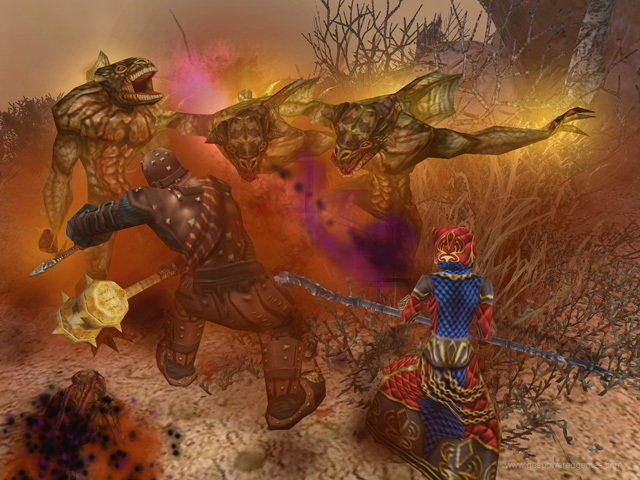
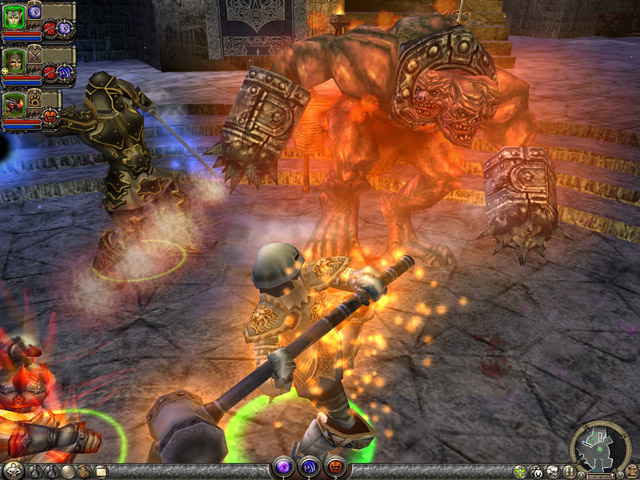
Those critical powers are used when your characters enter combat. Combat is a major focus of the game, and while there isn't a lot of innovation here the hacking and slashing is very satisfying. Holding down the mouse button on an opponent tells your main character to go to town. NPC allies can be given instructions to focus their attacks on your target, or put into a spree mode where they'll cut down anything that moves. Combat moves for both melee fighters and spellcasters have a lot of crunch to them. Opponents are dispatched with zeal, explosions of blood and body parts accompanying your victory. While the makers of the Dungeon Siege series have a background in RTS games, there isn't really a whole lot of strategy involved once the axes start falling. As long as you've got all the characters equipped with the best weapons and spells you could find or purchase, the chaos of battle will mostly run itself. The downside to this is that it's very hard to protect your weaker NPC allies. Magic users in particular fare badly, as the monsters all known the "geek the mage first" addage. In large combats you'll almost certainly be waiting on your spellcaster to regenerate from the large holes that have been ripped in his thinking parts. Additionally, while the entertainment value of new critters to kill is high, the combat mechanic never really changes and thus can get old in a hurry.
Combatting creatures, as always, nets you experience which eventually allows your party to level up. Depending on what they use in combat, you are given several options in a skill tree for ways to focus their advancement. While multi-classing is again not the best idea, each character has available all the different skill trees. Using the weapon type appropriate to each tree nets you skill points for that tree. For example, using a bow nets you a skill point for the Ranged Tree after a sufficient time spent in the field. Within the trees you are given several options to customize your adventurer's attacks. Melee fighters can specialize in one handed weapons with a shield, or can go the path of the strongman and wield a two handed weapon. Combat mages can focus on different elements (fire, electricity, etc.), while ranged combatants can focus on crossbows or throwing axes. Given the limited number of allies you can have, this ability to focus their abilities is crucial to ensuring that you have party roles fulfilled to your satisfaction.
Combat and mechanics are all well and good, but roleplaying games should be about storytelling. Questing and story are always important elements to a roleplaying game (though in this case I use the term lightly), and in this respect Dungeon Siege II manages to break a little ways out of the cookie cutter mold much of the rest of the game adheres to. Starting your career as an adventurer in a Dryad prison is hardly an auspicious start, but from there you are swept up into fight against your former employer, a wielder of a deadly dangerous artifact from an older era. Aside from the main quest pushing you ever outward into the world at large, folks you meet along the way have a series of errands and personal vendettas to settle up. While they're the usual "i can't be bothered to go five minutes down the road" type of RPG sidequests, the writing and voice acting are usually fairly well done. This adds a level of personality and polish to the experience that many other games can't touch. Additionally, the game isn't shy about giving you quests some time before you can complete them, giving you time to consider you objectives and watch out for the opportunity before you can actually fulfill the request. The only real frustration with the game's theming is the vanilla nature of your NPC allies. They occasionally stop to have prescripted interactions between themselves, and those are well done and usually amusing to listen to. You'll never grow that attached to your companions because they simply don't have a lot in the way of soul. The blank faces of DS II can't hold a candle to the likes of Minsc or HK-47.
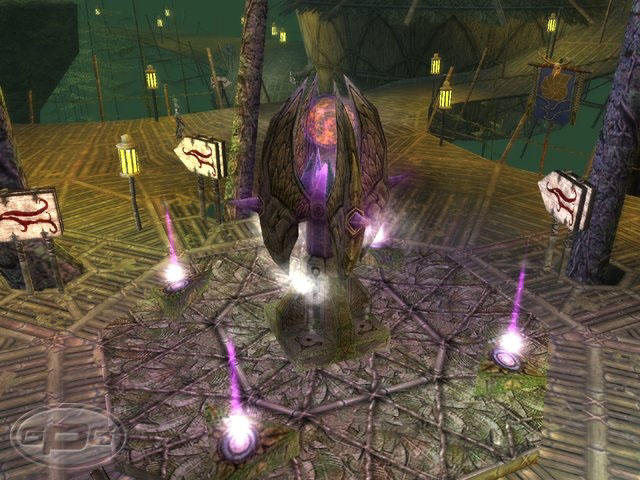
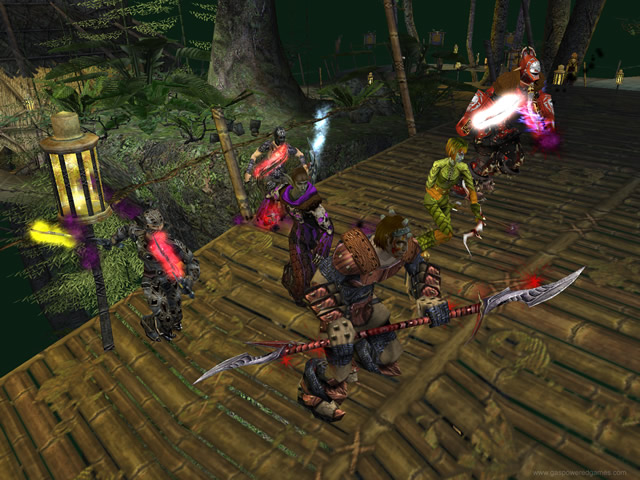
The game is somewhat lacking in personality when it comes to visual presentation as well. Up close, characters and monsters have a likeable roughness, with interesting details and personality coming to the fore. Pul back to keep track of the action, however, and the somewhat dated graphical look of Dungeon Siege II is readily apparent. There are some blocky elements to characters which stand out at a distance, and environmental textures can become somewhat repetitive. On the positive side effects for special attacks and magical combat add the same visceral quality to the game that the melee combat movements do, with sparks of light and fire limning the field of battle during most engagements. The auditory experience has the same quality, grunts and cries adding a first person experience to what could otherwise be dry hacking and slashing. The musical accompaniment is as successful in augmenting the gaming experience without overwhelming the player with its presence. The music itself has a similarity to the musical experience from the first game, but somehow didn't come off as repetition. The orchestrations are different enough that the feeling evoked is one of remembrance rather than ripoff, and works well within the gameworld.
Dungeon Siege II, then, is a competent hack and slash RPG. Built on the Diablo 2 model and paying close attention to the lessons learned from the original title, the sequel to the 2002 hit is a satisfying gaming experience if you're a fan of spilling orc blood. Combat, story, and questing are all well executed, with an eye towards presentation and visceral feel. Even though the game hews very close to the genre standard, the entertaining and visceral combat gameplay can make this a worthwhile addition to your library. If you're looking for some mindless fantasy fun, Dungeon Siege II will provide.
 Slashdot Mirror
The review doesn't describe *any* differences between DS2 and DS1. Which I guess is OK since DS1 was fun already.
DS1 was a very easy game. You don't have to aim or exercise much skill, you just have to follow along as the game more or less plays itself. As long as you don't stray too far outside of the realm that you are supposed to be in at any given point in your character's development, the creatures around you will be easy to kill and will provide more than enough experience to quickly level up and move on to harder creatures (which aren't really harder at all since your character is now more capable). It's repetitive but satisfying.
By far the most fun I had with DS1 was when playing multiplayer with my friend, when we would purposefully move early out into harder areas and try to figure out how to, using cooperation, kill creatures that would be far too difficult for either one of us to kill on our own. Usually the strategy involved having one character be chased around while the other laid into the creature, and then switching roles, until the creature was dead. Sometimes we could lure creatures into spots where they couldn't hit us but we could hit them (like from a ledge above them), which was fun too.
I personally much prefer games where you have to aim and dodge to games where you don't, but the DS series is still fun. I just wish these games didn't cost $50, or take so long (years) to drop down to lower prices.
Maybe im getting old, but nothing excites me anymore. Seems like every game coming out these days are rehashes of old gameplay with updated graphics. FPS/RPG/MMORPG/Racing/Sports/RTS and thats pretty much it. I don't know what I want either..Something dazzling, something different, something creative. I'm bored of games and I don't know what to do! HELP!
time is a perception of a being's consciousness
time is your 6th sense, the wierd ones are 7+
This review tries to make it sound like the game is good... but I can't help noticing that it succeeds in exactly the opposite.
"Diablo model"? (How old is Diablo now?)
"Very close to Dungeon Seige I"? (DS I was good but that was years ago.)
Those games are both archaic at this point when we have WOW and other MMORPGS, the game needs to offer something that those other games don't. Storyline? NPC's? FMV Cutscenes? Depth of character development? Thousands of rare items a la BGII?
I don't know if it was this review, but the game sounds positively retro.
------ The best brain training is now totally free : )
So, Slashdot is helping Microsoft advertise/profit now?
the original Diablo laid down many of the rules for the hack and slash adventure genre
This is totally incorrect. Diablo is a direct rip-off of Rogue and its many clones including NetHack. All Diablo brought to the table was evolutionary graphics.
Diablo isn't an RPG, it's just hack and slash with numbers.
Don't forget to check back in a few days for the dupe^W update to this review...
They took the original Dungeon Siege, absolutely ruined the pathing and AI, neutered the spell system, added an extremely shallow and uninteresting skill tree, and a handful of special attacks that can be triggered when you've dealt enough damage. Of course, the graphics have been dolled up. The game looks good; the environments are positively lush, and Jeremy Soule (Morrowind, Knights of the Old Republic, Neverwinter Nights, Dungeon Siege) did the soundtrack, but it's probably the most bland and forgettable score he's ever done.
DS2 focuses more on story than its predecessor, but has the usual array of predictable plot twists and subpar voice acting, all implimented by dialogue boxes, similar to Neverwinter Nights.
The crippling multiplayer problem that prevents just about anyone with a firewall (regardless of port forwarding) from playing online that was around in the original still exists, and although multiplayer has been improved, it's still impossibly shallow.
DS2 would be great... if it was an expansion pack. It's entirely unworthy of being a standalone game though. For Dungeon Crawler fans, I'd recommend picking it up, but only after it hits the $15 dollar bin.
DS1 is a Diablo-style game with focus on PvE, GW is a tactical semi-MMORPG with split focus on PvE and PvP. They aren't too similar really. You really have to like PvP in tournaments to some extent, and preferrably get into a guild too, to get most out of the game, which are aspects that are basically missing in DS2. But I agree GW is a greater game than DS1 as in "having more fun with it". We're talking evolution there, as opposed as with DS2, which is more in the cash cow milking department.
Beware: In C++, your friends can see your privates!
solution" is. A game becomes more fun when you dicipline yourself. Try playing in a way that you get bashed less so you use less potions. Don't buy that shiny new weapon when you can get by with what you have no matter how many times over your wallet can buy that new equipment.
Diablo, and every other game remotely similar to it, really drew their inspiration in terms of computer game heritage from the rogue-like text adventures, of which Nethack is the most shining example. While they've tacked on nifty stuff like shiny graphics and networked multiplayer, they have still completely and utterly failed to capture even 5% of the depth and complexity of gameplay that Nethack has enjoyed for years.
11*43+456^2
Diablo built on the game structure outlined by much, much earlier games such as Rogue, Hack, Nethack, Larn, Angband, Sword of Fargoal etc. Now these were all turn based, but there were a couple of early efforts to bring this type of game to a more action oriented real time style of play. The most famous is of course the arcade game Gauntlet, which stripped out almost all of the little details of the previous game, focusing instead on a heavily action oriented arcade game play.
Another early attempt that comes to mind, is the game Gateway to Apshai. This was a real time dungeon crawler that built on Epyx's Temple of Apshai series. Released for the Colecovision and Commodore 64, it was closer to the traditional Rogue style of gameplay than Gauntlet, but was played with a joystick in real time.
Sometimes my arms bend back.
It's all wrong anyway. The first game was prized for its strategy? Uh, did you PLAY the first game, Zonk? The first game was 25 hours of clicking on the screen with the mouse. It didn't really matter where you clicked, you just clicked. The game was dull as hell, and after enduring its boringness, there's no way I'd buy the sequel.
Comment of the year
Seriously - I've been looking for a good RPG for months now, I tried the demo of DS2 yesterday, and it's slightly better than 1, but it's still just a screensaver with swords.
Where's a GOOD RPG with a storyline? Character Development?
Where's this years System Shock 2? NWN? Eye of the Beholder? Morrowind? Fallout? Planescape Torment? BG2? Anything?
I've tried Sacred, DS2, and about 10 others that just sucked hard, either because of major bugs, or dull gameplay ( click-click-slash-slash-drink healing potion-repeat ).
Any suggestions? please? Or am I just going to have to wait for the Morrowind followup (Oblivion) and reinstall Nethack?
henry -- the human evolution news relay
You might as well just use a trainer if you are going to engage in that level of metagaming. Either you're a purist who wants to play it through completley the way it was intended, or you are the IDDQD type in which case save yourself the time and trouble and just use a trainer.
- Toby