 Slashdot Mirror
European Students to Put Microsatellite Into Orbit
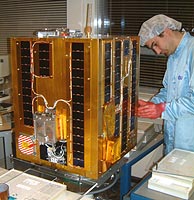
Astervitude writes "A Frankenstein's microsatellite made out of parts "donated" by university students across Europe will be launched on September 30 atop a Russian booster. Space.com reports that more than 400 students "spread across 23 universities and 12 countries" spent 18 months designing and building the SSETI Express. While its acronym sounds suspiciously similar to that of a project that seeks to uncover signs of intelligent life beyond Earth, the SSETI or Student Space Exploration Technology Initiative mission is actually part of an effort by the European Space Agency "to boost student interest in space technology and offer some hands-on experience." The satellite itself weighs a mere 136 pounds and is the "size of a small washing machine", as shown in this ESA photo. Visitors to the mission site may want to check out the contest page for ham radio operators to help collect data from the satellite."
It's not quite orbit (yet), but JP Aerospace has been running a PongSat program for the past few years which does something similar. Some of their past missions have gone above 100,000 feet, and would make great science fair projects for students. The description from their page:
A PongSat is an experiment that fits inside of a ping pong ball.
These ping pong ball 'satellites' are flown to the edge of space by balloon or launched in sounding rockets. The PongSats are then returned to the student.
It's an easy and inexpensive way to get students excited about science and engineering.
There are endless possibilities for experiments that can fit inside a ping pong ball. PongSat's can be as simple or complex as you want them to be. Experiments can be as simple as comparing how high a ball bounces before and after being exposed to vacuum. The PongSat can carry seeds to see if exposure to cosmic rays effect their growth. Several small inexpensive computers and other electronics can fit inside a PongSat. These can be used to create a wide range of experiments. Whether carrying a marshmallow to see if it puffs up in the vacuum of near space or an entire sophisticated satellite in miniature, PongSat can create motivation, drive
and passion in the classroom.
PongSats are flown at no cost to the student or school.
Actually, given the dimensions and capability of the first artificial Earth satellite, Sputnik, it would be interesting to know how it compares. It would be amusing if the second space race - the race to be cheap, not to do things regardless of cost - was basically being led by a new generation of Sputniks on top of a new generation of Russian rockets.
Panurge has posted for the last time. Thanks for the positive moderations.
Funny that the OBDH (On-Board Data Handling System) Core for the ESEO is running Linux with 2.6.9 kernel. However all the decoding software I have found is all UI-View plugins for Windows. Is there (going to be) a Linux decoder out there? I can use Xastir to decode the AX.25 packets but I'd hate to hand decode the packets data.