 Slashdot Mirror
Review: We Love Katamari
- Title: We Love Katamari
- Developer: Namco
- Publisher: Namco
- System: PS2
- Reviewer: Zonk
- Score: 8/10
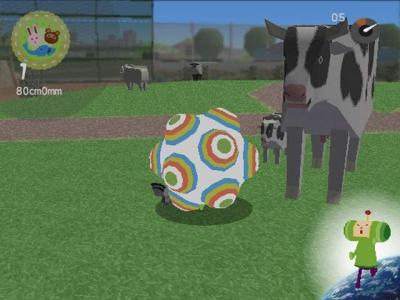
If you've played Katamari Damacy, you'll be quite adept at using the controls for We Love Katamari. There have been no real changes to the two thumbstick schema. Using the joysticks in concert, you push the Katamari and it gathers stuff. The more stuff you gather, the larger the Katamari gets. Missions are given to you by the King of All Cosmos, who usually tasks you with achieving a certain size of Katamari within a time limit. Added components to the gameplay are basically just new settings and mission objective types. For example, there are underwater levels now. Aside from some limited verticality, they're just missions with a lot of fish. The new objective types are slightly more interesting. One level lights your Katamari on fire, and requires you to keep it lit by continuously rolling up stuff. You pause too long, your Katamari goes out, and your dad shoots you with laser beam eyes. Tough love, indeed. Another level pits you against a second player in a race to assemble a snowman.
That integrated second player mission is part of the multiplayer emphasis in the second game. In addition to a few two player vs. missions, there is a head-to-head mode similar to the multiplayer mode in the first Katamari. It is better developed than in the first game, though, with a few different arenas of play available. The head-to-head mode emphasizes strategy as well, by requiring each player to gather more of a specific object that their opponent. The most enjoyable aspect of We Love Katamari's multiplayer is cooperative play. Two people working together can play every mission in the game. At least, working together is the idea. Moving the Katamari efficiently with two people operating requires a little getting used to, but with a duo working together you can really get the ball moving. It's also hilarious getting into a groove. "Go Backwards!" "I am going backwards!" "No, left backwards."
The fun factor of the game is still very high, even after a year spent playing the first title. There's an immense satisfaction in adding mass to your Katamari, and a sick pleasure in having your work transformed into a stellar object. The "purpose" of the game, if there can be said to be one, is to please fans of the original Katamari and assist the King of the Cosmos in refilling the rest of the sky. Completing missions is interspersed with extremely disconcerting cut-scenes about The King of the Cosmos' past. Starting with his youth, the cut-scenes give us background on exactly what makes the King tick. Because, of course, not knowing kept us up at nights. The fan service is literal and unabashed. The denizens of the mission select field cavort among the trees, giant birthday cakes, and oddly tapping birds. When you pass nearby they call out for attention, requesting that you see to their idiosyncratic whims. Various moments during the game will see you gathering up sweets for a sugar-rush seeker, cleaning up a kid's room for a lazy parent, and entertaining a class full of students by rolling up the contents of their school. Of course, I have to sit here wondering if they were all that entertained. After all, they ended up as part of a star.
The game has the same shaped-Lego look of the first title, with everything from penguins to people represented in the somehow appealing format. The game has its own beauty, but it will hardly stretch your PS2's capabilities. The enjoyment factor of the game's presentation lies in the variety and sheer amount of stuff that exists within the mission spaces. Every time your Katamari accrues mass and the game's scale shifts, you gain a new appreciation of the minimalist style. One vaguely frustrating change in the game is the addition of in-mission load times. The increased mission size has resulted in the need to load up additional materials in order to gain access to new parts of the map. An understandable but somewhat frustrating limitation.
Sound plays an important role in every game, and the brain-crushingly entertaining soundtrack from the first game has a successful successor in We Love Katamari. Catchy tunes with jazz, J-Pop, techno, and swing backgrounds round out the audio environment you roll around in. The main theme has several incarnations on the soundtrack, and all of the songs are enjoyable ear candy. The catchiness level of the first game has been toned down in favour of some more worked out pieces, but the experience is still thoroughly Katamari.
Fan service and catchy tunes. Fun and innovative gameplay. A game guaranteed to keep your raver buddy amused for hours on end. There are so many pleasant things you can credit We Love Katamari with. My only two big complaints are that it's basically the same game as the original, and it's very, very short. The game is well worth playing, but a bit more expansion of the concept would have been appreciated. As it's so similar to the first title, it shares the problem that once you've mastered the controls it is not very hard to work your way through the game in a frustratingly short amount of time. Nothing is perfect, though, and I'll take my fun where I can get it. If you've played Katamari Damacy and enjoyed it, there is no way you won't like We Love Katamari. If you haven't, it's well worth taking a look just so you can get a taste of what all the fuss is about.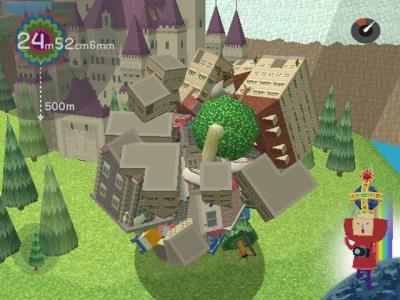
It's already fun, and it's already done correctly. You don't need a Nintendo Revolution controller.