 Slashdot Mirror
Cassini Returns Photos of Hyperion
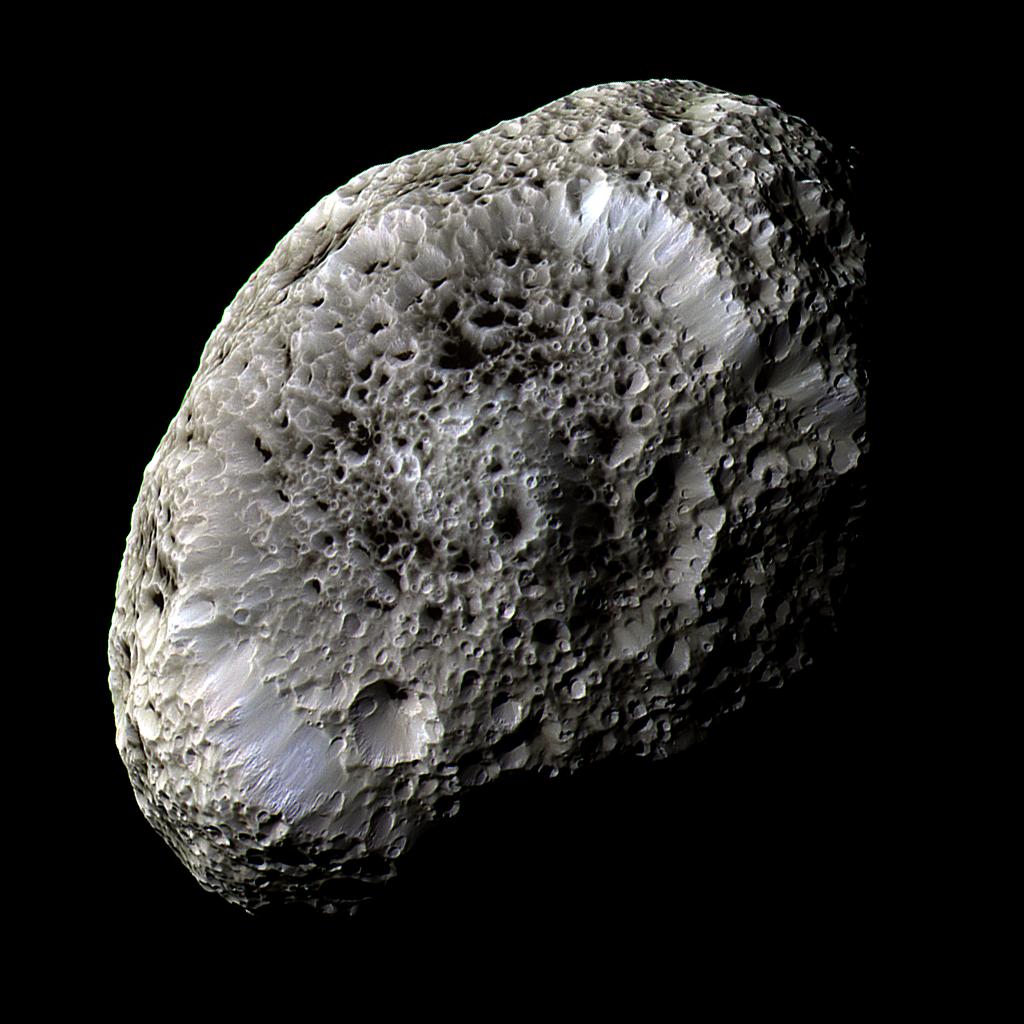
imipak writes "The Cassini Saturn probe has captured the previously unseen northern polar region of Saturn's moon Hyperion. Its weirdly eroded surface looks like nothing else in the solar system seen so far, demonstrating once again that when it comes to planetary exploration, "expect the unexpected" is more than just glib advice from the Hitch-hiker's Guide!"

The image in the post http://saturn.jpl.nasa.gov/multimedia/images/moons /images/PIA07737-br500.jpg is of the moon Tethys and not Hyperion.
It was a double flyby, hence the confusion.
The two pictures are from different moons, Tethys (second link), Hyperion (first link). Perhaps reading a caption from the real article at http://www.jpl.nasa.gov/index.cfm would help
You can see the raised part in the centre, around which is part of the old crater wall.
Note the crater wall is significantly brighter than the surrounds - this is exposed materials, mainly water ice to judge from the brightness.
The other thing to note is that the crater is incomplete, and is itself riddled with craters, both the centre and the crater walls. This tells us that the large crater is very old. How old I would leave to an expert of the Saturnian system, who would no more about impact frequencies than me.
Hyperion is interesting in that it is the largest irregular body in the solar system. Anything larger (and many smaller objects) are pulled into a spherical shape by their own gravity. Hyperion is not that much smaller than Enceladus, and is of a similar make-up (frozen H2O) yet these object are very different.
I would hypothesise that a large impact has sheared off part of Hyperion- that's why the large crater is incomplete - the rest is gone, possibly to become part of the ring material but I don't know what the timing of that blast was.
The very strange not-really-craters next to the very large impact crater I would say were outgassing artefacts, not any type of impact crater. Basically the heat from the large impact caused volatiles to rocket out of Hyperion, leaving those sort of "exit valve" formations.