Slashdot Mirror


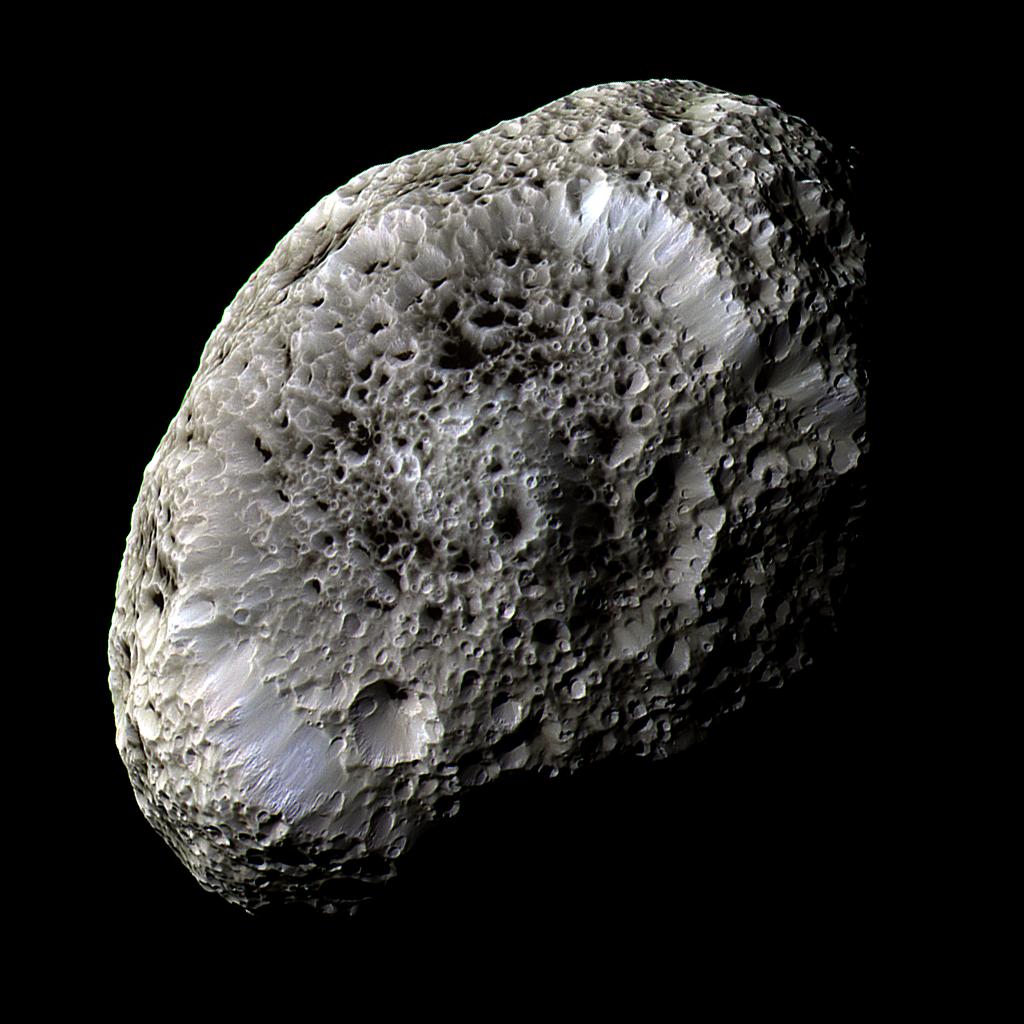
Cassini Returns Photos of Hyperion

imipak writes "The Cassini Saturn probe has captured the previously unseen northern polar region of Saturn's moon Hyperion. Its weirdly eroded surface looks like nothing else in the solar system seen so far, demonstrating once again that when it comes to planetary exploration, "expect the unexpected" is more than just glib advice from the Hitch-hiker's Guide!"
18 of 202 comments (clear)

  1. What is that? by Capt'n+Hector · · Score: 2, Interesting

    What's that thing in the top left hand corner of the second image? It doesn't fit with the rest of the landscape...

    --
    Quid festinatio swallonis est aetherfuga inonusti?
    Africus aut Europaeus?
    1. Re:What is that? by blincoln · · Score: 3, Interesting

      Wow, that is kind of eerie.

      The JPL page says the straight line is probably a fault or other geological feature, but the absence of any others in that area is a little suspicious.

      I blew up that section a bit, and it looks a LOT like something diamond- or arrowhead-shaped came screeching along the surface and plowed into the side of a hill, kicking up surface material and burying the leading edge. The "buried" object itself seems to be very sharply defined with straight lines, as opposed to the more "natural" landscape around it.

      An alien space probe would be neat, but I'm guessing it's a chunk of rock that impacted the moon at a weird angle. I'm sure Hoagland and his friends will have a field day with it, despite the crappy JPEG compression leading to terrible artifacts when it's blown up.

      --
      "...always new atoms but always doing the same dance, remembering what the dance was yesterday." -Richard Feynman
    2. Re:What is that? by blincoln · · Score: 3, Interesting

      The greyscale clear filter image I mentioned in another post is better for this work, and has less compression artifacts.

      The line really looks like a depression in that one, whereas in the false colour image it could be a protrusion.

      I blew it up considerably in Photoshop and increased the contrast to see details better. There are a number of smaller craters directly in the path of the line. If it were a rock impact, to my (non-astrophysicist/geologist) eye it looks like it behaved like a skipping stone - There are some bigger craters near where the top of the image cuts off the line, and about halfway along there's a pair on opposite sides of what appears to be a hill, as if it were skating along, used the hill as a jump, landed, and continued its movement.

      The bigger feature at the end of the line seems more symmetrical in this version. It looks kind of like a Concorde... or a giant bird footprint. Watch out Tethys, Colonel Sanders is too far away to save you.

      --
      "...always new atoms but always doing the same dance, remembering what the dance was yesterday." -Richard Feynman
    3. Re:What is that? by BeBoxer · · Score: 2, Interesting

      The JPL page says the straight line is probably a fault or other geological feature, but the absence of any others in that area is a little suspicious.

      Actually, if you look at the Hi res TIFF version you can see several more of them. None as large and obvious, but I found at least five or so linear formations in that picture. There is a cluster of three at the bottom beneath the obvious one.

    4. Re:What is that? by Anonymous Coward · · Score: 1, Interesting
    5. Re:What is that? by Anonymous Coward · · Score: 1, Interesting

      Uh... what caused the caverns in the first place?

  2. The Internet has RESURRECTED interest in space! by Work+Account · · Score: 3, Interesting

    And it's a good thing!

    Cassini was helped to more funding because WE the geeks of Web/Net WANT TO KNOW. We want to see our world, our Universe. We join advocacy groups and science foundations.

    Keep up the good work NASA. Let private groups continue as well.

    I see a 2nd space renaissance soon!

    --

    If you "get" pointers add me as a friend (116)!
  3. big crater and then small ones by sploxx · · Score: 3, Interesting

    Having no formal education in planetology does not stop me to spout nonsense on slashdot:

    But the first picture looks like there was just big collision (old big crater) followed by lots of small collisions, without any erosion in between. I *think* I have seen similar features on the moon.
    To have this picture is nonetheless an astonishing accomplishment.

    I think that simply the lighting makes this view impressive :)

    1. Re:big crater and then small ones by idlake · · Score: 2, Interesting

      A big crater like that on a little moon would probably have torn it apart if created by a collision. More likely, all the craters, big and small, are the result of the thing blowing up again and again from the inside.

  4. Re:something similar on asteroids, (to some extent by HermanAB · · Score: 3, Interesting

    One thing that I have never seen in discussions of cratering, is elastic collisions. Everybody seems to assume that collisions are necessarily plastic: A smaller body smashes into a larger body and the smaller body is pulverised in the process.

    However, in the asteroid belt especially, many collisions may be elastic, with bodies bouncing off each other like billiard balls, leaving behind large indentations. This could happen, as these bodies are moving in essentially the same direction and therefore collisions may not always have much force.

    --
    Oh well, what the hell...
  5. Re:Weird by null+etc. · · Score: 4, Interesting
    It looks like a microscopic picture of a grain of salt or something

    If it's a microscopic picture, I have to ask - what browser are you using to view it?

    Bad jokes aside, this is what a magnified grain of salt looks like:

    BBC Visions of Science

    (it's pretty enough to make desktop wallpaper)

  6. Looks Like Sublimated Ice by Derling+Whirvish · · Score: 2, Interesting

    It looks like the remains of sublimated ice/dirt from hoarfrost or something like that. Or the leftovers from a half-melted snowstorm on the side of the road. I've seen similar effects in the frost of my non-frost-free freezer. Definately not rocks/dirt like the moon or Mars.

    1. Re:Looks Like Sublimated Ice by Nuffsaid · · Score: 2, Interesting

      I agree: the surface small-scale smoothness, sharp lines where crater walls collapsed, the angle of slopes, everything suggests a snow landscape. Add sublimation to explain lowered areas of terrain and thus the distorted shape of most craters. In my armchair-planetologist opinion, the moon's low density is more easily explained by the material itself rather than by vast cave systems underground, as I've read somewhere.

      --
      Nuffsaid
      ________

      Don't know about his cat, but Schroedinger is definitely dead.
  7. IMHO by TheHawke · · Score: 2, Interesting

    I think that this was a bubble of magma that spun off of a world, bubble and seethed close to the sun, then cooled down to a pockmarked, gas bubble fulled rock. Then a asteroid hit opposite of the picture seen here, blasting a good sized chunk off of the surface, leaving that odd bump in the middle of that crater.

    --
    First rule of holes; When in one, stop digging.
  8. Great Expectorations by Doc+Ruby · · Score: 2, Interesting

    OK, the H2G2 Radio Scripts include "expect the unexpected". But I learned that advice from Arnold Horshack, on _Welcome Back, Kotter_: "when you least expect it, expect it."

    --

    --
    make install -not war

  9. Re:Erosion? don't make me laugh by McSmithster · · Score: 5, Interesting

    Actually there are a ton of reasons for such a surface.

    1) Its by Saturn which has a massive gravitational pull. This causes Saturn to pull in a lot of comets, asteroids, and dust. Thus Saturn gets hit with a lot more debris then the planets in the inner solar system. This would also increase the risk of the moons getting hit with this debris as well and therefore will have more impacts then that of the planets and moons in which we know.
    2) Saturn has rings filled with debris. So if the moon ever happened to swing into these rings it would go through hundreds if not thousands of impacts. That could have very well created the surface that you see. This could have happened at any time in the moons history and so is a very likely cause.
    3) The moon could have some sort geological processes that are responsible for such a surface, however thats very unlikely.

    Personally I would put my bet on number 2 cause it makes the most sense. If the moon went through on of Saturns rings especially when the rings might have just formed there would have been a lot of collisions leaving the surface scarred like you see in the picture.

  10. Looks like nothing else in the solar system? by Wolfier · · Score: 2, Interesting

    Bah.  First thing that came to mind:

    http://images.google.ca/images?hl=en&q=co ral&btnG=Google+Search&sa=N&tab=wi

  11. JPEG vs TIFF by The+Master+Control+P · · Score: 2, Interesting

    I took a close look at the high-res pictures they offer in TIFF (3MB) and JPEG (120K) format. Even though the jpg contains 1/25th as much information as the tiff, it still looked decent up close. When I tried turning the contrast way up (100) the tiff was far better up close (jpeg turned to gray mush), but at hi con both looked similar at 100%. The tif seemed to have more vibrant colors.

    What I'm trying to ask is, does anyone else notice a major difference between the two without using the GIMP @ 7 or 8X zoom?