 Slashdot Mirror
Tales Of Blood For the Nintendo DS
- Title: Castlevania: Dawn of Sorrow
- Developer: Konami
- Publisher: Konami
- System: DS
- Reviewer: Zonk
- Score: 9/10
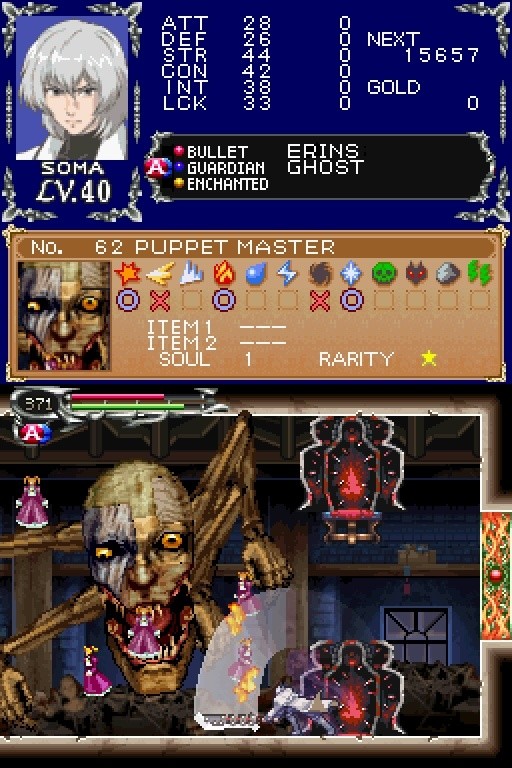
Though there is a Belmont in the story, the protagonist of this particular quest to end undeath is Soma Cruz, the near-Dracula from Aria of Sorrow. The game doesn't mess around, quickly tossing you into the midst of a cult headquarters crawling with creepy not-living things. The cult, led by an overly enthusiastic woman of darkness, is dedicated to reviving Dracula by offing Soma. Their headquarters is a re-envisioning of the classic castle, and their minions take every shape and size you would expect. Zombies lurch, worgs howl, and witches fly from every corner of the 2D field in an attempt to end your existence. This diversity of monsters comes in handy, because Soma actually has the ability to consume the souls of his defeated opponents. By consuming souls, you gain some of the critter's abilities. The witch soul, for example, lets you shoot a deadly cat projectile, while the spear guard lets you twirl a spear quickly about you. Souls have numerous uses, and by stealing more of them you become more adept at the soul's power. This "catch-em-all" aspect to the gameplay adds a fun element of randomness to what would otherwise be the usual slog through endlessly respawning baddies.
Souls can be equipped via an RPG-like interface, and you can have three equipped at any one time. In addition to souls, you have gear. You have many choices of modern and antique weapons, as well as armor and accessories. Diablo 2 it isn't, but along with the simple stat modifying trinkets you gain experience from slaying baddies. Experience points, of course, leads to leveling up. The more Soma fights, the more powerful he becomes. Adding another layer of complexity, some souls can be combined with certain pieces of equipment to make them even more powerful. You don't have access to them while they're fused, but you can release them again if you start to miss your mojo. A short while into the game you gain the ability to swap two sets of equipment at the touch of a button, allowing you an 'agile' set and a 'boss' set if you're so inclined. None of these elements are groundshakingly new, but they hang together very well and the resulting gameplay adds a thoroughly enjoyable level of depth to the traditional 2D gaming.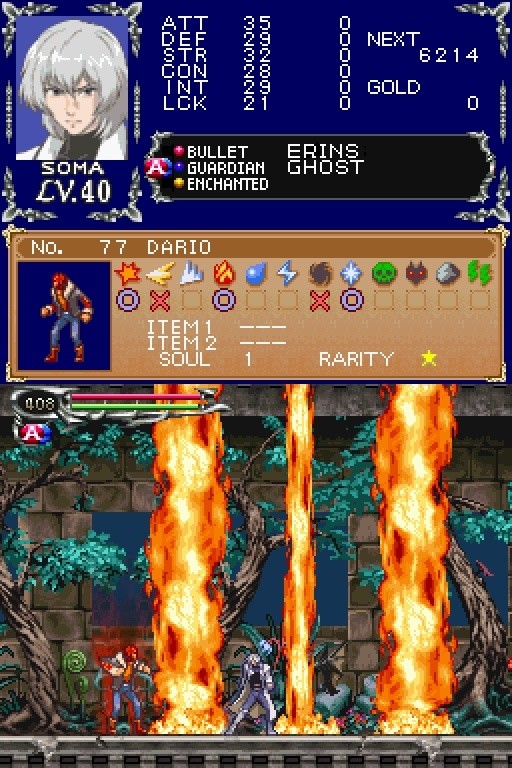
The touch-screen does see some use during the course of the game: at the end of the incredibly dramatic Boss battles. During the course of the game you find mystical seals that can be used to destroy the epic enemies scattered throughout the title. These seals are simple symbols that must be drawn on the touch-screen once you've lowered the boss's health sufficiently. It feels a little clumsy to quickly pull out the stylus at the end of a Boss fight, but it does switch up the gameplay a bit. Thankfully, Boss fights aren't mindbreakingly hard. They're challenging, but once you've learned a particular head critter's pattern they'll go down quickly enough.
Dawn of Sorrow may not be the most challenging Castlevania title to ever cross a nostalgic gamer's path, but it is a lot of fun. Level design is linear, with your trusty top screen map guiding you and reminding you where you've been. If you've played a 2D explorer in the Metroid style before you're not going to encounter many surprises, but the game doesn't go out of its way to explain the route for you. Backtracking and a small amount of headscratching will be needed to get you where you need to be. As new abilities open up, new parts of the map become available to your thirsty blade. This exploration element is something that just doesn't happen in games much anymore, and it was a lot of fun having to work out for myself the way forward in the dusty hallways of the cult lair.
Dusty hallways they may have been, but they looked tremendous. Hands down the most enjoyable aspect of Dawn of Sorrow is its impressive production value. While the touch-screen elements of the DS get short shrift its graphical capabilities are put on display, adding multiple levels of depth to the background locations you carve your way through the game. Some levels extend on for miles, while others feature details you may never have expected to see in a 2D title. Leaping on top of a van in one level, for instance, causes the vehicle to creak and tilt in your direction and the snow atop the roof to fall off. Creature design is also tremendous as a result, with even lowly one-hit skeletons having a lot of personality to them. Mini-bosses and Boss battles are epic encounters as the console can make the most of giant-scaled beasts. The auditory experience is just as enjoyable, with a funky melody for each area and some truly haunting themes orchestrated for important story moments. Sound effects have a slightly digital edge that just lets you know you're playing a Castlevania game. The whole package comes together wonderfully, making this easily the most immersive 2D Castlevania experience to date.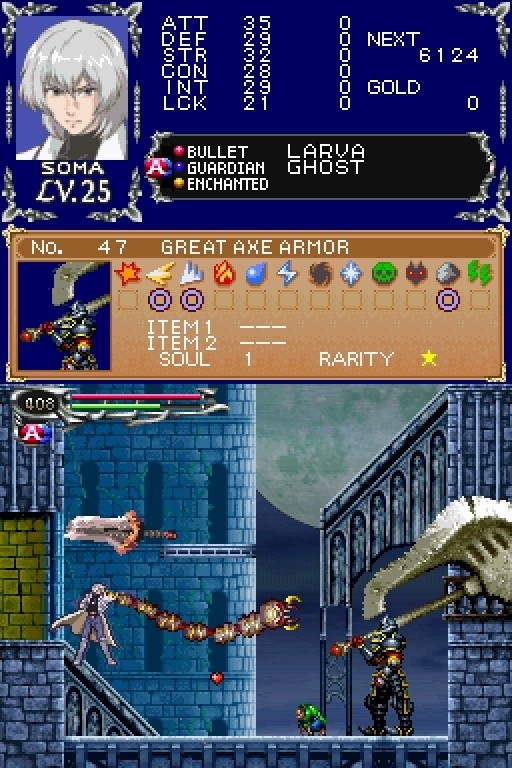
If you've ever played a 2D Castlevania title before, Dawn of Sorrow is going to bring back a lot of happy memories. There is a lot of fun to be had bashing in the dusty brainpans of the restless dead. My only real complaint with the title is that it doesn't do as much with the touch-screen and when it does the usage is sort of clumsy. Despite that minor issue, this is a worthy successor to the Belmont family's legacy. It even has replayablity in the form of an alternate character mode. Once you've defeated the game you can go back through the title with the ability to switch off between Julius Belmont and some other NPCs. There's also some limited multiplayer aspects, though they're nothing to write home about. Dawn of Sorrow is an extremely enjoyable 2D title, and categorically proves to any doubters that there is plenty of life left in the 2D perspective.
- Title: Trauma Center
- Developer: Atlus
- Publisher: Atlus
- System: DS
- Reviewer: Zonk
- Score: 7/10
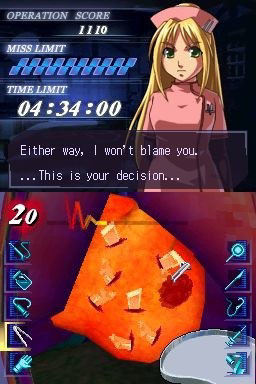
Derek Stiles is a newbie to the field of surgeon, and it shows. His cocky attitude nearly gets a patient killed, but he manages to regain his confidence when he's the only one who can save a desperately wounded patient after an accident. He accomplishes this medical marvel with 'The Healing Touch', a semi-mystical ability that lets him slow down time. Throw in enough dramatic text boxes to rival an RPG and an ironically named bioterrorism agent called GUILT and you have the makings for an extremely unique storyline.
The gameplay itself focuses on what happens inside the patient. You're given several tools to ply your trade, including a scalpel, laser, suturing needle, and some hi-tech antibiotic gel. After opening the patient, you're presented with your task for the puzzle. Each one is slightly different and requires a specific technique to resolve. The procedures are introduced to you at the beginning of the game, but once you're in the thick of the over-the-top plot you're going to have to remember exactly how your nurse told you to deal with the issue at hand. For example, in order to remove a tumor you have to find it with ultrasound, cut it open, drain the fluid, cut it off, remove the tumor, place an antiseptic skin patch, disinfect the patch, and rub it into place. And that's just one tumor. Many puzzles require you to remove a series of tumors, and once the bioagent starts affecting the city some of the tumors move. It's all very disconcerting. In addition to following procedures and keeping your eyes open for complications, you'll be racing against two countdowns. One is a simple timeclock, a time limit that you can't exceed so as not to endanger your patient. The other is the ever-falling number that represents your patient's vital signs. This score drops when you cut into someone and can be increased via the use of an injection. The injection, though, takes time away from following the procedure and getting the surgery done. In order to succeed in Trauma Center you have to have a good memory and be very quick. The experience, if you have a strong enough stomach, feels wholly unique.
The problem, though, is that it's a very stressful experience. I'm not a dedicated puzzler, but I'm no slouch either. Trauma Center requires you to move so quickly, at times, that you'll find yourself tempted to use your DS as a batarang in frustration. Especially once you're deep into the storyline, expect to have to repeat surgeries over and over as you fine-tune your procedures and race against the clock. The time slowing healing touch helps a lot, but even with the time slowdown you can quickly find yourself overwhelmed by the pace of exploding veins or bleeding wounds.
Visually, the title could have been torn from the pages of a high quality manga. The characters are all well drawn, and while there is no animation per se to the upper screen storyline there is still a great sense of movement to the primary players. The squishy innards of the lower screen look pretty good too. They're certainly gory enough for the subject matter. Blood oozes and seeps, and the first time you find yourself having to pull glass from a victim's subdermal layer you'll find yourself wincing. The dialogue and music could have been pulled from an anime as well. Every pre-surgery session involves Derek posing mightily and shouting, "Let's begin the operation!" The music ramps up during surgery and heightens the already tense mood as you eye the clock and try desperately to keep the patient from bleeding out on the operating room floor. There isn't a whole lot to the audio environment here, but what there is works.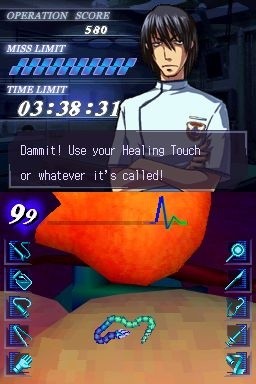
Overall, Trauma Center is a unique experience. Anime-inspired elements combine with varied puzzle action to produce a creation that could only work on the DS. Aside from the sometimes frustrating difficulty, the story mode is brief, leaving you wondering about the future of the young Dr. Stiles. Re-playability is available in the form of challenge modes, where you can go back and re-do previously successful surgeries for higher marks. If you're looking for a challenging puzzle game that will get you weird looks on the subway train, Trauma Center: Under the Knife will make the med student in you very pleased.
By far, Dawn of Sorrow has the most backtracking of any game I've ever played. You'll be going back and forth through the whole castle after every boss trying to figure out what your new soul enables you to continue with. This is hardly new to the Castlevania series, but it seems even more pronounced in this title. This isn't a true detriment to the game (it's fantastic, a must for any DS owner), but it is a bit annoying at times.
The Braying and Neighing of Barnyard Animals Follows.
Actually, in the original novel Dracula, vampires were not injured by the sun. In one scene in particular, Dracula himself is seen doing some heavy lifting in broad daylight.
While there could very well be a precedent in myth, I think most of this sunlight killing vampires business started with the silent movie Nosferatu.
Julius made his debut in Aria of Sorrow. He was called "J", and he had amnesia. When Soma became Dracula, Julius regained his memory. He had fought Dracula a few years ago, sealing the Castle with the "Vampire Killer" (the whip). But now that Soma was Dracula, it was Julius' duty to stop him (even by killing him).
:D
It wasn't the first time in the Castlevania series you had to fight a Belmont (SoTN, Circle of the Moon, Lament of Innocence - the doppleganger -), but it certainly was the most exciting. Everytime I replay Aria of Sorrow, it's to beat Julius with no weapons or souls, and to try to break my record (HP lost). Plus, the boss music for this battle is awesome (it's a heavy-metal remake of "Heart of Fire" and other castlevania songs).
So having Julius in "Dawn" was certainly a must. I really hope that for the boss battle vs. Julius (as spoiled in one of the trailers), they really have improved the AI. The AI in "Aria" was difficult for Julius, but once you learn his behavior it gets kinda boring. However, it doesn't stop surprising you once in a while, making a move you didn't expect. Just this boss battle is like having a mini "beat-em-up" game inside.