 Slashdot Mirror
Review: Shadow of the Colossus
- Title: Shadow of the Colossus
- Developer: SCEI
- Publisher: SCEA
- System: PS2
- Reviewer: Zonk
- Score: 8/10
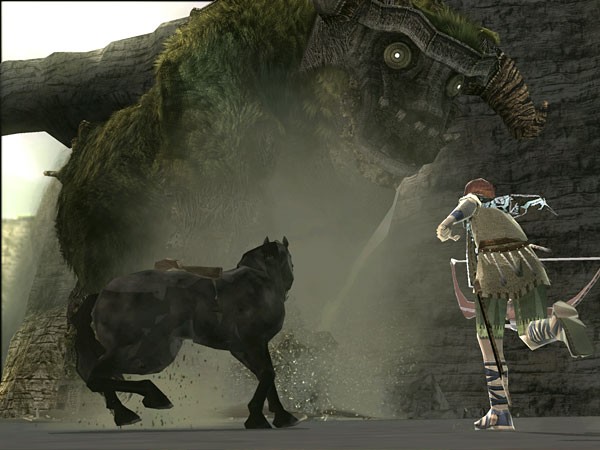
Gameplay centers around the only real activity to be found within the game: finding and killing the sixteen Colossi. The lands you find yourself in are vast, and to travel quickly from place to place you have the use of your horse Agro. Agro is a swift steed, and sometimes difficult to control. After you've mounted, you essentially just aim the beast in the direction you want to go and then spur him onward. While he maintains a trot relatively well, you'll find if any turning is involved you'll have to continually encourage him. Once you're moving across the field the game allows you a simple way to locate your next quarry. By holding your sword up to the light, a beam appears. Focusing the beam of light until it points out a locale on the horizon tells you where the next creature you seek lies. Reaching the beast is a simple matter of navigating the beautiful landscape and locating the area that the shrine's presence indicated.
Once you've found the Colossus, a short cut scene shows the beast stirring and reveals the creature in all its majesty. Every Colossus is different, though they all share similar qualities. First and foremost is their size. The sheer magnitude of the creatures you face is awe inspiring. On many of them, your tiny form barely reaches their ankle (or whatever they use for that purpose). Some come in vaguely humanoid form, while others appear as flying or four legged beasts. No matter what shape they come in, all have a slow and graceful majesty about them that makes doing what you're there to do more than a little uncomfortable. Your tools for dispatching your prey are simple: a bow and a sword. The tools may be simple, but the task is not.
With the beast on the move, it's up to you to discover how to bring it down. Each Colossus has a weak point on it somewhere, a magical symbol that indicates it is vulnerable. The problem is their size. In order to reach the symbol you're going to have to clamber up their body and hold tight to do your work. While some creatures can simply be leapt onto, there's often some sort of trick to figure out in order to gain access to the thick fur that covers many of the creatures and provides you with a climbing surface. Clinging to their fur is draining, and a circle of energy in the corner of your screen represents how much longer you can hold on. This circle is also used for tasks such as holding your breath or keeping an arrow nocked. Most creatures have some sort of flat surface on them, meaning that scaling these enormous beasts holds similarities to assaulting a mountain. Once you reach a base camp you pause for a breath before continuing towards your goal: the symbol. At the symbol you draw back your sword, and plunge it into the creature's flesh. You can attack the titan anywhere on its body, but the only way to do a significant amount of damage is to reach the symbol. While the procedure is the same for each Colossus, the tactics are different every time.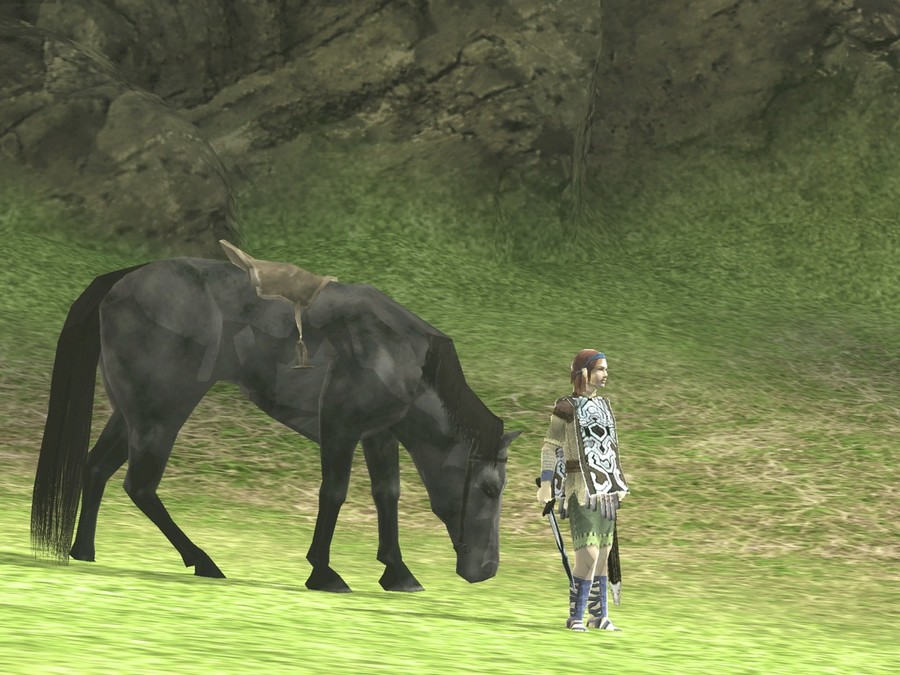
The game is essentially a series of sixteen boss battles, and the razor sharp focus of the gameplay allows the player to appreciate every tense moment spent clinging to a shaking beast's fur. I can describe the gameplay, but words simply do not do the experience justice. Every single 'vertical dungeon' you encounter during the course of the game has a personality all its own, and despite some frustrations it never gets old actually trying to kill them. Without the distractions of a thousand little minions to kill or annoying puzzles to solve, individual moments in Shadow of the Colossus have a lot more weight. Just riding across the plains on the way to your next encounter is a joy, being able to watch the landscape roll past and enjoying the extremely adept environmental design.
Misty moors, jutting cliffs, and rune-covered ruins dot the plains that you explore. The soft, dreamlike style of Ico has been transferred successfully to a less abstract space here in Shadow. The shrine and its immediate surroundings are your first real experience with Shadow's world. Light streams in from above to illuminate the darkness of the shrine, playing over the ruins of whatever intelligence built the structure so long ago. The lay of the land comes at you in broad visual strokes, a green plain giving way to a dark slab of a mountain. A pass leads through the mountain to a secluded ruin surrounded by water. The water itself is fluid and reactive, extremely well rendered. The Colossi themselves are works of art. The humanoids evoke powerful warriors, while the animals are all vivid forces of nature. The flying creatures are particularly awe-inspiring. It's not every day something the size of a building takes to the air over your head. Whatever form they come in a gentleness emanates from the furry goliaths, even as they try to crush you under their feet. The emotional nature of the title and the beauty of your surroundings combines to create a truly unique experience. Additionally, Shadow supports 480p, widescreen, on HD screens. If you can arrange to play the game this way it is well worth it. What is already a magnificent title seems to leap off the screen due to the high fidelity of the image.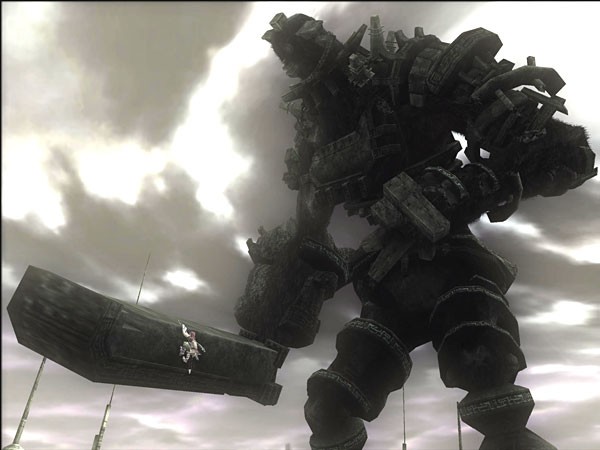
As awe-inspiring as Colossus fights are, as beautiful as the gameworld is, Shadow of the Colossus is not without its problems. Shadow was made in a world with flaws, and the title's execution reflects that reality. The camera is the primary problem. In an effort to afford you the most majestic view of your encounters, the camera will occasionally make extremely confusing decisions. While it might seem like a good idea to pull quite a ways back, allowing you to view your avatar as an ant on a beast's back, it is quite difficult to see what you're doing that way. In tight maneuvering situations the camera has a tendency to clip through the Colossus, often obscuring your view mid-leap or as you crawl around a corner. The beauty of Shadow's world doesn't come without a cost, as framerate slowdowns can be an issue during tense moments. While nothing catastrophic ever happened to me as a result of a slowdown it can marr what might otherwise be a scene from a motion picture. Finally, I encountered a few odd collision detection bugs. I managed to get Agro stuck in a pillar at one point, and despite my being able to dismount and call him he was unable to get free. Less humorously, in the middle of a fight with one of the truly majestic flying Colossi I became stuck in an upside-down crawling position. I'd been clinging to the beast's back, and somehow while I was crawling I tumbled and became stuck on my back. I fell from the Colossus and landed in a pond, where I quickly realized that I needed to leap out of the water relatively often so that I wouldn't drown. While it was amusing to swim around upside down for a minute or so, I was basically forced to reset my game. I'd gotten the Colossus down to only a small amount of health, and it was a frustrating decision to have to start all over again.
Shadow of the Colossus, then, pushes the edge of the art form that is the videogame. The story is essentially nothing more than a setup, with everything that follows simple acts that require you to make value judgments about them. The gentle nature of the Colossi would seem to make your acts violations, but the game's finale makes that a questionable assumption as well. The graphical presentation is beautiful and visionary, headily recalling the days when the PS2 was new. The game pushes the boundaries of what the PS2 hardware is capable of, and the title suffers as a result. The control scheme is intuitive, but can sometimes be unwieldy as events in the game get away from you. If you see past the technical problems, the biggest complaint you're likely to have is the brevity of the experience. The game's focus is such that only a few hours of concerted effort will be required to plumb its depths. There is replayability, in the form of a hard mode and time attack tests. The time attacks can net you new objects which you can use in the hard mode of the game, and little things like a different color for Agro.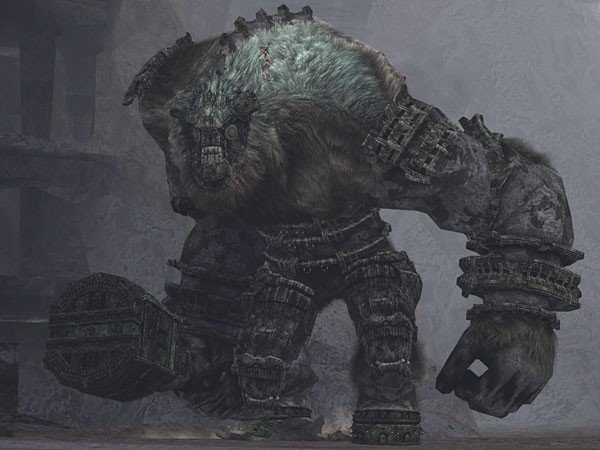
At the end of the day Shadow of the Colossus is truly a work of art. It stands as a unique experience in the field of gaming, with intense action set pieces and hauntingly beautiful landscapes. Honesty requires me to talk about the technical problems that marr the perfection here, but for me personally they're not a consideration. Games that have the power to move the human heart are so few and far between today that most commentators are still tentative to call gaming an art form. It is titles like this that will make them see the light of day, titles that can move beyond coin collecting, monster fragging, or skull cracking. Not everyone can identify with a psycho killer or a misunderstood alien. Our common humanity binds us to the man who has traveled so far and sacrificed so much. Giant-slaying for the people we love is not merely a fairytale, after all. Shadow is a 10/10 in my book, and easily the best gaming experience the end of the year has to offer.
http://www.penny-arcade.com/view.php?date=2005-10- 21&res=l
"Size is definitely the focal point of the game"
Apparently, you've heard from my wife then.
"There is something exhilarating about climbing onto a gigantic beast and hanging on for dear life as it tries to shake you off."
And now you're calling her a gigantic beast?
Bastard.
"Trolls they were, but filled with the evil will of their master: a fell race..." -- J.R.R. Tolkien on Olog-hai
Because if we could only review games made for consoles that WEREN'T produced by heartless evil corporations, we'd be left with... uh... Word Challenge for the Tapwave Zodiac.
"Do you expect me to talk?" "No, Mr. Bond. I expect you to die!"
http://www.ctrlaltdel-online.com/?t=archives&date= 2005-10-31
: )
You can't take the sky from me...
Being honest is hard.
:)
No, being honest is the easiest thing in the world. You just have to say what you think, which is a skill so innate that most of us are taught not to do it. (I say "most of us are taught" because a depressingly large number of people seem never to have learned.)
Personal opinions and experiences color everything we do, we can't do anything about it.
That's a run-on sentence. I think you meant to use a semicolon in place of that wildly inappropriate comma. But aside from that, it's also a blatant contradiction of the sentence immediately preceding it. Being honest is easy specifically because it's hard to set aside our opinions.
75% of what I'm thinking abot when I write a review is trying to be objective and come at the game from the opinion of "everybody".
Wow. Where do I even begin? First of all, you never, ever begin a sentence with a numeral; always spell out numbers that begin sentences, or rewrite to start the sentence with another word. Second, the percent sign is never used except in tabular presentations; in prose, always spell out "percent." Third, never use idiomatic or hyperbolic expressions containing the word "percent." Phrases like "110 percent" are hyperbolic and should be avoided; phrases like the one you used here imply a degree of precision greater than what you actually intend to denote. You should have said "Most of what I'm thinking about."
Of course, the whole damn sentence should have been rewritten, because it's embarrassingly awkward and ineffective. If you'd written a better sentence, maybe you wouldn't have made the amateurish mistake of putting a terminal punctuation mark outside a closing quote.
Taking into account the technical problems knocks the game down from a 9 to an 8, which was what I was going to give it until I found myself swimming upside down and drowing.
This non sequitur comes on so hard it poses a distinct whiplash hazard for the reader; a warning should be attached to the beginning of this paragraph advising pregnant women and people with heart conditions from reading it.
Again we see Zonk's troubles with numerals. Numbers less than ten are never written as numerals; they are always spelled out. Round numbers greater than ten can either be written as numerals or spelled out. ("Ten," "a hundred," "a million.") In this sentence, "nine" and "eight" should have been written rather than being shown as numerals.
The "which was" construction is problematic for inexperienced writers; we see why very clearly in this sentence. The antecedent of the "which was" construction must immediately precede it in the sentence; otherwise the "which was" phrase dangles and the meaning of the sentence is unclear. In this case, Zonk meant to say that he intended to give the game a score of nine until he experienced a frustrating aquatic interlude that inspired him to give the game a lower score. What he actually said is that he was going to give the game a lower score until his disorienting experience provoked a higher one. Because his modifier dangled, the meaning of the sentence was not merely lost, but actually contradicted.
That said, objectivity is not the only goal of a review.
The use of "that said" is another minefield for the inexperienced writer. One uses "that said" to introduce a seeming contradiction. "I buy floor wax at Costco. That said, I disagree with the company's hiring policies." Using "that said" without first making a point leads to reader confusion. Zonk had not established his point before acknowledging that he was about to contradict it. The net result is that the reader is confused at best. At worst, the reader is so frustrated that he simply gives up and stops reading.
If he had organized his first paragraph differently, "that said" could have been used to great effect. For example: "Until I discovered the swimming glitch, I was going to give the game a high score. I had t