 Slashdot Mirror
"Bookshelf" Computer Wins Design Contest
aibrahim writes "Industrial designers at Purdue University win a competition for next generation computer design sponsored by Microsoft. The design emulates a bookshelf, with hardware components that are "stacked" horizontally around a cube shaped CPU. The design attempts to address hardware issues from a user perspective and is pretty cool despite a focus on DRM."
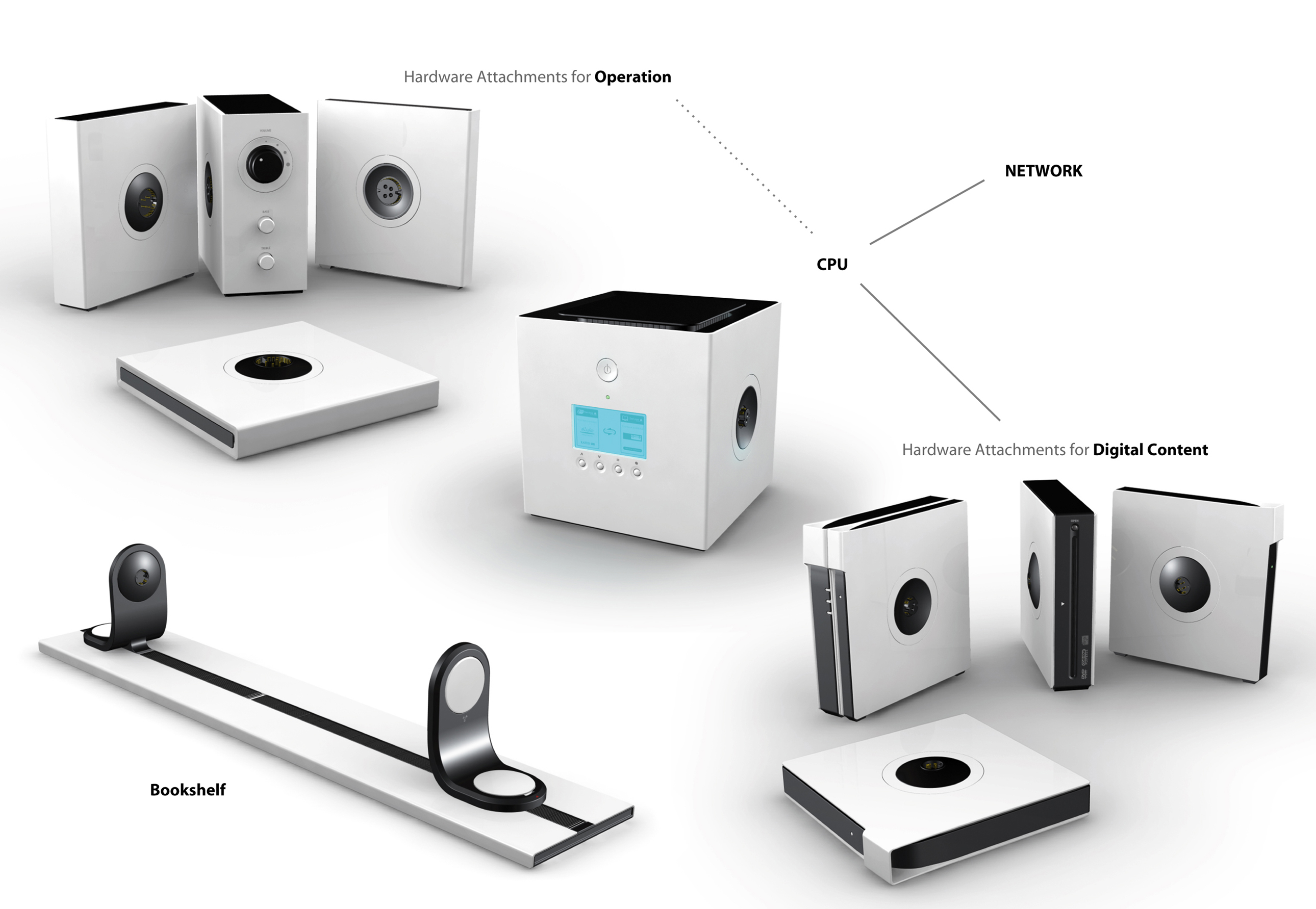
First of all, I'm always curious and a little suspicious when anything is a winner of a competition, "next generation computer design sponsored by Microsoft." My gut reaction to MS sponsored design is that the winner is going to be more about something Microsoft will leverage and much less about what is good for the consumer. Here's why:
Interesting design, but even more constrained in some ways than traditional computers. For my personal taste I much more prefer to put my computer somewhere completely out of sight and not taking up any desktop real estate. I'm not adding and modding so much that I need the "bookshelf metaphor" to accommodate my computing needs.
I'm not even sure I'm convinced this modular design will stem the constant support I give to friends of family when things don't work. Visually it looks simpler for managing a computer, I wonder that vendors would do any better creating truly modular and plug 'n play components for this design.
As for the DRM, from the article:
This new look is essentially a Bang and Olufsen computer -- lots of sizzle, but compared to what really could be done advancing computer design, not much new. If you're into eye-candy, this is for you.
With present machines if you want to add a USB drive, just plug it in. But then where does it physically sit around. On your desk, I guess. If there are many such add-ons it becomes messy. So this design sorta addresses the mess issue.
I'd like to see a standard spec for stacking (verically) components. They can be connected at the back with USB.
What is the greatest issue facing computing today? For the users, it is security, for some vendors, it is the security of their hold on some part of some market. DRM answers the second interest to the detriment of the first. The jury who awarded this prize don't understand this, or they do, and have themselves some interest, therefore are not impartial.
aka the "Dressing up a turd" competition.
Having to change the aesthetic of the computer to hide the fact your paid for content is under someone elses control is exactly that.
Aside from the chicklet keyboard, it's claim to fame was expansion by stacking cartridges on the side.A little memory here, a printer port there, and you had a few feet sticking off the side.
http://www.oldskool.org/shrines/pcjr_tandy
Sounds like the same thing with a new paint job.
You know what we be cool to put on that bookshelf? An Encyclomedia PC! This is by far the nicest form-following function I've seen home-brewed in a long time. I couldn't resist the chance to plug it.
-- I have fans? Wow.
The book The Design of Everyday Things discusses horrible design decisions in appliances, doors, locks, gadgets, computers, and basically anything with a user interface. The book shows how the same mistakes are made over and over by each new designer, issues of user interfaces as simple as buttons and levers, which many engineers know little to nothing about.
In this book, the author repeatedly criticizes designs with the phrase "It probably won an award." He attacks design awards as being given out to aesthetically pleasing or structurally innovative designs, but without sufficient consideration and testing by people who actually have to use the device.
xkcd.com - a webcomic of mathematics, love, and language.