 Slashdot Mirror
Dungeons and Dragons Online Impressions
- Title: Dungeons and Dragons Online
- Developer: Turbine Entertainment
- Publisher: Atari
- System:PC

One aspect of the title I know I have a firm grasp on is the setting. Eberron was developed by Keith Baker for a contest held by Wizards of the Coast a few years ago. Since then the pulp action setting for the D&D system has become the company's premier IP. Novels, sourcebooks, comics, and miniatures are all being created with the Eberron world in mind, and Dungeons and Dragons Online is the second work of electronic entertainment to use the setting. You may recall Dragonshard, the D&D RTS title. That too is based in Eberron, but with an (understandably) less immersive look at the setting. DDO delves deep into the backstory of the gameworld. Set in the settlement of Stormreach on the continent of Xen'drik, the game allows you to explore some of the elements that make Eberron unique. The powerful merchant and political factions known as Dragonmarked Houses make an appearance in the game, as benefactors and opponents. Dragons are rare, powerful, and mysterious. While I would have liked to get more of the backstory from the setting's main continent of Khorvaire, there is a definite sense of place in DDO. It's thin, but it's there.
Creating a character is the first of many DDO aspects that reinforce a D&D feel. Attributes are created using the 'point buy' system, allowing a player to build a character to fit a class without relying on random die rolls. If you're uninterested in tweaking a character's skills and attributes, you can simply select a class/race combo and accept the pre-built character the game will provide you. Prebuilt characters all have fairly sane choices made as regards attributes and skills, and if you're not interested in learning the particulars of D&D character creation it's a safe choice to make. All of the D&D iconic classes are available (even poncy bards), along with the typical player races. The Warforged are the stand-out race for the game, living constructs that resemble animated statues. In the game's lore, Warforged were construct troops created for a titanic century-long war. With the war at an end Warforged are emancipated creatures and can fill any role the fleshy races do. While I find them intriguing plot elements, I've heard a lot of player commentary about their inhumanity. It's a fact that the race most often played in a MMOG is 'human', and the unliving nature of the Warforged may make them an unpopular race. Just the same, their inclusion is a powerful reminder of the setting's background. The classes available are typical to what you'd find in most MMOGs; With good reason, as most MMOGs stole their class concepts from D&D in the first place. One class element that might surprise some folks who haven't done table-top gaming before is the role of the cleric. D&D clerics are almost as powerful front-line fighters as your fighter or paladin. They wear heavy armor, kick ass, and take names in the pursuit of their god's goals. Rogues are also fundamentally more useful than in many typical MMOGs. There are plenty of traps in D&D dungeons, and rogues are the only ones who can disable them. Making your character 'feels' very D&D, and sets the stage for your integration into the Eberron setting.
Once you're in the game, you'll find that the D&D setting is the least of the elements setting DDO apart from other MMOGs. Combat is a very different animal than almost any other title in the genre. In a word, DDO combat is realtime. Instead of hitting fight and using abilities as they become available, or simply watching as your avatar filets a bunny, DDO is a click-fest worthy of either Diablo game. Each click is a swing of the sword, and whether you 'hit' or not is determined by your stats. In the corner of the screen you're shown your to-hit roll, which is a random number between 1 and 20 modified by your Strength score. To score a hit, you have to get higher than your opponent's AC, and on a natural 20 you do more damage (a critical hit). In other words, you're going to do a lot of missing. This gets frustrating very very quickly. In fact, it's gets just boring after a while. Tabletop D&D combat is fun because it's abstract, with the blows landing on the screen in your mind. Actually having to sit there and watch the swords swing over and over is more than a little tedious. D&D monsters aren't like the villains of Diablo; They jump around, move out of range, and generally do their best not to get killed. That means that in addition to repeatedly clicking on your opponent you're going to be trying to follow their movements. It's all too dang chaotic to be truly fun.
Besides just poking the baddies, there is actually a good deal of depth to DDO combat. All characters have the option of using some tactics in their fighting. Skills actually play a large part in combat if used correctly. Diplomacy attempts to throw off aggro, making a monster attack someone else. Intimidate is the opposite, encouraging foes to attack your character. Rogues can use the Hide and Move Silently skills to avoid notice, and bypass monsters if need be. If they don't, they can strike from hiding and possible score a sneak attack for massive damage. Rogues can even do sneak attacks in combat by using the Bluff skill to throw an opponent off balance. Magic is more your typical MMOG fare. Wizards, Clerics, etc, have mana points which are used up by spellcasting. Even with that as the base mechanic, the system is very D&D. Spellcasting classes have only a few spell slots, and can only swap out what they have online when resting. Further, arcane spellcasters only know a subset of their available spells and must find or purchase additional spells before they can use them. These elements are all laudable additions to the game, but in reality many combats feel more like a group of individuals doing their own thing than a party effort. Because of the frenetic nature of real-time clicky combat fights are fast and hard to manage. A group comfortable with each other, with voice chat in use, will have a good deal of success. Pick-up groups, though, are at even more of a disadvantage than in most games simply because things happen so fast.
That's what you do in combat. What you're actually *doing* when you play DDO is almost entirely dungeon-crawling. You receive quests from the people of Stormreach, all of whom need help with this or that. Like City of Heroes/Villains, your missions are instanced, meaning that you and your party get to play around with your own copy of the dank basement/decaying sewer/giant ruin that you have to explore. With the missions instanced, DDO dungeons are allowed to do some really interesting stuff. Traps, for example, are deadly challenges that affect the world in real-time. More than just kicking open a chest and being set on fire, razor-sharp blades swing from the ceiling. Splashes of acid fly from spigots in the walls. If you don't have a rogue with you, some traps can be avoided by using your platforming skills to time the gap in a trap's movement. If you do have a rogue handy, the trap mechanisms can be searched out and disabled. The traps are a very cool addition to the genre, but the quests are unfortunately laughable. The thin layer of Eberron that I mentioned above is mostly related through quest text, and what is offered through NPC interaction is cookie cutter and boring. Quests usually have a voice-over, from an intangible Dungeon Master, to spice up your understanding of the situation and evoke the table-top setting. In my opinion, the voice-over doesn't add much. In truth, the storytelling that Everquest 2 and World of Warcraft manage through questing makes the story attempts of DDO look like a student project MOO in comparison.
Besides traps, dungeons are populated with all manner of gross and icky critters. While you start off fighting skeletons, slimes, and kobolds, you eventually graduate to some of the archetypal monsters of the Dungeons and Dragons product line. They're smart, too, with even the dim-witted kobolds doing their best to dance outside the range of your swordarm. You get real satisfaction from slaying enemies in DDO, both because they're a real challenge and because you can stop clicking for a little while. What you don't get is XP. Experience points are only handed out at the end of the mission, when quest objectives are completed. While some missions may have a subquest asking you to slay x number of monsters in the dungeon, each individual kill nets you nothing more than a clear hallway. I'm pretty ambivalent about this design decision. On the one hand, I like that they're emphasizing the quest instead of bashing in a kobold's brains. On the other, I don't feel quite the surge of success for whacking the baddie I might get in another game. Additionally, since the quests are so blah the XP I receive for completing them seems ill-gotten somehow. It's a toss-up, but it mostly feels like they made this decision just to be different.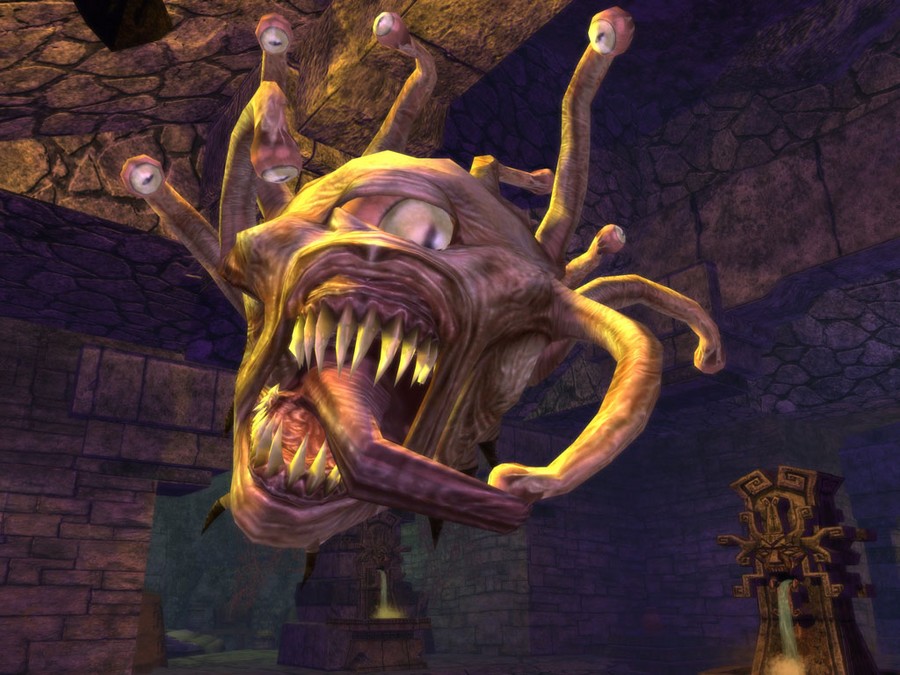
That XP is put towards your next level, as with all MMOGs. There is a difference here, though, in that each level is a very long time coming. You do gain in power on a semi-regular basis, but instead of gaining a level you gain a rank. Each level is broken down into four ranks, waypoints along the road to your next level. Each rank nets you an action point, which can be spent on a character enhancement. Every race/class combo has different enhancements available to it, and all of them increase specific aspects of your character abilities. (+3 to Search, for example.) With every level being a major milestone, it won't come as a surprise that there aren't that many to gain. At the moment DDO only allows you to achieve level 10, rank 4. You can go no higher than that, but there are plans in the works to add level 11-20 content at a future date. For most normal players this will take a while; the much loved experience penalty is enacted if and when you wipe. If you die and other folks are still alive, they can take you to a resurrection shrine in the dungeon to revive you. Rest shrines are usually nearby these areas, allowing characters to regain hit points and mana mid-dungeon. Besides these rest shrines, the only way to heal HP in-dungeon is with a potion or clerical spell. I hate hate hate almost everything about these design decisions. In reverse order: Long downtimes suck. HP and MP not regenning sucks. It is not fun to sit in an inn after a mission is over watching my hp bar creep upwards. You can buy food and drink to improve this rate of regen, but it's nothing like the regeneration you'd see in other modern MMOGs. Experience penalties are evil. Taking away accomplishment from a player is the worst thing you can possibly do. It's not as harsh an experience as you'll get in FFXI, but it's still frustrating to have XP taken away because of something you may not have even had control over. Finally, their decision to ship with only ten levels is a very bad one. I'll expand on why that is below.
You'll note I've usually said 'you' when talking about gameplay, but that's misleading. I should be saying 'you and your party', because in order to play DDO you'll have to be grouped. I'll say that again so you can be clear on this: It is not possible to play Dungeons and Dragons Online solo. The intention, of course, is to evoke the flavour of a table-top session. The publisher has even included voice chat as a built-in feature to the game client to facilitate team communication. The result is a title that you cannot play alone. Some classes, like spellcasters and rogues, will have trouble soloing even the introductory quest when you first get off the boat. Clerics are probably the best soloing class, as they can heal themselves most effectively, but after the first few 'figure out the game' dungeons they're outmatched by the strength of most monsters. I can't really fault them for deciding to go this route, but it's a very harsh line. Even Vanguard, the upcoming hardcore MMO being designed very specifically with grouping in mind, is said to have something like 15% of its content geared for solo players. There isn't even that much for the individual in DDO.
The one thing I can say without prevarication is that Dungeons and Dragons Online looks good. The streets of Stormreach are beautifully laid out, with a style of architecture that really gets across the character of Eberron. A floating inn out over the water is just the tip of the iceberg; DDO has a truly unique look. Character and monster animations are well done, and the soft lighting that pervades the game gives an otherworldly charm to the title. The visual look does more than anything else to establish the character of the dungeons and city streets you'll be exploring. The sound situation has likewise gotten a good deal of attention, but the results there seem merely adequate. Sound effects are competently accomplished, and the musical track highlights game moments without being offensive. There is 'combat music', though, which I'm already tired of. Combat music is fine in a single-player RPG, but FFXI is the only MMOG in which I find that acceptable.
Another website is quoted in a DDO television commercial as offering "A Genuine Online D&D Experience". Whoever it was that came up with that piece of pabulum has never actually played Dungeons and Dragons. Table-top D&D is about storytelling, camaraderie, and having fun with your friends. Somehow in the brave new electronic frontier, these qualities are translated into meaningless grind quests, chaotic click-fest combat, and swearing over voicechat. I'm enormously frustrated by DDO because there is just so much new and interesting going on here. The skill use and traps are real firsts for the genre, providing meaningful player choice in how to navigate a dungeon and how to do combat. These awesome mechanics are sandwiched side by side with other elements that seem more appropriate for launch-day Ultima Online. There are so many contradictions within this game that it's hard to know which is most confusing, but I have a top pick. For those who will like this game, they're going to just eat this thing up. And when I mean eat it up I mean "grind through the game in about a month or two". There were already characters at max level before the game's headstart event had finished out. Whoever did that payed about fifty bucks for ten days or so worth of play. They undoubtedly started a new character, but because of the simple questing structure there's almost no replay value currently in the game. Thankfully not all is doom and gloom. Turbine just announced that they're already planning to add 15 new dungeons and a raid on a dragon's lair in April. That commitment to new content is the going to be the only thing keeping the hardcore around because there is nothing at all available for you once you hit level 10. There is nothing to the endgame yet; It's all still in production.
So, let's review: The game isn't for the hardcore because they'll eat the content too quickly. It's not for the casual gamer because it's impossible to play on your own. Dungeons and Dragons Online is very specifically crafted for folks playing with other people at a non-hardcore pace. And in a way I think that's a good thing. It's good they have a target audience in mind, and if I were planning on adopting DDO as my game of choice that would probably be a good description of me. Just the same, it's a very bold decision to make. Only time will tell for sure, but I have a feeling it's a decision that will come back to haunt them. In the meantime: If you've got a group of regular online gamers you play with, you and your crew should consider giving DDO a try. It's got some interesting new elements that make it stand quite apart from most other Massive games. Don't be surprised if you get bored of it sooner rather than later, but if you and your group are tired of raiding Molten Core for the hundredth time this should keep you out out of Azeroth for a month or two. Hardcore gamers should stick to whatever they're playing now. They'll eat this title for lunch and find themselves frustrated with the lack of endgame content. Casual players should just keep on moving. If you're not willing to commit the time and energy to the constant search for a group, you won't find anything to do here. At the end of the day, DDO is a game with a great deal of promise squandered by some very confusing design decisions. Now go find your DM and give him a hug.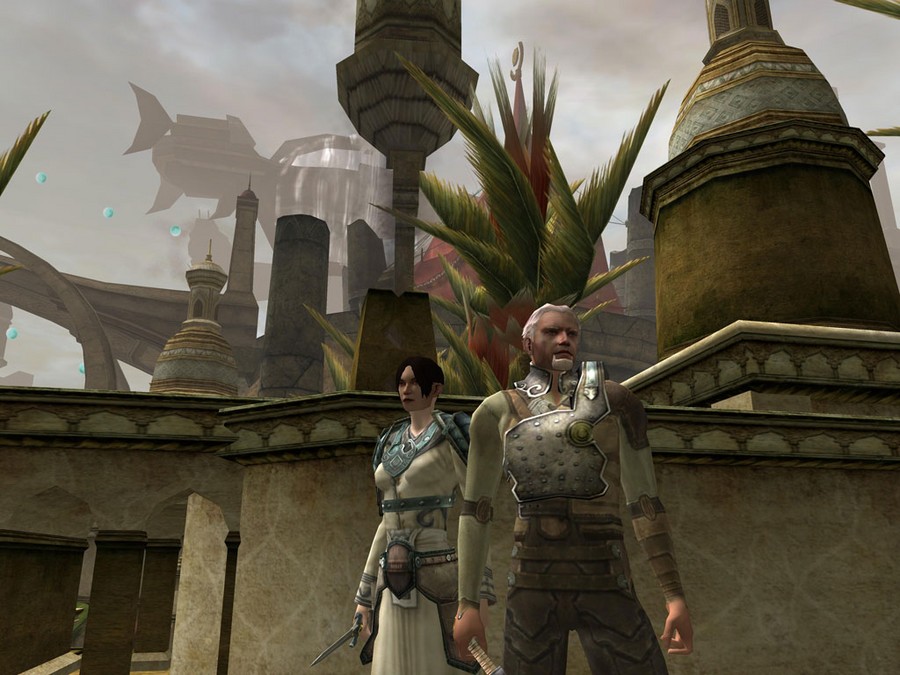
I guess being modded Troll for a comment in this story would be a good thing.
"You'll get nothing, and you'll like it!"
Something that seems to be missing from all MMORPGS, is stories. Tabletop role play was about epic stories, and interaction with people on your adventures. MMORPGS seem to be about killing things and collecting loot. I didn't play DnD with friends for getting cool magical swords. After all, all it took was writing in a cool item on your character sheet to 'have it' anyway. Also, DM's are famous for scaling their adventures to the players stats/skills/items anyway, so leveling up was simply a way to keep score, not the goal in mind.
I played such games for *stories*. Things to tantalize my mind, to experience in a more direct role. I look at a role playing session as like experiencing an epic tale that I can have a direct hand in. All attempts to recreate that in a digital form for MMORPGS have failed dismally in my opinion. Even WoW.
Is it so hard to create some gameplay that is more like playing the Baldur's Gate style games? Or Planescape Torment? Most of the single player RPG's manage this pretty well. What about NWN? That game has managed a multiplayer component that has virtually no rivals in the digital age, purely from it's lack of centralized multiplayer, and by allowing players to create their own content. These are all food for thought I think, although I'll stop rambling now about this, as I could go on for a while.
So, writing as an "over the hill geek" - my first roleplaying experience was in late 1983, I have a suggestion: put in the effort to find people who want to play!
I started playing D&D 3rd edition again a few years ago with a few friends. At that point, we were all in grad school. Now, I'm a consultant, and most of the rest are lawyers. The game improves as you age. We haven't been in a dungeon in a year, but we've had fantastic debates over deposing the current ruler of an autocratic city-state ("Who will rule when we leave?" "Do we really have the right?"), the morality of killing the few to save the many (or killing the many to save the even more), and the banter between characters and between characters and NPCs is better than that in most fantasy novels. ('Cause, you know, we're older and more mature than we were when we were in high school.)
So: go check out your local gaming store. Or the local grad school. Or ask around among friends and say you're running a D&D game. Get people to come for just one day of gaming. Some of them will turn out to be hardcore and play every week. Our current group of 4-6 people meets every Sunday for about 5 hours. (I haven't missed a week since January, in spite of working 60+ hour weeks).
Some people will drop out, other will try to join, but it's worth the effort to making it work.
Disclaimer: Children will probably kill the whole thing. But until then... swords high!
---sheath
The author only has it half right. There is, indeed, an auto-attack mode, which can be turned on by the press of a hotkey (by default, "1") or by double-clicking on the creature you wish to attack.
What I did not see mentioned in my quick glance through the article is that the NPCs you fight are actually somewhat intelligent. They will move around, try to get behind you. It's very interactive in that manner. You have to keep the creature in front of you, and it's going to try to keep NOT in front of you.
... "I read part of it all the way through." -- Movie Mogul Sam Goldwyn (and some slashdot readers)
You are facing two problems. The first is that it's very hard to translate a paper-and-dice RPG to computer, regardless if it's a MUD, MMORPG, CRPG, etc. The reasons for this are myriad.
The second problem, however, is that you might be confused as to what "D&D" actually is. It's a rules set for apaper-and-dice RPG. It has nothing to do with milieu, setting, or environment. A D&D game could be set in Greyhawk, Forgettable Realms, Middle Earth, or your own setting. It could have every monster in the Monster Manual I and II, or it might have none of them. It might have trolls, but not the typical regenerating trolls. It could have twenty different races, or it might have just humans. The point is, D&D is a set of rules, nothing more.
Now that I've thought about it a bit more, my unhumble opinion is that wanting a "D&D" MMORPG is silly. There's so much a MMORPG can offer, that wanting it limited by a set of tabletop rules is dumb. It's like wanting a word processor to be limited to the concept of a pencil. An MMORPG can use *REAL* statistic probabilities instead of rolling a silly s20. Why use hitpoints when you can now calculate damage based precise hit location, armor covering and layering, weapon aspect, wound types, etc? Even with the grossly simplified and abstracted combat necessary for performance, a computer is still going to give you a combat experience that would otherwise take you pages and pages charts and tables in a tabletop game. And that's just combat! Imagine would it could do for skills such as lockpicking, trap detection, spell research, weaponcrafting, ale brewing and literacy!
A Government Is a Body of People, Usually Notably Ungoverned
So you got modded insightfull? Fine. May I add some insight? ...
I got WoW and installed it. I've never ever played an MMORPG before. It took me aprox. 30 seconds to get going with the game. The people I know that play MMORPGs have been buying GuildWars just to get away from WoW and give other games a chance and yet they come back to WoW.
It's hardware specs aren't insane, a n00b can play it and if I log on after 4 weeks I don't feel like I need another 2 days to get into it again.
Remember StarCraft? It had a max resolution that was allready considered pointless back then. Yet it literally crushed the market and it is still considered one of the best RTS games ever.
Why is that?
Blizzards playtests.
It's that simple.
Playtesting is a core component of development with blizzard. SC was playtested for two years!. How else do you think they could balance 3 factions so well? Something NOBODY has achieved again since then. And the same goes for WoW. A year and more is allways part of their developement. That's the reason WoW rules todays MMORPG scene. They get the medium to higher specs of todays PCs, and develop for those for a few years, allways counting that extra year of playtesting and balancing and tweaking. Thus Blizzard gives you games that A) Are finished. B) Don't suck. C) Run on normal PCs. D) Run stable. (Updates on Blizzard games allmost exclusively cover balacing, rules and game mechanic issues) E) Stay very fun for an allmost indefinite time. Ergo: Blizzard rules.
I recently checked out EQ2 (sucked royally) and talked to a MMORPG fan that has his share of GuildWars and other accounts. His comment went like this: >>WoW is the ticket. It currently doesn't get any better so don't waste your time if your not a fulltime gamer.
Given Blizzards track record I'm inclined to believe that.
We suffer more in our imagination than in reality. - Seneca
You might not know the disaster turbine will make of this. They've had good people -- and good streches -- in their games, but it has been rare.
... flawed. Depending on how your character name hashed, you would either be mostly-as-intended (in the middle), or Wi (you get 10x of the aggro you should), or myself (you get 1/10th of the aggro you should).
If you think some of their DDO decisions are laughable, you should have seen some of the AC ones. Spells researched by dumping components into a bar and hitting a button. Eventually it turned out that your spell components were just the result of a formula applied to a hash of your account name (not character name even). Programs popped up to bot it for you (thank god it was awfully boring). Thus was the start of the great Macro-on's Call. A problem they never really banned anyone for but that caused serious problems in the game, especially for PvP as the "level cap" without macroing was effectivly unreachable (and almost unreachable with macroing).
Then there was the "spell economy." You see, magic is "depleted" by being cast. Both in a school (critter, life, item, and war) and per-spell/per-spell-level. So a spell that should have given you +35 to a stat (for example, focus self 6) would actually only give you +30 to a stat, because so many people were casing it (namely everyone in existance who had critter magic and could eek out a 6th level spell -- highest there was in AC at the time). Meanwhile, other spells like crossbow mastery self 6 were providing a +40 bonus since next to nobody used xbow. Kinda cute, but when you combine it with the Flavor Of The Month problems MMOs face it started sucking. Especially with reguard to mages -- you spent a lot of points buying all those magic schools, and someone else without them but with arcane lore could use jewlery that would always provide that +35 bonus (item cast buffs were not part of the spell economy). There was in theory some indicator bar for the spell economy but it never actually indicated anything as far as I could tell. Needless to say the system was nixed after (too long) a time.
And let's not forget the most brilliant decision ever: allow monsters to gain XP off killing players. Also, provide monsters with a flat 10xp/pt curve to improve their stats, as opposed to the exponential curve players faced. Have the Virindi Executor resist your first 2 war spells? May as well run away, he just gained ~500-1000 xp, and dumped all 50-100 points that provides into his magic resistance skill. Needless to say your war magic skill of 250 to 300 won't be landing anymore.
Last but not least, no discussion of turbine is complete without mentioning the "Wi Flag". See, the way they calculated monster aggro (initial (and often final target) not based on damage or healing or anything -- purely random amoung targets in range! Fight till one of you dead or target out of range. Run back to spawn. Acquire new target.) was
Now, this Wi or anti-Wi flag was kinda interesting tactically. You could send my toons with it into situations nobody could normally go, because most mobs would ignore me. It could be annoying though; my friend (who had a Wi) zones in to the dungon I'm fighting in and suddenly the 15 bugs surrounding me (Olthoi -- the one cool thing about the game) are off in another corner. Even the one I was fighting turns around and tries (and fails due to the "I run at your location" pathing AC has) to run at him, dragging me behind it across the dungon.
But overall it was just irratating. People who were wi-flagged often couldn't do quests; they'd just die due to concentrated fire at the start of a spawn. It lasted, what, 2 years before one of their good (last good? I think she moved on) programmers found it. Despite them telling us "we've tested it there is no wi flag" the whole time.
So yeah, go Turbine. Not a company I plan to play a game from again.
Probably get karma-dinged by a D&D fanboi for bashing the developer of The Best Game Ever or something, but that's okay I've done my time (in AC and playing D&D -- gestalt at the moment thanks for asking) and said my peace.
Slashdot Patriotism: We Support our Dupes!
It feels like most of the negative reviews of DDO I have seen thus far on the net are from people in two groups:
1. Those who dislike MMOs, but love PnP D&D, and are upset that DDO does not have a human gamemaster who can generate infinite variety and choice of path.
2. Those who are in love with a current MMO, and are upset that DDO is not "EQ with D&D terms" or "WoW with D&D setting".
What has the g/f and I (and several of our friends) sucked into DDO is that it addresses so many of the things we did _not_ like about other MMOs. Boring combat? Gone. Lack of strategy? Gone. Easy mode? Gone. Time sinks? Gone. Downtime? Gone. Rogues as uber-warriors instead of thieves? Gone. Static play environment where nothing changes? Gone. Dungeon as "scenery" that is 99.9% noninteractive? Gone. Dungeon as "place to stick 1000 monsters to slog through"? Gone.
This review, in particular, seems to come from someone who not only has not played the game much, but also has not read the manual or explored the interface. Truthfully, it sounds like someone who has read all of the complaints on various discussion forums, and is summarizing them, without ever having played the game itself.
The review complains of the "inhumanity" of the Warforged. I think that was the point. They are very inhuman and little distinction is drawn between male and female. This was enough to turn my g/f off of playing one, in fact -- but that's okay! The Warforged are different! Here we have a character who can come built-in with his own armor and other benefits from day one, but suffers the inability to actually wear "real" armor that others wear. It is interesting and different. That's a good thing.
The review complains (repeatedly) about the click-fest that is combat. (Tell that to the millions of people happily and madly clicking on Diablo for the past 10 years.) The click-fest is _optional_. The very first icon on your default toolbar is auto-attack. Don't want to click? Click once.
Single-click combat is actually useful in DDO, because the game allows (forces?) you, the player, to take an active role in combat. Your character does not block. You do. Your character does not tumble or evade. You do. If you don't, neither does he. Single-click combat allows you to more precisely time your swings between your opponent's swings and spend more time blocking or evading his attacks.
If you're playing the game by running straight up to an enemy and right-clicking on him til he dies, you're going about it all wrong and will enjoy less combat success than someone who advances carefully, choses a defensible position, blocks, tumbles, tries to set ambushes, etc.
The article states incorrectly that a natural 20 is a critical hit. It is not. A natural 20 is an automatic hit and nothing more. Each weapon has a critical hit range, which can be 20 only, 19-20, 18-20, etc. If you roll in that range on the die, the computer makes a *second* die roll. If the second roll hits, you score a critical. If the second roll misses, you score a normal hit.
"It is all too dang chaotic to be truly fun." The chaos is the *reason* it is fun. DDO captures the feel of real combat in a way no other MMO has. Monsters can not walk through each other. They can't stand on each other to attack you. They can't walk through you, either. Want to have the fighter block a doorway with his body while the mage stands behind him (in safety) and fires spells over his shoulder? It actually _works_.
The monsters are intelligent. Rogue-ish monsters will hide, sneak around the back of the battle, and try to sneak attack vulnerable characters... but you CAN see or hear them coming, if you're paying attention, and intercept them (or light them on fire, my favorite).
The game rewards planning and coordination.
The environment is truly dynamic! Because everything is instanced, the game can really respond to events. Traps are common, varied, and devilish. Monsters