 Slashdot Mirror
Walking Other Worlds
- Title: Final Fantasy XI
- Developer/Publisher: Square/Enix
- System:360 (PC, PS2)
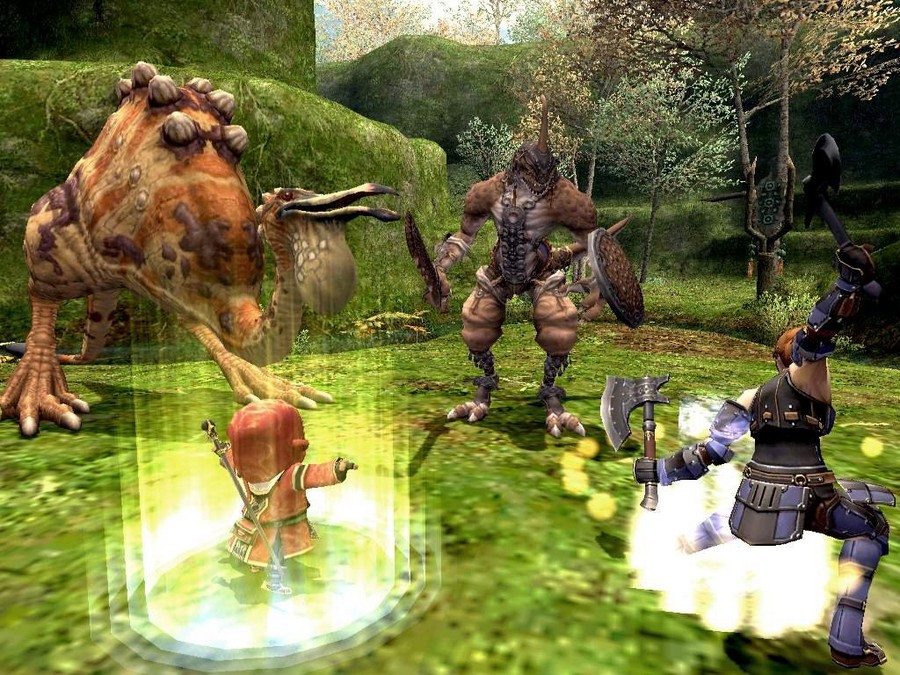
2003 was a long time ago, though. The Taru Taru are still cute, but just about every other aspect of the game feels dated in comparison to modern online games. Questing is extraordinarily awkward; There are lots of quests to do but almost no way to know how to find them. Hint books or the internet are really the only way you'll know that the surly gang of school kids behind the fish warehouse in Windhurst is a consistent source of fun missions. Graphically, the game looks serviceable but out of place on the Xbox 360. On a hi-def screen the jaggies ignorable on the PC or PS2 try to reach out and remove your optic nerves. The job system (allowing you to try all the classes with one character) is still one of the finest examples of balance and utility in the genre ... but raising levels on those classes will drive you to distraction. Leveling is an unrelenting, punishing grind. The first ten levels are basically required soloing, but beyond that you'd better be grouped or you're going to be enjoying the 'feature' of xp loss on death. My favorite moment is when you die just after having gained a level. You lose xp so, of course, you lose your level. That's some class A fun.
The 360 version collects up all three expansions to the game (Rise of the Zilart, Chains of Promathia, and Treasures of Aht Urhgan) along with the original gameworld, to allow the 360 experience to be a 'complete' one. Unfortunately, unless you've already been playing this title on the PC or PS2, much of that content will be weeks or months away from your level 1 character. The most recent expansion, Aht Urghan, has been getting very positive commentary from those who can play it, but the expansion's inclusion into this bundle is of limited interest to the new player.
Me personally, I like Final Fantasy XI a lot. After the minty-clean ease of WoW or EQII, the brittle hardcore crunch of FFXI is a really nice change of pace. That said, I don't really understand this title's release for the 360. In essence, this game was only released on the console so that Microsoft could check off a box for the MMOG genre in its launch window library. With new and innovative Massive offerings still quite a ways off (such as Huxley), FFXI provides a stopgap marketing measure for Microsoft, and once again proves Square/Enix's skill with hardware integration. Definitely not for the MMOG newcomer, and probably already a notch in the belt for the experienced, I'm just not sure who this bundle is for.
- Title: Guild Wars: Factions
- Developer: ArenaNet
- Publisher: NCSoft
- System:PC

The two new classes brings the total up to eight, and fit seamlessly into the world of Ascalon for both PVE and PVP play. The Assassin is a direct damage character, carrying a lot of similarities to the Warrior class. An Assassin character has to get very up close and personal to do maximum damage, though, not having some of the skill with ranged weapons other classes do. The class also breaks ground with 'combo' moves. The mix-and-match actions that any character can slot are always fun to combine in interesting ways, but the Assassin relies on stringing together specific moves for increasing damage. The other new class, the Ritualist, is a support class that features a good deal of group buffing and debuffing. I found the Ritualist's laid back style of play kind of awkward in PVE, but it was a lot of fun in PVP matches. As long as you're in the main pack of your team, you're doing some good. A simple strategy even an inexperienced player like me could follow.
The new questing continent, the region known as Cantha, will keep the PVE players happy for a very long time. It's simply gorgeous, and artistically very different from many of the initial Prophecies zones. For example, the summer green that the lower-level original zone uses gives way to an autumnal orange and gold in Eastern-themed Cantha. There are over two dozen core quest missions, and enough side-quests to keep even the most dedicated PVE character busy for some time. For me, the most enjoyable element of these environs is the smaller zones, some of which go far beyond the traditional fantasy tropes we've come to expect. A beach-front area dominated by villages built on giant tortoises, and an ancient city built into a massive gorge, are just two of the nonstandard zones you'll travel through in Cantha. The Guild Wars designers went about as far as they could from the look and tone of the original Prophesies zones, and the Eastern sensibility and flair is like a breath of fresh air.
PVP is the gameplay that most people come looking for when they sit down to a session of Guild Wars, and Factions provides for these players as well. Besides the same gameplay seen in Prophecies, travelers to Cantha have the opportunity to align with two warring groups seeking to control the newly found lands. In PVP battles, guilds can struggle back and forth across a highly militarized zone. The more PVP victories a faction has, based on the guilds associated with it, the more land it can claim to control. The most interesting thing is that individual guilds can then lay claim to some of these lands, based on the amount of favour they've curried with their patron faction. This favour is earned not by PVP, but by PVE questing. The most successful guilds under Factions, then, are mixed bags. PVE questers garner favour with the ruling faction, while PVP gladiators ensure that their faction has control of a large swath of land. It forces players that normally would not associate to come together in a common goal, and is a right brilliant idea.
As has been the case since its launch, the heights of this game are not for the hardcore. At this week's E3 ArenaNet has flown some of the most dedicated guilds out to compete live on the show floor. These players spend hundreds of hours each month honing their skills in the arena, and if you want to compete at that level you're going to have to sacrifice. For those of us with less ambitious goals, Factions is a lot of added flavour for a great casual game. You can pop in, play for 30 minutes with NPC allies, and pop out having had a lot of fun. It still has the same drawbacks as the original; Communication elements are a little rough, and if you find yourself questing with other people you're likely to find yourself frustrated sooner rather than later. That said, if you enjoy the Prophecies portion of Guild Wars ArenaNet's additions to the game are going to make you reconnect with your very first humiliating loss and that sweet, sweet first victory all over again.
I played FFXI the other day. For $30, I got the game and a 30 day trial for me, and another free trial for a friend. I uploaded the game to him (He's in Norway) and we eached played for a while. I cancelled after about 2 weeks. I think he cancelled closer to the end of the month.
It was total grind-ville. There was nothing to do but grind. Want to hunt? Grind. Want to make potions? Grind. Want to fish... Okay, you could fish a bit without grinding much. But only a bit. And only after you earn enough money for a fishing pole and bait.
I spent the first 2 hours walking. Not looking and talking to people. Walking. I was looking for a way out of town so I could hunt. Once I finally found it, I killed a couple things, got hurt and wandered back through town to rest and get healed. I eventually stopped a passerby in the field and asked if there was another way (no mention in the manual) and she said it was a certain button on the gamepad. (I was on PC, she PS2.) I thanked her and started the button hunt again. It turns out, after you hit the button there's a pointless 2-3 second delay, and then the animation begins. Grinding went a little quicker after that, but was always still grinding. (Kill, kill, rest, repeat.)
As for GW: Factions... I played the PvE of the original Guild Wars for 260+ hours before I finally got bored. For a person who thinks 40 hours games are long these days, that's pretty impressive.
Now, I have a full time job and don't have the time I used to dedicate to gaming, but it's excessively hard to find the time needed to sit down and do a mission on GW Factions now. I need to dedicate at LEAST an hour, probably 2-3 because there are so many noobs that think Assassins are cool and they can play them like a warrior. The usual solution is to just reject any group that has an Assassin in it. Since most groups are doing this anyhow, good groups aren't as rare as they could be. It still takes time, though, to find any group at all.
The first mission you get if you sail your character to Cantha requires that not only you find a group, but that you get lucky and another group from another area isn't totally stupid, too. You each have to keep a single character alive through many swarms of mutants. It's not hard, but you HAVE to heal your NPC. It's a small nightmare. (I won't even mention that that quest glitches quite often and the NPCs stop moving, and you can't go on. Ooops, I did anyhow, didn't I?)
Once you get past that mission, things liven up quickly, but it's a real downer at first. I've only managed to put 10-15 hours into it so far, so there's still a chance to have the kind of fun I had in the original. We'll see.
"If you make people think they're thinking, they'll love you; But if you really make them think, they'll hate you." - DM
I would like to point out that within the Guild Wars fanbase, Factions has been met with a great deal of outright anger over a number of problems:
1. Compared to the original Guild Wars, despite costing the same, you get SIGNIFICANTLY less content. When you buy one of the chapters, you get 4 character slots. When you add on another chapter, you only get 2 more slots (e.g. - you double your cost, but you only get 50% more character space). The map is also much smaller.
2. The problem with character slots above means that your storage is limited. The original GW had an abundance of items, so storage was already problematic. The fact that if you combine chapters you get a diminishing return on character space compounds the existing storage problem a great deal. ArenaNet has claimed many times now that a fix is in progress for this.
3. Many people have complained about the "delivery boy" syndrome Factions suffers from. many of the quests, especially early on, require that you run messages or items from one person to another. Because there is now no way to explore on your own (see #4 and #5), this often means literally having to slog through dull, repetitious fights to do the quest.
4. In the first chapter, many people enjoyed exploring on their own and opened up areas by simply running around the map. In Factions, this is not possible as they have locked gates placed around Cantha that only open at the completion of missions (only six missions were actually necessary in Prophecies to complete the game).
5. Monsters were not very challenging and were easy to avoid in some places in Prophecies. In an attempt to solve this, many patrols were overlapped in Cantha and given a very wide range of movement. Unfortunately, this means that it's not uncommon to submit to a very large and growing group of enemies because other patrols came into range from far off while you were battling another group.
And, of course, the main problem:
6. GRIND.
In Prophecies, many people chose to grind for gold and items, but it was not required. In Factions, because of Alliances, the only way to get to many of the missions is:
a) To join a large guild - a daunting task as groups of trusted players solidify - so you can be part of a large alliance
b) Grind out "faction" points for your chosen side in the Canthan war to contribute to your Alliance so that you can retain control over towns - the only way you can play certain high level areas ("Elite" missions) is if you are part of the Alliance holding the related town, which requires these Faction points.
I would say Factions is an enormous disappoint. At guildwarsguru.com/forum you can find many, many people who agree.
Fine, so it's your pet peeve that GW doesn't comply with your definition, but you are actually entirely wrong in your assessment. What you really mean is that for you, a "MMOG" is the traditional kind of MMOG with all its traditional problems, as in EverQuest.
Well let me tell you something: the world changes, and the EverQuest idea of how you define a MMOG does not fix it in stone for eternity.
ArenaNet designers found a way to preserve all the good things in the genre (most importantly the gameplay), and throw out all the bad things, like camping, kill stealing, training, harrassment, downtime, level grinding, and mindless repetition.
They did so by instancing, but that's no different to what many other MMOGs have done with instanced dungeons. The big difference with GW is that they did it with outdoor zones, and the result is 100% absolute magic. They succeeded beyond their wildest dreams in removing the bad and promoting the good.
You are hung up on the bad things, and think that by not being able to have 50 mobs trained on you by a passing idiot, then somehow it's not a MMOG. Wake up. You're simply not thinking straight. None of the shared world "benefits" you claim are real, they're just a right pain in the butt, and I speak as someone who took two of the largest traditional MMOGs to their end games on several characters.
Guild Wars has got it very very right, and boy, not only is it a full-blown Massively Multiplayer Online Game (it's truly Massive, because it doesn't split people off onto different named servers), it's also one of the very best.
"The question of whether machines can think is no more interesting than [] whether submarines can swim" - Dijkstra