 Slashdot Mirror
1-Click Rejection Rejected
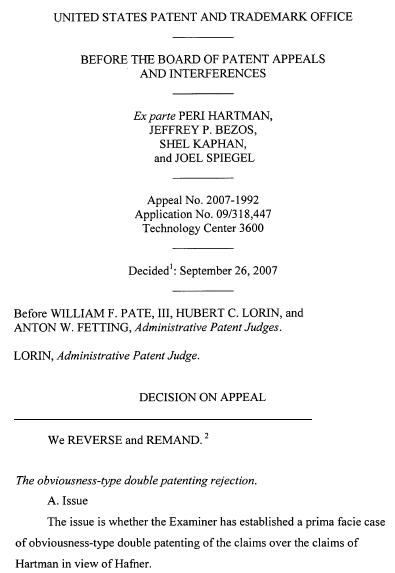
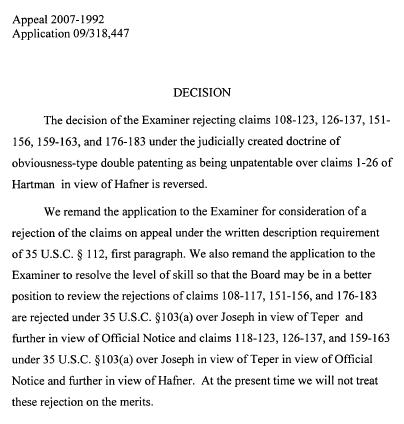
theodp writes "On Wednesday, a three-judge USPTO panel convened at Amazon's request rejected a USPTO Examiner's rejection of Amazon CEO Jeff Bezos's 1-Click patent, ruling that it wasn't obvious to them what the Examiner found obvious. The application has been remanded to the Examiner with instructions to make the obviousness more obvious."
But it would have been really helpful to have a story on the original decision linked, such as to the Slashdot post, or, perhaps, even a direct link to the original rejection?
The cesspool just got a check and balance.
Non-obviousness is a legal requirement for a patent. The Examiner is required to make his determination based on a reasoned finding of fact and conclusions of law. If the Examiner failed to make his reasoning clear that the legal requirement of non-obviousness has not been met, then his determination is legally deficient. This doesn't mean that the Board doesn't see the obviousness; it means at the minimum that the Examiner did not adequately do his job in defending his determination in writing as required.
(My emphasis added above.)
One thing I've learned in lengthy 'discussions' (... and by 'discussions', I really mean 'arguments') with a group of law grads is that legal definitions of words are a very limited subset of the real world definition. Many words mean exactly one specific thing. No matter how much nuance or implication you can attach to a word in the English language, these things do not apply in Legal English. I can't tell you how many times I simply sat there, agape, as these people were explaining to me that simple words do not have the same meanings that I have attributed to them for my entire life.
The trick is, these magic keywords are sprinkled throughout the text without any indication... so unless you know beforehand that the word "obvious" doesn't really mean "obvious", but rather "something which would be put together in exactly the same way by someone of average skill in the art with the same components at their disposal." (Note: That definition is from memory, rather than a factually accurate quote. It may be off but I cba to look it up.)
Not necessarily any old web developer, given a database of user information, would create a 1-click purchase system (thankfully!) and therefore it's arguably not obvious, in Legal English. Whether or not you agree, that's the logic. It may be internalized, bizarro-world, insane troll logic with little to no bearing on the real world but there is some sort of consistency to it, however twisted.