 Slashdot Mirror
1-Click Rejection Rejected
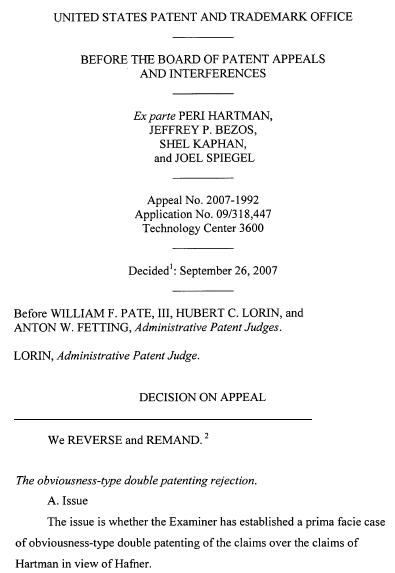
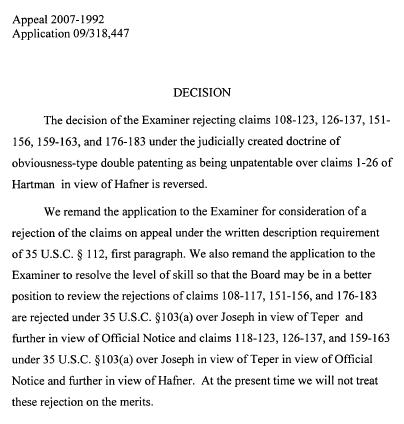
theodp writes "On Wednesday, a three-judge USPTO panel convened at Amazon's request rejected a USPTO Examiner's rejection of Amazon CEO Jeff Bezos's 1-Click patent, ruling that it wasn't obvious to them what the Examiner found obvious. The application has been remanded to the Examiner with instructions to make the obviousness more obvious."
And as far as I've heard it's a crap 'invention' anyway, one wrong click and you just spent money on something you didn't really want. I'd rather review my account data and address every time.
molmod.com - computing tips from a molecular modeling
But, but... It's so OBVIOUS!
The problem with the whole area of tech patents evaluated by non-techie people is the classic teacher's dilemma: for those who understand, no explanation is necessary, while for those who do not understand, no explanation is possible.
Almost by definition, something is obvious if it is apparent without further explanation. However, like the many tests of "reasonableness" in law, obviousness is in the eye of the beholder and depends on context. Defining an accurate, repeatable, qualitative test that determines whether something is or is not obvious in general is impossible.
However, one realistic and credible test is whether other people in the field in question could sensibly be expected to "invent" the same thing in the same circumstances without much thought. I would argue that claiming a typical web developer wouldn't think of the idea to have a single click in a specific place perform an action is pretty insulting to the intelligence of web developers, not least because hyperlinks have been following this principle since before Amazon was a twinkle in Jeff Bezos's eye. Similarly, the idea of remembering user data to minimise repetitive data entry has been around in database world since many years before the web existed. This is drifting into prior art rather than obviousness, perhaps, but I suspect that's the best way to attack this particular lunacy. After all, you can't credibly argue that other people wouldn't think of the same thing in the same circumstances if many of them already did.
If you disagree, post your argument. (-1, Overrated) isn't your personal censorship tool for views you don't like.