 Slashdot Mirror
Very High Tech - Elevator Garages in an NYC Hi-Rise
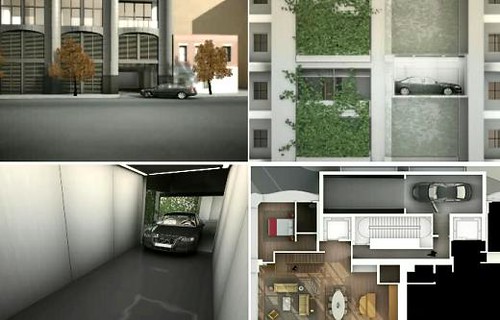
theodp writes "If the hassle of getting groceries from the parking garage to your 12th floor condo has been holding you back from buying a deluxe apartment in the sky, wait no more. Wired reports on the En-Suite Sky Garages at 200 Eleventh Avenue (Flash) in Chelsea, where an 8,000-pound-capacity freight elevator will whisk your Bentley directly into your pad. The convenience doesn't come cheap — a garage-equipped 2BR starts at $4.7M."
New York parking prices are insane and with all the traffic, it's cheaper and faster to bicycle through the freezing snow and angry muggers. Maybe that will eventually make it a "green" city.
Anti-Globalism
This was described fully in Heinlein's "I will Fear No Evil". While the book wasn't exactly great Heinlein, it does describe apartment buildings with elevators for your cars. They are needed because in that worldview, crime was so rampant that your car was an upolstered tank, and your home was a fortress. Happily, that particularly dark vision has yet to come. However, it was written in the years of "burn, baby, burn" and very high crime, so it is certainly fodder for speculative fiction.
Joseph Bacanskas [|] --- I use Smalltalk. My amp goes to eleven.
I used to live on the 23rd floor of a high-rise in Chicago. Groceries were never a problem. The 1st floor of the building was a grocery store and they delivered with purchases of $20 or more (excluding alcohol and cigarettes). Likewise all the local grocery stores would deliver to your apartment free of charge with a minimum purchase. You could phone or fax your grocery order in and pay for it on delivery (even pay with a check) or you could go down and select your items, pay for them, and one of the box boys would lug the stuff up for you.
It would've been possible for a hermit to never leave the building. The local laundry picked up and delivered for free. The drug store would deliver prescriptions for free. And we had a full gym with half-Olympic pool on the 5th floor. There was even a dog-walk service available for a small fee. That's how things work in inner cities.
Re modding up -- that's sadly true; they already have. :)
GP beat me to it. But just to put things in perspective, the energy required to lift your 1000 kg car once is roughly equivalent to leaving a 100 W light bulb lit for 81 mins. Surprisingly modest, actually.
Cheers, Rudi
licet differant, aequabitur
Very funny, but I suspect this thing is going to be controlled with a keycard coded to your aparment. Insert keycard, you and your car go to the parking, you leave car, open door and you're in your hallway. So, no button-pushing pranksters, I fear.
Ahhh...the great dumpster continuum. Many a free computer will be found there. -- sowth (748135)
This has already been done in Germany, and the whole building revolves around the concept of the garage: http://www.carloft.de/
Raising and lowering all those cars probably would consume a lot of energy. While the address uses Con Edison, one of the most expensive utilities in the country.
However, if the elevators used regenerative braking, they wouldn't consume much energy at all. Lowering the cars could charge a battery that raises the next car. Such efficient tech could be applied to all NYC's many elevators, even at lower loads per trip, if it became cheap, reliable and maintainable. Overall the energy saved could be very large.
In the meantime, Americans will proceed to evolve to a point where we never leave our cars. We'll need the wheels just to drive around the batteries for all our mobile devices. Especially as we'll need to stay inside a generated mediasphere all the time, rather than face the ugly reality of a world we've twisted around that growing consumer lifestyle. We'll probably average a kilowatt or two consumption, undocking our personal carts from our larger cars to redock into our office cubicles.
--
make install -not war
I previously lived in a small hick town http://www.meridianstar.com/ that had a similar 'elevator garage'. The numbskulls in charge of city spending were sold (or bought) on the idea that three parking garages with elevator only access (for cars) was a way to eliminate parking problems downtown. Now, imagine Aunt Bee with half the soccer team going for pizza. They arrive in their typical deep south suburban, hand the car jockey the keys and walk three blocks for pizza. After filling themselves and sludging three blocks back IN THE RAIN, they find there is a line (queue) of folks waiting on THEIR suburban. Now, the estimated time of top to bottom service (oh hush) of the elevator was 6 minutes, including putting a vehicle on at either end. That means there is at the very least a 6 minute, or 12 minute wait depending on where the elevator is, and your position in line for your car. Oh, and if you forgot something (ever done that) and want to retrieve it before departing the 'garage', you STILL have to wait all that time again. Needless to say the garages were abandoned (paid for mind you) for about 15 years. Someone decided they could be retrofitted (enclosed) to store medical records and now they are gov't white elephants again. Just with the added expense of the retrofit. Note, there is no reference to the old parking garages found in their articles search. Odd, isn't it ?
Actually, it's probably a good idea to try and improve building efficiencies as much as possible. Parking on a residential floor is a costly use of square footage. In addition to a large lift you have to provide several hundred square feet for each parking spot. That could easily add up to the same square footage as several units. Which means in financial terms you aren't realizing potential revenue and in terms of efficient use of the building footprint you're not providing the same number of units for people to live in. Considering the costs and potential pollution that goes into constructing a building, not using the footprint efficiently is a decidedly "un-green" thing to do. There's a real reason why urban buildings are very different from suburban ones.
I would imagine that a more likely driving factor in this case was the site's adjacency to the water. I don't work in NYC so I don't know the geotechnical specifics of Manhatten, but if it's silty soil you're going to have a lot of water penetration which means pumps running 24/7 and limitations on how deep you can go. I would imagine the developer simply saw this issue as a justification for doing something as exorbitant and unique as having people park on their floor. More of a marketing gimmick that anything else. A green building has bike storage, public lockers and showers, and is normally situated to make using public transportation easy and practical.