 Slashdot Mirror
Phantom Hourglass Review
Of all the titles in the Legend of Zelda series, some of the most-respected have been for handheld consoles. Link's Awakening, the Oracle duo, and Minish Cap all manage to combine on-the-road gaming with a certain purity of Zelda-ness. Link's most recent adventure on the small screen, Phantom Hourglass, generally continues this tradition and introduces a number of new elements to the property. Unique controls, a true sequel, and cel-shaded graphics all make Hourglass stand out from 'traditional' Zelda games, and together the whole hangs together fairly well. Read on for my impressions of this pint-sized return to Hyrule.
On that gameplay front, Phantom Hourglass offers up more new elements than in any other recent Zelda title. Twilight Princess had Link swinging his sword with the Wiimote, but fundamentally the game played like pretty much every game since Ocarina. Phantom Hourglass makes full use of the DS's touch elements and microphone to produce a completely new play experience. Moving Link, attacking, throwing the boomerang, all are done with the stylus, and these elements were all polished to varying levels of success. Simple movement is effortless, and is an easy mental switchover from the D-pad. There are some moves done with the stylus that take some getting used to (like a circle at the edge of the screen for a tuck-and-roll), and those I found to be sometimes a bit clumsier. Actual combat is as easy as poking your enemy with the stylus, and those simple attacks also feel very 'right'. Some more advanced combat moves will require practice to get regularly, and some never quite felt spot-on to me. The best element of the touch controls is the 'drawing' gameplay, used for items like the boomerang and in navigating Linebeck's ship. The boomerang control feels like this is something that should have been in Zelda games from the very beginning, and it never got old using that simple 'low-level' item.
Beyond the controls, a lot of the gameplay additions were hit or miss. The phantom hourglass itself adds a time-based puzzle to the Temple of the Ocean King maps, requiring you to complete a series of puzzles in a specific amount of time. Given the handheld nature of the game I felt that worked really well. In fact, the handheld basis of the game was well respected throughout. Puzzles never required more than a minute or two of mulling to figure out, you can save whenever you want, and in most cases an entire island only required about 15-20 minutes of your time to complete. Sailing, on the other hand, was just as tedious as it was in Wind Waker. The designers took some deliberate steps to make the experience less onerous than in Hourglass's predecessor, but it still felt like far too much time was spent wandering the ocean or fighting off pirate attacks. Boss battles on the whole were fairly strong, often using DS touch elements in interesting ways. A few, like the requisite fight with Dodongo, felt like they made things different just for the sake of being different. The Gleeok battle, on the other hand, was a great use of the DS's charms to turn old hat into new fun.
Visually Phantom Hourglass holds up the standard of Wind Waker very well, which is highly impressive given that the latter is a GameCube title. I've always personally liked the cel-shaded style used in these games, but folks who found the style's use in the original game offputting won't find any comfort here. In fact, Hourglass goes a step further with the 'semi-cartoony' elements, giving Link some goofy expressions and over-the-top takes over the course of the game. If you go in expecting cartoon instead of Twilight Princess, none of these gags should be too annoying. Probably the only 'classic' element of the game is its auditory presentation. Sound FX are taken right out of Wind Waker, and the musical compositions are surprisingly sophisticated for a handheld game. I particularly liked the composition of the Zelda theme used for the title screen, a stirring combination with Wind Waker music elements set against an ocean scene.
It's strange saying that a Zelda title is 'merely competent', since I've over-the-top enjoyed most of the other entries in the venerable series. Link to the Past is still one of my favorite games, and so in some ways I feel like every new attempt to rescue the princess is held up to that gold standard. Here, sailing around islands that were once the mountaintops of Hyrule, I feel like the gameplay too was a bit flooded. Nintendo tried to cram a lot of new elements into one experience, and ended up with some that were spot-on, and some that weren't. I'm not even sure if the weaker components could have used more time; in this game, some things just felt out of place. Overall, though, it's hard to fault them for trying something so deliberately new. Phantom Hourglass is a fun handheld title, with a focus on quickly-resolving puzzle and action elements perfect for its format. It's well worth a look for anyone who has yet to tire of another try at the Triforce.
- Title:Legend of Zelda: Phantom Hourglass
- Developer/Publisher: Nintendo
- System: DS
- Genre: Top-Down Adventure Game
- Score: 3/5: This game will appeal to genre fans. Not the strongest entry in the series, but worth your time.
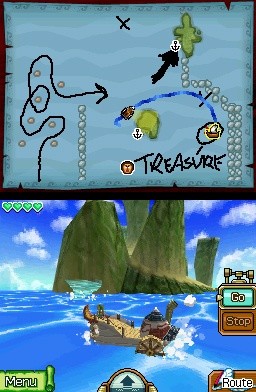
On that gameplay front, Phantom Hourglass offers up more new elements than in any other recent Zelda title. Twilight Princess had Link swinging his sword with the Wiimote, but fundamentally the game played like pretty much every game since Ocarina. Phantom Hourglass makes full use of the DS's touch elements and microphone to produce a completely new play experience. Moving Link, attacking, throwing the boomerang, all are done with the stylus, and these elements were all polished to varying levels of success. Simple movement is effortless, and is an easy mental switchover from the D-pad. There are some moves done with the stylus that take some getting used to (like a circle at the edge of the screen for a tuck-and-roll), and those I found to be sometimes a bit clumsier. Actual combat is as easy as poking your enemy with the stylus, and those simple attacks also feel very 'right'. Some more advanced combat moves will require practice to get regularly, and some never quite felt spot-on to me. The best element of the touch controls is the 'drawing' gameplay, used for items like the boomerang and in navigating Linebeck's ship. The boomerang control feels like this is something that should have been in Zelda games from the very beginning, and it never got old using that simple 'low-level' item.
Beyond the controls, a lot of the gameplay additions were hit or miss. The phantom hourglass itself adds a time-based puzzle to the Temple of the Ocean King maps, requiring you to complete a series of puzzles in a specific amount of time. Given the handheld nature of the game I felt that worked really well. In fact, the handheld basis of the game was well respected throughout. Puzzles never required more than a minute or two of mulling to figure out, you can save whenever you want, and in most cases an entire island only required about 15-20 minutes of your time to complete. Sailing, on the other hand, was just as tedious as it was in Wind Waker. The designers took some deliberate steps to make the experience less onerous than in Hourglass's predecessor, but it still felt like far too much time was spent wandering the ocean or fighting off pirate attacks. Boss battles on the whole were fairly strong, often using DS touch elements in interesting ways. A few, like the requisite fight with Dodongo, felt like they made things different just for the sake of being different. The Gleeok battle, on the other hand, was a great use of the DS's charms to turn old hat into new fun.

Visually Phantom Hourglass holds up the standard of Wind Waker very well, which is highly impressive given that the latter is a GameCube title. I've always personally liked the cel-shaded style used in these games, but folks who found the style's use in the original game offputting won't find any comfort here. In fact, Hourglass goes a step further with the 'semi-cartoony' elements, giving Link some goofy expressions and over-the-top takes over the course of the game. If you go in expecting cartoon instead of Twilight Princess, none of these gags should be too annoying. Probably the only 'classic' element of the game is its auditory presentation. Sound FX are taken right out of Wind Waker, and the musical compositions are surprisingly sophisticated for a handheld game. I particularly liked the composition of the Zelda theme used for the title screen, a stirring combination with Wind Waker music elements set against an ocean scene.
It's strange saying that a Zelda title is 'merely competent', since I've over-the-top enjoyed most of the other entries in the venerable series. Link to the Past is still one of my favorite games, and so in some ways I feel like every new attempt to rescue the princess is held up to that gold standard. Here, sailing around islands that were once the mountaintops of Hyrule, I feel like the gameplay too was a bit flooded. Nintendo tried to cram a lot of new elements into one experience, and ended up with some that were spot-on, and some that weren't. I'm not even sure if the weaker components could have used more time; in this game, some things just felt out of place. Overall, though, it's hard to fault them for trying something so deliberately new. Phantom Hourglass is a fun handheld title, with a focus on quickly-resolving puzzle and action elements perfect for its format. It's well worth a look for anyone who has yet to tire of another try at the Triforce.
I recently finished the game and wrote my review on Sunday, giving it an 8 out of 10. I felt like that the new stylus driven gameplay aspects were great and really added to the series, but the game focused way too much on repetitiveness. You literally run through the same dungeon something like 5 or 6 times throughout the course of the game, and the dungeon is just kind of obnoxious. Plus the whole "phantom hourglass" only matters in that one particular dungeon, basically negating what could have been a cool concept or object nearly completely.
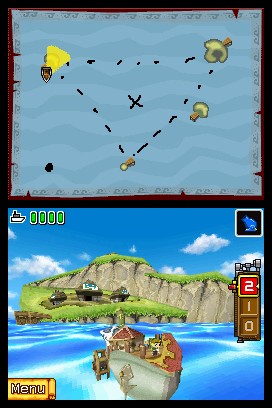
I didn't think the sailing was as bad in this game as in Wind Waker (which I still enjoyed in that game too). You would draw on a map point A to point B, and your ship would go there for you. The only annoying part was having to fight enemies on the way with your cannon (very basic bad guys - cannon fodder if you excuse me) on the way, sometimes it's just nice to sit back and check out the scenery as you sail. There were also six warp points that allowed you to get to point B very quickly, basically eliminating any long and tedious journeys.
I also thought the exploration was fun, and appreciated "uncharted islands" and such, really kind of felt like I was setting out on the new ground. There was an island shaped like a Nintendo DS though, and that breaking of the fourth wall was really out of place.
Anyways, my review is here if you're interested, just a little side site I run to more or less keep track of what games I beat.
Reviewing just the first hour of video games.
This is the first game in which I have experienced some serious calibration issues with my DS touch screen. (The proper "click on red squares" calibration is totally shot on my DS...) The item select, the map drawing, etc. It is driving me friggin nuts!
I admit the control scheme is (when working properly) quite well-conceived and makes me happy. The boomerang and bow+arrow especially are fun, as is the boat cannon.
The game is great, although whoever came up with the idea of repeating that one Temple over and over (even with some shortcuts thrown in) is a total prick.
I like basketball!!1!
"Phantom Hourglass is a first for Nintendo in a few ways. Story-wise, it's the first time a Zelda game has directly referenced elements from a previous title.
Actually, it's not the first sequel. The second Zelda game was the first sequel:
"The Adventure of Link is a direct sequel to the original The Legend of Zelda" Wikipedia
Actually, there were several Zelda games that were either direct sequels or directly referenced earlier entries in the series. Link's Awakening is almost certainly a direct sequel to A Link to the Past, Majora's Mask IS a direct sequel to Ocarina of Time, and talks about it quite a bit, and Wind Waker makes a lot of semi-obscure references to Ocarina of Time...
-Moses
Just wondering, when did game reviews start popping up on slashdot?
Anyway, I recently beat the game so I'll add my 2 cents.
Its a very good game. The first time I put it in my DS I could not put it down and managed to kill 6 hours in a single sitting. The graphics were very good, the characters are nice and developed, and its got a great story to it.
There are of course some drawbacks. First, an option to use classic controls would have helped at some point, as its somewhat hard to control link in close quarters combat using just the stylus. It also would have helped if the L an R buttons could have controlled different items, like how in almost all zeldas since ocarina you cna have multiple gadgets equipped on different buttons somehow.
Second, the audio wasnt as detailed and thoughtful as in past zelda games. The same short tune plays in each dungeon, and its not even a really suspenseful tune. I finally got around to playing Twilight Princess a few weeks ago, and every dungeon in that game had a different, deeply immersive tune that added to the feeling of the game. Heck, even the first portable zelda: links awakening had unique tunes for the dungeons.
Third, and this has been mentioned before, you have to repeat the same dungeon like 6 times in the game, and only after the 3rd or 4th time through does a portal open up to take you back to that point the next time you enter. It wouldn't have been nearly as repetitive if each time through you unlocked one of these portals.
Now, this game did offer a lot of positives. Being able to draw routes for your weapons was absolutely brilliant. This is the only zelda game in which I actually enjoyed bombchus and regularly used them. Being able to tell your boomerang exactly where to go was great as well, and helped in many places. Being able to draw notes on the map was a great addition as well, and I hope they add that feature to the next Zelda on the Wii. Sailing was also much less of a chore in this game than wind waker, and the warp methods were actually useful, even tho I didnt manage to get all of them before I beat the game.
Humerously, when I started the game I actually had the same feelings as a recent VG Cats comic and literally said out loud "Oh no, not navi!" But the fairy in this game isnt that bad, and actually ads a decent amount to the game in the later stages, especially if you pay attention to one of the side quests.
Anyway, I think its an extremely well put together game, and a must-have for any zelda fan or DS owner. There were some shortcomings, but the freshness more than makes up for it. This anonymous coward gives it a solid 8.7 out of 10.
I think its the best DS game I have played so far. The game play is highly addictive and the story works great if you have been following the game for the last few installments then you will be right at home.
5 out of 5 stars
Apparently you didn't pay much attention to the plot while reviewing, eh?
Not to mention they use the same puzzle with the microphone multiple times. Ok, I blow into the ds, I get it, it's interesting, but not something I'm willing to do in a public place(and since we are talking about a portable, it will often be used in those places). Doing it once, ok, but requiring me to blow into the microphone multiple times to solve what is basically the same puzzle(lighting some lamps, blowing off dust on my map) is just dumb. And don't even get me started about having to shout.....
The game also breaks the 4th wall multiple times. When you are first starting the game I can understand why you might need to do so, but the game just keeps on breaking it and breaking it. The worst being when you had to close the DS to solve a puzzle. It just really takes you out of the game.
I think Nintendo broke a cardinal rule of alternative inputs here: If you use them, don't disable the more "traditional" inputs unless you have a good reason to do so. Phantom hourglass has yet to produce a good reason for why you cannot use the d-pad or hit alternative keys instead of blowing into the ds etc... Still an alright game, but pales in comparison to how much fun Minish Cap was.
Monstar L
I've become hooked on Battle Mode. I won't review it here, but will offer my experience with it. The game itself is a lot of fun. The biggest drawback, however is that users disconnect when they are losing. When a user disconnects, it seems that they suffer a slight point loss while the player who was winning gains nothing. It's a real shame. If it were not for that, the experience would be top notch. I've learned to throw the rankings out the window and just play the game. I simply chalk the disconnect up as a win for myself.
Another thing that is sometimes frustrating is lag. I've yet to be able to figure out if it's a flaw in the game or the result of cheating. But it seems that sometimes lag suspiciously begins to occur just when the Link player is in a tight situation. The Phantoms and Link both freeze up. The Phantom player cannot draw lines to guide the Phantoms. Link appears motionless, but when the lag ends, he has "teleported". I can't help but think that this lag is brought on intentionally by the Link player. Maybe they are sitting by their wireless router and unplugging it for a second. Who knows, it might just be an issue with the game.
In any case, if you can play with a non-cheater (friend codes, or luck of the draw) and there is no lag, you'll be in for a treat with this game. It's short enough to play "just one more" again and again. Buyer beware!
Snap your fingers in front of the microphone. One of the NPCs even tells you about that trick ;-)
Real Daleks don't climb stairs - they level the building.
Someone keeps deleting my save game and im running out of fingers to snap! I dont know if its worth it to begin snapping my toes =\