Slashdot Mirror


DoubleClick Goes MIA At FTC Chief's Old Law Firm

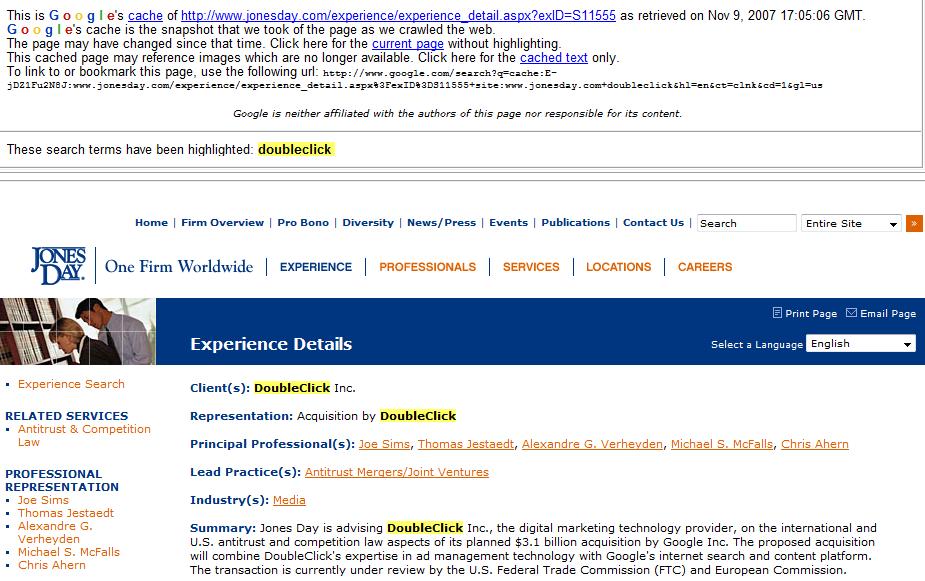
theodp writes "FTC Chairwoman Deborah Platt Majoras has refused to recuse herself from the agency's review of Google's $3.1B DoubleClick acquisition, despite her current and past ties to DoubleClick law firm Jones Day. EPIC and the Center for Digital Democracy, which had requested her recusal, are keeping up the pressure as DoubleClick-related pages and references have been disappearing from Jones Day's website. Although the statement issued by the Chairwoman suggests Jones Day's DoubleClick representation is limited to the European Commission, the Google cache of one MIA document boasts: 'Jones Day is advising DoubleClick Inc., the digital marketing technology provider, on the international and US antitrust and competition law aspects of its planned $3.1 billion acquisition by Google Inc.'"
12 of 39 comments (clear)

  1. Quite surprising by gravesb · · Score: 3, Interesting

    I'm surprised she's willing to take this kind of risk, and I'm very surprised that Jones Day is aiding her. Its just one client, and one matter before the FTC. Better that she recuse herself and be able to go back to Jones Day with no issues of impropriety than to play games and face some bar action. Most states have more liberal conflict guidelines for government employees, but sometimes arguing the letter of the law isn't worth the PR cost.

    --
    http://bgcommonsense.blogspot.com
    1. Re:Quite surprising by Jah-Wren+Ryel · · Score: 2, Insightful

      I'm surprised she's willing to take this kind of risk, and I'm very surprised that Jones Day is aiding her. Lawyers are this country's ruling class.
      Pride goeth before the fall.
      --
      When information is power, privacy is freedom.
    2. Re:Quite surprising by hey! · · Score: 4, Insightful

      Well, it smells fishy to me. In a nutshell, you are asking why anybody in this position wouldn't recuse themselves?

      If you were looking at a decision in whose outcome you didn't have a stake in, and there was any question of conflict of interest, it would be in your plain self-interest (as you point out) to recuse yourself.

      This leaves only two logically possible explanations: either (a) she's acting against her own self-interest or (b) she has a stake in the outcome. In some universes where government accountability still functions, she could be doing both. But at least one of these has to be true.

      In all fairness, we can't exclude the possibility that she is working against her own self-interest. Maybe the FTC simply can't come to a reasonable decision on anything like this without her unique and valuable participation. Maybe she's just really egotistical. Or maybe she's naive and is being used as a patsy. On the other hand, she was a partner at Jones Day, so presumably she's not naive.

      Of course, we might be missing a third possibility (c) : maybe she doesn't give a rats ass for what the law says if nobody is going to hold her to it. Given that she served under Gonzales at Justice after she left Jones Day, and her former colleagues there would be responsible for going after her, it seems plausible. Naturally this doesn't preclude a, b or both.

      --
      Post may contain irony: discontinue use if experiencing mood swings, nausea or elevated blood pressure.
    3. Re:Quite surprising by cfulmer · · Score: 2, Insightful

      Or (d) she has a job to do. When you're named to the FTC, it's because your expertise is valued. She should be involved in everything unless theres a strong enough reason not to.

      There are two general duties involved in a Lawyer's duty to avoid conflicts.

      The first is the duty of loyalty -- you generally can't be on "both sides" of a deal, because your duty to be loyal to one side will conflict with your duty to be loyal to the other. So, if one client wants to sue another, they both need to find another lawyer to do it.

      The second is the duty of confidentiality -- you can't put yourself in a position where you could use confidential information about a former client. If, when you defended a (now) former client, you found out all sorts of salacious details, you can't litigate against them.

      I don't think either of these are implicated here. She doesn't represent either DoubleClick or Google, nor has she. And, she doesn't have any knowledge about either, nor (apparently) does her husband.

      Besides, you can't realistically have a rule against marriages between lawyers who work for firms on opposite sides of a transaction. Among large firms in any given city, there's an enormous number of cross-marriages. That rule would put them all out of business, and then how would two companies merge?

    4. Re:Quite surprising by hey! · · Score: 2, Interesting

      Or (d) she has a job to do. When you're named to the FTC, it's because your expertise is valued. She should be involved in everything unless theres a strong enough reason not to.


      Agreed. However, you probably missed that we'd gotten past that point in the thread already, because we've already stipulated that she has the appearance of a conflict of interest -- and a strong one at that. Judges, after all, routinely recuse themselves in these situations. Surely they are chosen because their experience is considered valuable.

      Getting the job done is the whole reason that people who are trusted to be neutral, such as judges or commissioners, recuse themselves. Doing their job requires that their rulings and actions be beyond any reasonably grounded question that they have an improper interest in the result. If any such question were not clearly resolved, the decision would be tainted, and surely gone over again. That's an expensive and disruptive way of not getting the job done. Recusing yourself is the right thing to do because valuable as your experience may be, it is almost never in practice irreplaceable.

      [discussion of common law duties snipped]

      Besides, you can't realistically have a rule against marriages between lawyers who work for firms on opposite sides of a transaction. Among large firms in any given city, there's an enormous number of cross-marriages. That rule would put them all out of business, and then how would two companies merge?


      I think you're a little bit off the trail here.

      You wouldn't prevent the lead lawyer for the defendant from arguing the case when he's married to a partner in the plaintiff's law firm. That's up to the defendant. If the lawyer doesn't reveal this tidbit to the defendant, that would be really, really bad on too many levels to name, starting with ethical violation and moving up through mistrial. But granted, you wouldn't prevent the defendant from going ahead with his lawyer, once he was duly informed. On the other hand, you'd sure expect the judge to recuse himself in that case, unless there was literally no other judge in town who could take the case. Especially if he himself were a former partner in that law firm.

      The case for regulatory officials is even greater, since it is extremely likely that official will apply to his former law firm after his term in office expires. It's not exactly forthright to pretend the problem here is that this person has prior inside knowledge of the deal. That isn't the question at all. The question is whether she has a conflict of interest.
      --
      Post may contain irony: discontinue use if experiencing mood swings, nausea or elevated blood pressure.
  2. Privacy by proudfoot · · Score: 3, Funny

    The privacy groups oppose the merger because, they said, it would give one company too much private information about consumers. These fears are unfounded. Google has made enough information available for everyone, and I don't think DoubleClick really has any information that can identify you personally.
    1. Re:Privacy by Janos421 · · Score: 2, Interesting

      Not so sure: so far Google defense about privacy was "If you don't like our method, you don't have to use our services".
      But if Googel acquire DoubleClick, you won't have choice, Google will gather information about you.

    2. Re:Privacy by iminplaya · · Score: 2, Funny

      But if Googel acquire DoubleClick, you won't have choice, Google will gather information about you.

      Even if
      127.0.0.1 ad.doubleclick.net ?

      --
      What?
  3. Re:Ethics? by AuMatar · · Score: 3, Funny

    Actually, I think that returns 404.

    --
    I still have more fans than freaks. WTF is wrong with you people?
  4. WTF? by Cctoide · · Score: 3, Funny

    I was going to read TFA but I went MIA, probably due to a PEBKAC. Will give a sitrep ASAP.

    --
    "Let's face it, it's a good story. Accuracy would kill it."
  5. Commissioner's Wife's DoubleClick Tie Vanishes by theodp · · Score: 5, Informative

    Also refusing to recuse himself from the DoubleClick acquisition review is FTC Commissioner William E. Kovacic, whose wife - Kathryn M. Fenton - is a partner at Jones Day. Fenton is listed as a contact on the web page touting Jones Day's experience with Media clients, which was recently modified to eliminate DoubleClick.

  6. Lawyers BREEDING!!!??? by whitehatlurker · · Score: 2, Funny

    Besides, you can't realistically have a rule against marriages between lawyers

    Really! Lawyers MARRYING!??? BREEDING??? In this day and age!

    WELL! There should be laws against this sort of thing!!

    --
    .. paranoid crackpot leftover from the days of Amiga.