 Slashdot Mirror
Amazon Patents Customized 404 Pages
theodp writes "Among the patents awarded to Amazon CEO Jeff Bezos on Tuesday was one for his invention of Error Processing Methods for Providing Responsive Content to a User When a Page Load Error Occurs, which covers displaying alternate web pages in response to HTTP 404 page-not-found errors. So is this the technology that causes Amazon's Home Page to be displayed when Bezos' MIA Patent Reform Page can't be found?"
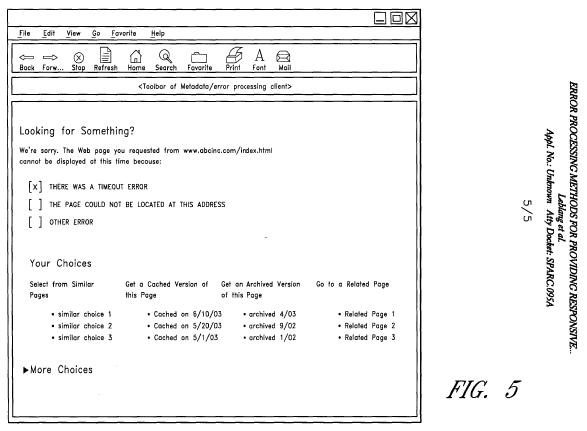
It's not a patent on 404 handlers. It's a patent on a client-side component that detects errors including, but not limited to 404s, then relays the error to an external server and receives an alternate URL or resource to serve the user. Blame the patent office for being idiots if you want, but this time *you* are the idiot.
Its not all the patent offices fault. They have to follow the rules, and those rules were not set up for the torrent of patents they receive these days.
If you get too many patent applications, the process of establishing if prior art exists also gets swamped. Thus without a special effort, patents which have prior art can still get granted.
I've skimmed the patent in question, and it sounds like a new thing to me. There may be bits and pieces that invalidate some of what it does, but since the USPTO allows patents for software products (which has always struck me as dumb), this is probably valid.
Much as I'm loath to hold it up as an example of anything ever, Internet Explorer has been using client-based action to generate a friendly "This page cannot be displayed" page in place of 404 errors for years and years.
Slashdot Burying Stories About Slashdot Media Owned
Which is exactly the situation with the 1-click patent. Cookies were invented to allow a site to recognise a returning user/customer, so patenting the act of using cookies to recognise a returning customer (and by "recognising" I mean linking them to an account) should never have been allowed a patent.
There is a VERY simple solution: don't buy anything off Amazon, and tell your friends not to too. I don't. If they want my money they can stop trying to prevent me from working.
TWW
"Encyclopedia" is to "Wikipedia" what "Library" is to "Some people at a bus stop"
The "client-side component" in question is (or can be) simply a part of the browser's built-in functionality. And don't tell me that using a redirect to a different server dedicated to dynamic 404s is bloody "innovative".
(And having a 404 handler that tries to figure out what the user is looking for [which is the other major component]? That has very, very much been done before).
IANAPA, but coincidentally in another window right now I am writing a patent disclosure application. I am lucky enough to work at an office that has a cadre of patent attorneys and just last week I had a discussion about a topic just like this Amazon patent (or I think it is).
In my case, I've "built" a system using nothing more than a set of other peoples building blocks. Each existing component is already extensively patented and/or in common use with TONS of prior art. The system I created performs a useful function that is also covered by prior art (in my case, it is a medical diagnostic tool).
The patent attorney told me that my idea was very likely patentable because it was a "novel" (new) implementation, even though the pieces exist and a (different) end product already exists.
... which is using a well known malware/phishing technique.
It is a client component (read adware/malware) that intercepts 404 messages, calls home to find out where to redirect the user, then redirects.
i.e. if you type in "slahdsot.org" it will search a database of misspellings and redirect you to "slashdot.org".
or.. in the case of malware.. if you type in "myinternetbank.com" it could redirect you to "myphishingsite.com".
I'd be surprised if there isn't prior art among the less ethical Internet inventions out there.
If you get too many patent applications, the process of establishing if prior art exists also gets swamped. Thus without a special effort, patents which have prior art can still get granted.
Um, easy solution, don't issue any patents until you're sure there's no prior art. If there are too many patents submitted, tough shit, no patents for anyone. That would motivate reform!
Give me Classic Slashdot or give me death!
Bezos has stated in the past that he is patenting software methods as a defensive measure. "We're not saying we have bad patents," Amazon.com spokesman Bill Curry said. "We feel very good about our patents... [Bezos] makes the point very emphatically in the letter that we cannot unilaterally disarm in a world where there are big ugly players who aren't disarming."
It's like road rage. When people are cutting you off and breaking all the rules, you have to tailgate and cut them off as a defensive measure (sometimes, at least). Nice guys finish last. The entire system is broken and the Patent Office really needs more legislative direction because it has strayed from its original mission.
I think software and business methods should not be patentable in the same way that physical inventions are. Also, I question the concept of selling patents. We end up with these litigious patent holding companies that have no technical abilities of their own, only a lot of lawyers.
A few years ago I looked into making and marketing a telephony device that would be an incremental but useful improvement over existing equipment, and discovered that so many methods related to telephony and voicemail are patented that practically speaking there was no way to make a device without infringing. "A method for playing back a telephoned message by pressing a button"--give me a freaking break. No wonder the U.S. has slipped behind in technical innovation, when much of the incentive for incremental product improvement has been removed by the threat of instant litigation. Thank goodness the Asians still believe in incremental improvement.
I'm OK with Amazon patenting stupid obvious things, as long as they don't enforce those patents, which I believe they have done very little of, and as long as Jeff Bezos continues to crusade for patent reform. Just my 2c!
it's = "it is"; its = possessive. E.g., it's flapping its wings.
People seem to forget that prior art is not the only criterion for exclusion even under the currently broken patent law.
Patents are supposed to be non-obvious to a person having ordinary skill in the art.
I've read through this patent. Yes, it sounds vaguely "new," as this type of error handling is usually done on the server or on a proxy. Yet it is simply a straightforward application of universally used programming concepts.
It's just describing a web browser (or browser plugin/script) that responds to web server errors by displaying alternate content. What is non-obvious about this? Nobody can seriously claim it's something that is "only obvious in retrospect." I can't even conceive of a programmer of ordinary skill to whom this patent's claims could appear non-obvious.
By permitting such patents, the patent office is violating its own legal criteria of acceptance. Regardless of whether the patented matter already has prior art, it is also required to be somewhat inventive (i.e., non-obvious).
Well, Amazon is making clients now. Is it possible that this is related to what Amazon is doing with Kindle?
...or it redirects you to MSN search for some ludicrous reason.
Every time I start to have faith in humanity, I ruin it by driving to work between 7 and 8 am.
If I read the patent right, this is a client-side error handler (Javascript, perhaps?) which, instead of just accepting a 404 error page, forwards the URL to a separate web server which determines another page to display somewhat like mod_speling, but I'd guess it could be more powerful (which I'd imagine would be useful with the URLs I've seen Amazon come up with). But then, who would be hand-typing an Amazon link anyway? Are they recording bad links within Amazon's pages so they can fix them?
It's certainly more powerful than simply customized error pages, but I'm not sure I see a point to it. Other than not letting someone like SCO or Raymond Nero get it.
All comments are properties and trademarks of the voices in my head. Not like I'm gonna claim them.