 Slashdot Mirror
Judge Rejects H-1B Visa Injunction
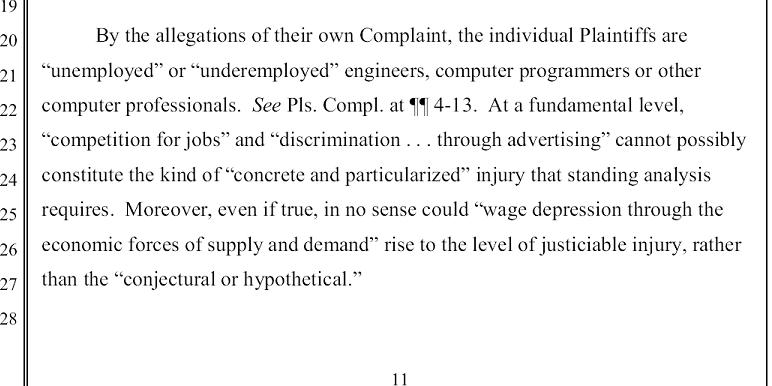
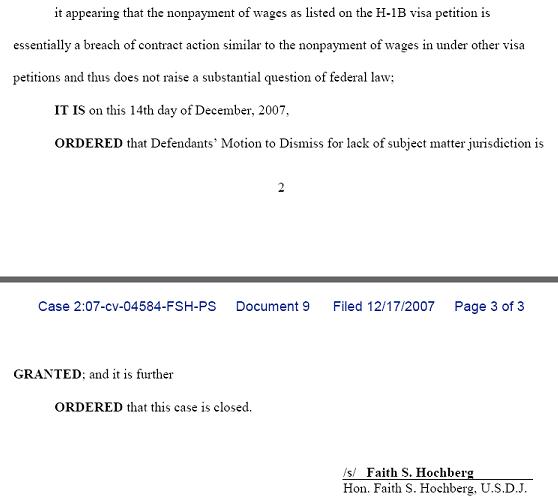
theodp writes "Judge Faith Hochberg has denied a preliminary injunction sought by the Programmers Guild to put a hold on a controversial 'emergency' rule change by the Department of Homeland Security to permit foreign students to work continuously in the US for two-and-a-half years after graduation without an H-1B visa. Hochberg indicated she failed to see how an increased labor supply could result in wage depression for engineers and computer workers. That seems disingenuous, since in Andaya v. Citizens Mortgage Corporation, Judge Hochberg recently saw first-hand how a US employer got away with paying an H-1B computer engineer as little as $15,000 to do a job with a 'prevailing wage rate' of $41,000. In that case, Hochberg ruled against Filipino H-1B visa holder Almira Andaya, arguing that 'nonpayment of wages as listed on the H-1B visa petition ... does not raise a substantial question of federal law.'"

Read the links. It was a year.
I prefer the "u" in honour as it seems to be missing these days.
As a H1B visa holder, let me just squash this myth right here: H1B visa holders can quit and change jobs at will. If you quit, you have 60 days to find a new job before you are asked to leave the country. Most people I know find a job first and then leave. And there are no binding contracts or such associated with the visa. And there's only minor paperwork involved when changing jobs. So yeah, your above-mentioned scenario is total hogwash.
But hey, don't let me and my facts get into your way of perpetuating anti-immigration propaganda.
In New Zealand they have a pretty reasonable solution solution; the minimum salary for a foreign worker on their equivalent of an H-1B visa is $55,000. Since your salary is usually a pretty direct measure of how scarce people with your abilities/training are and how much demand there is, anyone who is coming into the county to fill a shortage in a particular field should almost by definition be getting a relatively high salary.
Your post is almost 100% bullshit political conjecture about 'illegals,' corporate american, and employment. BTW, RN salaries here:
http://swz.salary.com/salarywizard/layouthtmls/swzl_compresult_national_HC07000001.html
Yeah, they make 60k, not 10-20k.
I'd mod parent down, but I'd rather explain why I disagree.
Good. Moderating a post down simply because you disagree with it is an abuse of the moderation system - you may notice that there are no "-1, Wrong" or "-1, I Disagree" options.
It's official. Most of you are morons.
I've worked with offshore programmers in both China and India. Time zones make it difficult, but the Indian company moved their working hours so there'd be more overlap. China had swing shifts going. Getting someone to talk to wasn't hard.
Understanding them was difficult. I found the Indians to have better English, both in terms of grammar AND accent.
Both produced working code and very, very good technical documentation.
--Mike
This is partly true. There are 3 stages in the Green Card process - PERM, I-140 and I-485 (a.k.a. Adjustment of Status). The day the PERM application is filed is called the priority date and roughly decides your place in the queue. Roughly because the USCIS frequently processes out of order.
After the I-485 has been filed and pending for over 180 days and the I-140 has been approved, the employee can switch jobs as long as it's in a similar position. It's also possible to recapture the priority date by having another employer file for PERM and I-140 if the old I-140 has been approved and not been revoked by the previous employer.
As long as you have an approved PERM and/or I-140 it's fairly easy to keep extending the H-1B indefinitely beyond the 6 year period till your I-485 gets approved. You can also choose to work on EAD instead of H-1B if the I-485 application is pending.
The biggest hiccup in the Green Card process is the per country limit of 7% of the quota which keeps applicants from large countries like India and China waiting in line indefinitely while applicants from most other countries get approved a lot sooner because they are not affected by the per country quotas.