 Slashdot Mirror
Hubble's Exoplanet Pics Outshined by Keck's
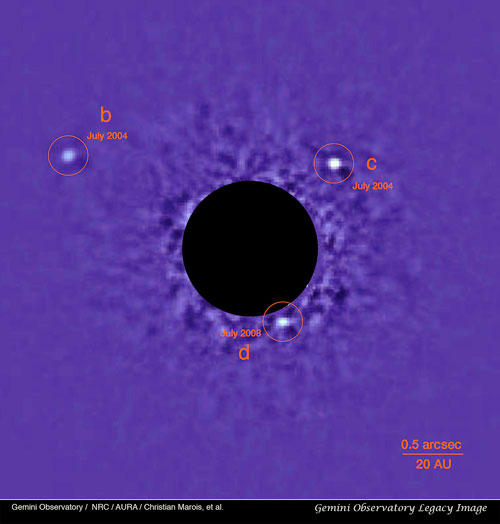
dtolman writes "Scientists at the Keck and Gemini telescopes stole the thunder of Hubble scientists announcing the first picture of an extrasolar world orbiting a star. Hubble scientists announced today that they were able to discover an extrasolar world for the first time by taking an actual image of the newly discovered exoplanet orbiting Fomalhaut — previous discoveries have always been made by detecting changes in the parent star's movement, or by watching the planet momentarily eclipse the star — not by detecting them in images. Hubble's time to shine was overshadowed though by the Keck and Gemini observatories announcing that they had taken pictures of not just one planet, but an entire alien solar system. The images show multiple planets orbiting the star HR 8799 — 3 have been imaged so far."
Hello,
I think the discovery was made by the team led by Paul Kalas:
http://astro.berkeley.edu/~kalas/index.html
Math is beautiful... e^(pi*i)+1=0
This came out after I posted the article... Hubble presents - Fomalhaut B! This graphic is particularly nice!
You have to see the orbital progression to get over the thought that it's just another speck of light noise. Here is a larger image showing the position of the planet from 2004 and 2006. Also, here is the url for the release showing the image of HR 8799 with its 3 planets.
Of course, this hasn't stopped both groups trying to spin up their results in a perfectly understandable fashion. The downside is that many online press stories are showing very signs of confusion as to what's what, not at all helped by the blizzard of parallel press releases from various institutions on the HR8799 3-planet system result.
Indeed, the Gemini Observatory release shows images taken with their telescope showing just two of the planets, presumably because they don't want to cede any ground to the Keck, their rivals on Mauna Kea, where the third planet was found. Again, potentially very confusing indeed to the public.
As for the complementary aspect of the two discoveries, that's mostly the case and both discoveries are very important. But it's not true to say that one's (Fomalhaut) an old planet seen in reflected visible light while the others (HR8799) are young and shining in their own heat: both stars are roughly equally young and the Fomalhaut planet seems also to be shining in some mix of its own heat even in the visible (it's at 400K, possibly), plus perhaps some additional reflected light from a dusty disk around the planet (as opposed to the obvious disk around the star itself).
Also, I wouldn't say the HR8799 planets are close to their star: nothing like. They're out at the equivalent of Neptune's orbit and beyond, even though the Fomalhaut planet's a bit further out still.
Hope this helps allay your (understandable) scepticism.
HD189733b: not directly imaged, but has had a temperature map of it reconstructed from very careful analysis of the change in the light from the parent star as the planet transits in front of and behind it.
2M1207b: this orbits a brown dwarf, not a star.
GQ Lup b: not a planet by any reasonable stretch of the scientific imagination, unless you happen to have been a co-author of the original paper. Believe me: this one is dead, Jim, and was known by most of us to be so on arrival.
It's unlikely there's any civilizations on ANY exoplanets we've discovered, since they're all gas giants. Civilizations like ours are only likely on small, rocky, warm planets, which are currently undetectable to us as they're too small, and too close to their stars.
Of course, Fomalhault "b" is only a temporary designation; if smaller planets are detected closer to the star, then one of those would become "b" I imagine. But even so, it still isn't likely there'd be a civilization on one of those, since this star is so young, and so would any planets orbiting it. If the age of this star is correct, it didn't even exist when our world had dinosaurs on it, which wasn't really that long ago considering the age of our planet.
As for moons, however, I wouldn't be surprised to find that Fomalhault's gas giant planets had some moons. Our own gas giants have tons of moons, many of them just tiny asteroids really. Surely at least a few stray asteroids have been captured by these gas giants over the past 60 million years.