 Slashdot Mirror
Hubble's Exoplanet Pics Outshined by Keck's
dtolman writes "Scientists at the Keck and Gemini telescopes stole the thunder of Hubble scientists announcing the first picture of an extrasolar world orbiting a star. Hubble scientists announced today that they were able to discover an extrasolar world for the first time by taking an actual image of the newly discovered exoplanet orbiting Fomalhaut — previous discoveries have always been made by detecting changes in the parent star's movement, or by watching the planet momentarily eclipse the star — not by detecting them in images. Hubble's time to shine was overshadowed though by the Keck and Gemini observatories announcing that they had taken pictures of not just one planet, but an entire alien solar system. The images show multiple planets orbiting the star HR 8799 — 3 have been imaged so far."
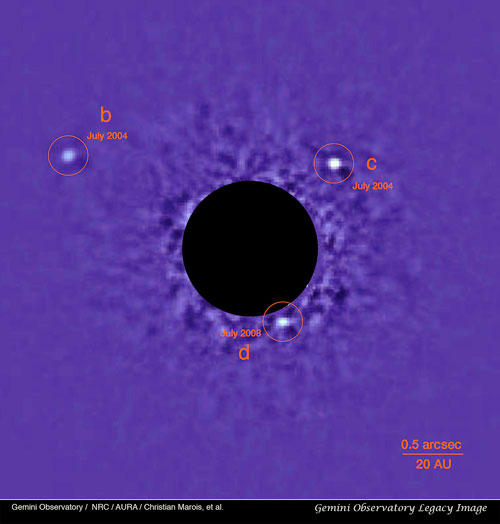
If the "noise" obeys Kepler's laws, it's probably an image of something real.
Taking pictures of them *is* news. In fact, that's the point of these releases. These are the first direct images ever released. Before this, all evidence was indirect (oscillating plots of star brightness as the planet periodically eclipsed the host star, for instance).
Not entirely sure why the summary touches on one being overshadowed by the other.
On the contrary, the two works are complimentary, and it is thus no coincidence that they have been released at the same time. Hubble shows an old cold planet on the edge of a solar system, while Keck shows some very young hot infra-red emitting planets close to their star. The two discoveries help elucidate the workings of other solar systems - and each is just as valuable as the other.
What they have right now can give a pretty accurate idea of the atmosphere on that planet. Pass the light from that dot through a diffraction grating and the spectrum will tell you which gases are present in what proportion in the atmosphere, and what is their temperature.