 Slashdot Mirror
MSI Wind U100, Overclocked With Liquid Nitrogen
james writes "What do you get when you combine a MSI Wind U100 notebook with liquid nitrogen?
The new Intel Atom frequency World Record ... and some
damn cool pictures!
A large copper pot is used, sitting on top of the GPU and chipset, and cold transfer through the original heatsink plate to the CPU. This was cooled down to about -20 C to achieve the new world mark. (Intel Atom N270 @ 2315mhz) For more information you can check out the original forum thread.
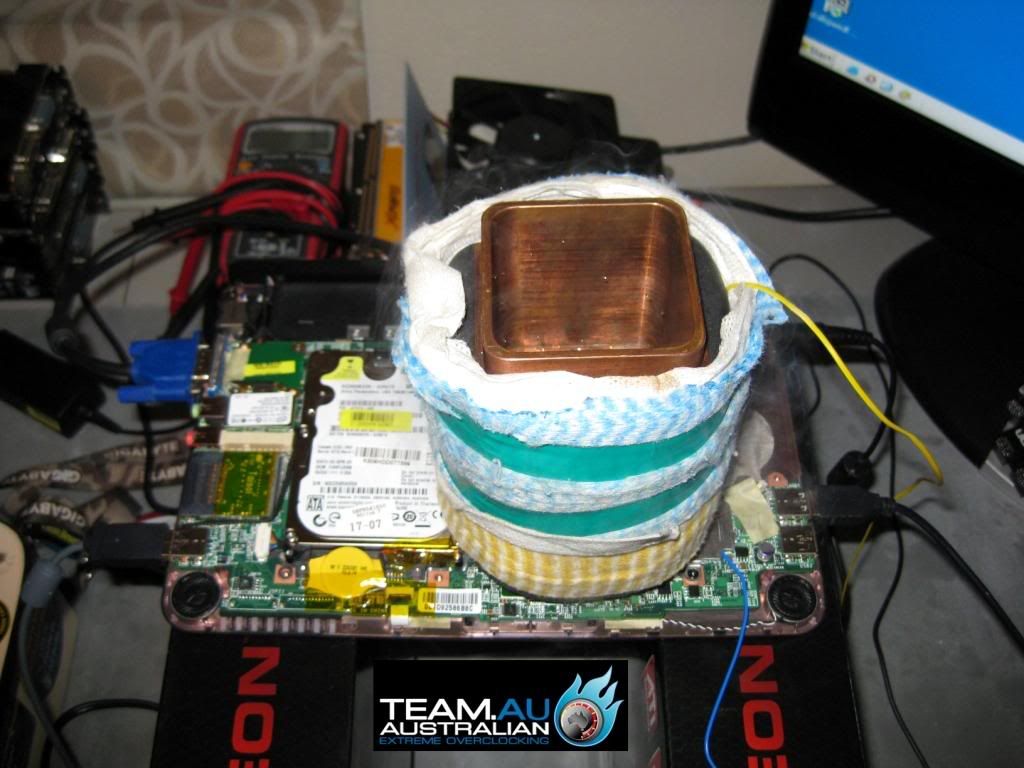
Try here.
The simple truth is that interstellar distances will not fit into the human imagination
- Douglas Adams
You might think so, but silicon seems to deal with it OK. When I worked in astronomical instrumentation, we built LN2-cooled CCD cameras with the chips cooled to about -150 deg C (they had heaters in the cryostats to hold this temperature; they went down to about -200 if the heaters were turned off). These things were thermal-cycled many times a year and we rarely lost a chip. Astro CCDs are big chips, albeit very simple compared to CPUs.
Conversely, detectors cooled to liquid helium temperatures are likely to die if cycled up to room temperature a few times.
With the CCD cryostats, the chips were in a vacuum vessel, so condensation wasn't normally a problem; all the water had been sucked out before cooling. If moisture did get in, then they had to be warmed and re-evacuated.
My guess as to why chips last so well when thermally cycled would be because they undergo very little contraction as they cool. Microchips are made from extremely pure single crystals of silicon (essentially) so they are already in a very low energy state. Cooling them down isn't going to change very much. I wouldn't be surprised if newer SOI chips break more often when thermally cycled as they are in a higher energy state to begin with. Anyway, I have no evidence of this, just a gut feel from studying materials at a wide range of temperatues.
I used to have a better sig but it broke.
There's no such thing as -20 K
Not so, though it's a very strange thing indeed.
"Little does he know, but there is no 'I' in 'Idiot'!"
Is overclocking still worth it? Does it make sense?
It's not worth as much, and it's not the same beast as it was ten years ago, but at least its gotten easier. There's a bigger selection of hardware and cooling equipment. Consequently, a small increase in speed (1-10%) doesn't amount to much for the average user, with all the other bottlenecks. A big monitor, good graphics card, high performance SSD and gigabit ethernet have more of a positive impact than overclocking, from the average geek's point of view.
Whether it's worth it to overclock a processor, always depends on who does it and why. Every percent can save hours, for math intensive tasks.
Or is it mostly a challenge for fun and glory today?
People that push overclocking beyond 25% of the rated speed, are doing it for fun and glory.
Lastly, because of the way things are progressing. In five years, 12% will be the fringe, a few more years and 6%, and so on until finally there wont be any way to overclock. In the end, the last option will be temperature-dependent clock rate. Speed it up by 1% when you're not doing anything. Right in the bios where spread spectrum used to be (the joke of honor).
I mean, unless the processor *needs* to be at LN2 temperature wouldn't it be more practical just to increase the flow rate of a water cooling system?
The processor is never going to be the same temperature as the liquid nitrogen (or any cooling median). As long as there is thermal resistance and/or heat being dissipated there will be some temperature difference.
You could just increase the flow rate of a water cooling system, but that is not without issues either. For example, pumping power increases exponentially with flow rate and heatsink geometry is typically optimal for a given flow rate.
Using the liquid nitrogen is just an easy way to get a high heat transfer rate by maximizing the temperature difference between the processor and cooling medium.
What I wonder is why people just put the liquid nitrogen is simple hollow copper tube. This isn't any different than a natural convection air heatsink. Why not create fins inside and try to maximize surface area and convection?