 Slashdot Mirror
MSI Wind U100, Overclocked With Liquid Nitrogen
james writes "What do you get when you combine a MSI Wind U100 notebook with liquid nitrogen?
The new Intel Atom frequency World Record ... and some
damn cool pictures!
A large copper pot is used, sitting on top of the GPU and chipset, and cold transfer through the original heatsink plate to the CPU. This was cooled down to about -20 C to achieve the new world mark. (Intel Atom N270 @ 2315mhz) For more information you can check out the original forum thread.
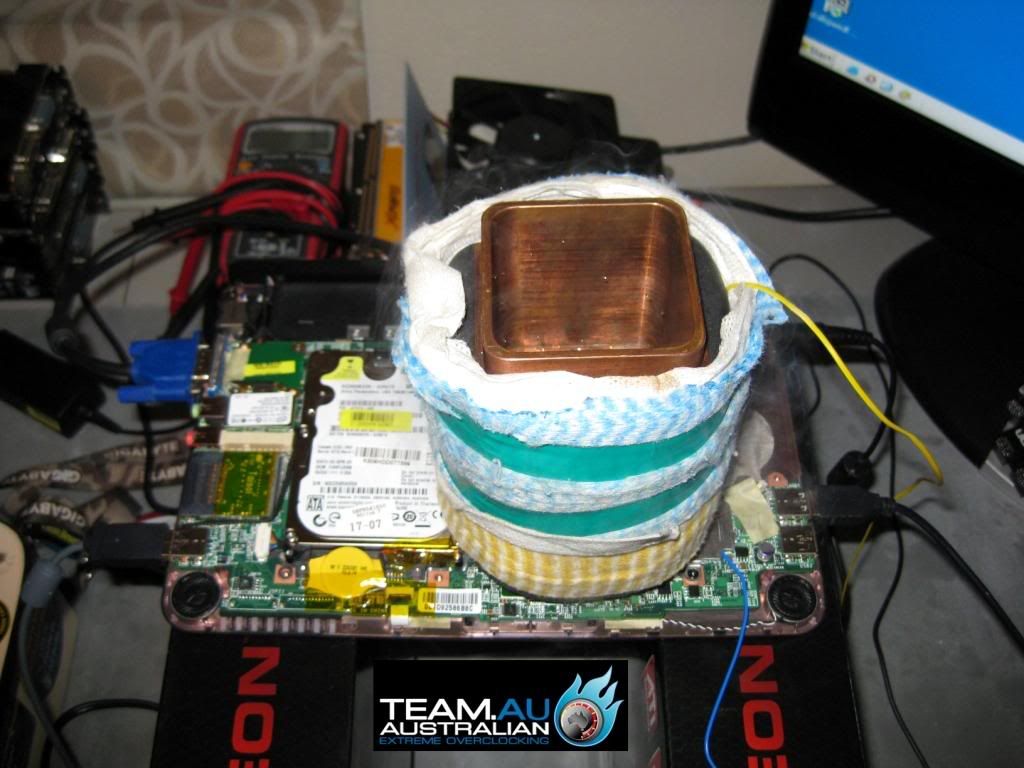
+5 hack points for being completely impractical. I like...
...and you thought it was bad when your laptop's battery started leaking into your lap. Just wait until its liquid nitrogen cooling system starts leaking.
The really impressive thing isn't that they overclocked a processor, it's that they cooled it to -20 K!
All this shows is that Atom is clock limited by design. A 700MHz speed up - less than 50% in this case - from using liquid nitrogen? And all to get a CPU that's about as powerful as a 1.5GHz Pentium M or a 1.2GHz Core 2 Duo ...
Atom is reasonably neat, but I would have been more impressed with under-volting to half power consumption. Or designing a better chipset.
Better wear the insulated cod piece.
There are no loopholes. It's either legal or it's not.
I've always wondered why things like this don't cause physical problems related to thermal expansion/contraction - why doesn't the processor package crack due to the temp differences? Or condensation form in bad places etc? There's gotta be a whole list of bad side effects to worry about when supercooling one part of your computer...?
I work for the Department of Redundancy Department.
Try here.
The simple truth is that interstellar distances will not fit into the human imagination
- Douglas Adams
The author clearly has a very broad definition of cool.
No sooner do I get over one, then you put a better one right next to me. Bastards.
Maybe they won't sniff out the nitrogen (I'm not even sure that it is even sniffable, there is ton of it in the air- not exactly a weird element to have around). But they will likely catch the massive hollow copper beam they are using for a heat sink and at least want to check your bag.
was cooled down to about -20 to achieve the new world mark.
They could have done this alot easier by performing the experiment in my back yard in January (I live in the upper Midwest).
Attention all planets of the Solar Federation! We have assumed control! - Neil Peart
first one, then t'other.
Operation Guillotine is in effect.
It's generally not a good idea to keep liquid Nitrogen in a closed system - it expands by something like 700 times when it goes from liquid to gas, so either you need to keep it cool - hard to do if it's sitting on a hot-plate, or make the pot extremely pressure proof... And then you still need to keep it cool. Best to just let it boil away and top it up...
What no Vista jokes yet? Must be the Slashdot holiday skeleton crew...
Skilled in differentiating ravens from a writing desks.
I mean, unless the processor *needs* to be at LN2 temperature wouldn't it be more practical just to increase the flow rate of a water cooling system?
The processor is never going to be the same temperature as the liquid nitrogen (or any cooling median). As long as there is thermal resistance and/or heat being dissipated there will be some temperature difference.
You could just increase the flow rate of a water cooling system, but that is not without issues either. For example, pumping power increases exponentially with flow rate and heatsink geometry is typically optimal for a given flow rate.
Using the liquid nitrogen is just an easy way to get a high heat transfer rate by maximizing the temperature difference between the processor and cooling medium.
What I wonder is why people just put the liquid nitrogen is simple hollow copper tube. This isn't any different than a natural convection air heatsink. Why not create fins inside and try to maximize surface area and convection?