 Slashdot Mirror
Ninth Anniversary of Amazon 1-Click Injunction
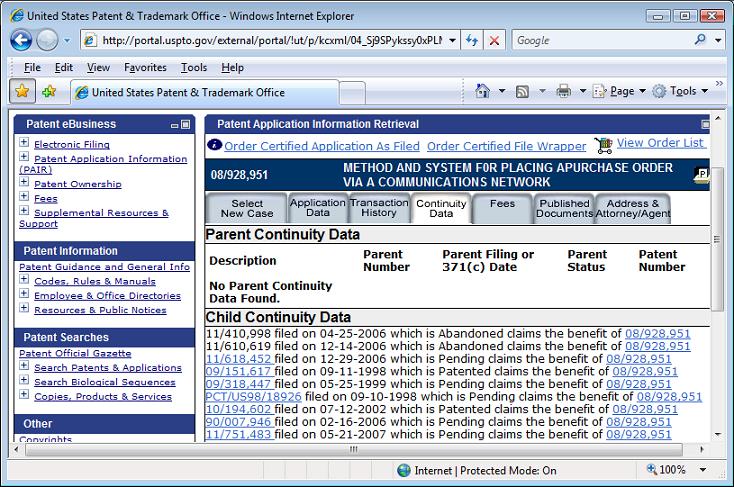
theodp writes "Nine years ago Monday, Amazon kicked off the Holiday Season by slapping Barnes and Noble with a court injunction barring BN from using a checkout feature that Amazon said represented illegal copying of its patented 1-Click technology. 'We're pleased that Judge Pechman recognized the innovation underlying our 1-Click feature,' said Jeff Bezos in a press release. But an Appellate Court wasn't quite as impressed with Amazon's innovation. Nor were USPTO Examiners who were asked to take another look at the merits of Amazon's 1-Click patent claims. Still, 1-Click lives on, although Amazon's lawyers are currently fighting two separate rejections by USPTO Examiners, burying USPTO Examiners in paper, and employing canceling-and-refiling tactics that some may find reminiscent of Eddie Haskell's chess end-game strategy. So much for Amazon-led patent reform."
You know, it's a bit of a shame this ever happened. Normally I'm a fan of Amazon but this kinda tactic has made me consider other places to buy from first ever since it happened.
I can't imagine I'm the only one who reconsidered Amazon purchases because of things like this.
"Just a fox, a whisper."
Amazon was dishonest in their "patent reform", but what about Tim O'Reilly? Why doesn't anyone mention his role in this mess?
And the 3 click... 4... 5... to 100 clicks!
Just imagine how difficult it'd be for your competitors if their customers had to click 101 times to buy anything.
God spoke to me.
All this litigation must be costing Amazon a fortune! Are they expecting to sue B&N and others to recover their costs and maybe make money if they actually prevail?!?
This should be on The Onion, it's so ridiculous.
I've already patented the 1-hover purchase as well as the one-keystroke accessibility purchase. What other non-click methods can you think of?
Want to improve your Karma? Instead of "Post Anonymously", try the "Post Humously" option.
I don't know how you could patent a kind of interface, though. Isn't that like patenting a particular way of arranging your furniture? It's definitely not an invention, it's a way of presenting an existing invention, no?
I think that should be copyright territory, like, "Whatever you do, you can't call your system a '1-click' system", instead of what they are saying which is, "You can't use an interface that resembles our '1-click' system or functions in a similar way".
Does that make sense?
Why doesn't the patent office just charge fees sufficient to fund enough examiners to get anything done in a month? Meaning, they should be allowed to charge whatever fees they need in order to, BY LAW, respond to anything filed in their office within 30 days. So if you send them 10,000 pages of documents, you have to pay $5 a page or whatever it costs them to employ an educated person to read and respond to said documents.
Doesn't the Bilski decision make Amazon's chances on appeal/re-exam pretty much dead?
Fascism starts when the efficiency of the government becomes more important than the rights of the people.
Checkout in shops has always been subject to innovation. Remember the overhead pneumatic tube system to avoid having lots of cash registers and to protect against thieves? Supermarket tills have been constantly improved with innovations like conveyor belts and laser barcode readers. All of these things are patentable. Now consider the back office. Business methods are not patentable, but you don't let the competition into the back office to see how well you have integrated all your systems.
Amazon's problem is that their ingenious checkout system is in software so it cannot be patented, but also it is seen by the user so it cannot be a secret clever backoffice system. They fall between two stalls. This will inevitably discourage people from developing innovative POS systems in software, because it is far cheaper to reinvent something already known.
Solution? Yes, I have a solution. Reasonably, if a large department store introduced a pneumatic system, their competitors could follow them in around a 1-2 year timescale. What's more, they were free to visit the first one installed and look at its advantages and disadvantages. So why not allow software patents and business method patents but give them only a 2 year life from filing and a 1 year life from first commercialisation, whichever results in the earliest expiry? A year of leadership is a long time in retail.
In fact, short terms for different classes of IP seems reasonable nowadays, when books are usually remaindered in a year or so and and popular music rarely lasts more than a few months. As a first shot, how about:
At present, musicians get a ridiculously long copyright period even when they are just making derivative works, and this probably does more than anything else tobring the system into disrepute.
From scarped cliff or quarried stone she cries "A thousand types are gone, I care for nothing, no not one."
I agree, and the chess game reference was buried in that horrid formatting. As a public service, this AC will save others the trouble of digging through that link and explain the joke here:
When Eddie Haskell saw that he was about to lose the game of chess, he would upend the board and claim it was an accident. As such, he would claim that the game is not over and they would need to start again. This parallels Amazon's attempts at withdrawing and resubmitting their appeal when they sense that they are losing, thereby restarting the process.
Ironically, my AC post will also be buried in this thread most likely...
If you want to use your useless lawyers to something I would suggest suing some banks and fix so that you can deposit my income from you into a non-American bank account.
Another real problem is that it's expensive to order stuff internationally. Just a button with "Buy this from another country" (So that one can see if it's available from a closer Amazon and maybe possible to pre-order for really cheap shipping) would be great for me and my international customers. I personally often don't care if it takes a month to get some stuff, as long as it's cheap (Like the pirate-flags for $2) and the popular stuff is available from all Amazon shops so just ship from the closest.
It's also a pain for affiliates when someone reads their review of a book, and then buy it in Japanese from the Amazon in Japan and the affiliate gets nothing unless they register there too (which demands knowledge in Japanese).
All of this is more important for Amazon to fix than this stupid patent-fight.