 Slashdot Mirror
The Hairy State of Linux Filesystems
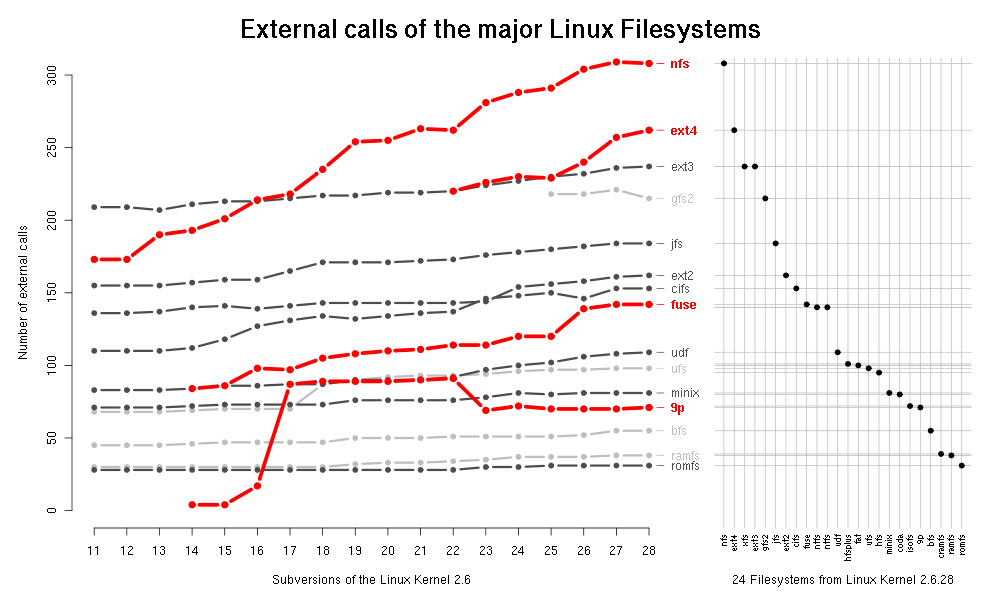
RazvanM writes "Do the OSes really shrink? Perhaps the user space (MySQL, CUPS) is getting slimmer, but how about the internals? Using as a metric the number of external calls between the filesystem modules and the rest of the Linux kernel I argue that this is not the case. The evidence is a graph that shows the evolution of 15 filesystems from 2.6.11 to 2.6.28 along with the current state (2.6.28) for 24 filesystems. Some filesystems that stand out are: nfs for leading in both number of calls and speed of growth; ext4 and fuse for their above-average speed of growth and 9p for its roller coaster path."
Two things of note with NFS...
1. NFSv4 support was added. v4 is complex and has a lot of authentication stuff in it that wasn't in v3.
2. SunRPC is "part" of the NFS tree, but is effectively just a transport layer. It is completely abstracted, hence the numbers of symbols. It could be used for other stuff, so it pushes up that number too.
.
1. The AC was a satire. In fact, I remember reading those exact lines at least once before. Its actually quite funny, so props to the original troll for making something really nice to read.
2. ntfs-3g should be all you need to handle read/writes in Linux these days. I think its nested on top of fuse, so you'll probably need it as well. (Side note, glad Linus finally caved on allowing fuse into his kernel releases)
3. WinFS is a meta-layer on top of NTFS, so not in itself a disk file-system.
Bye!
Off topic, but just in case anyone is curious as to how Hans Reiser is doing in prison...
Not particularly well so far: http://www.kcbs.com/pages/3634907.php?