 Slashdot Mirror
The Hairy State of Linux Filesystems
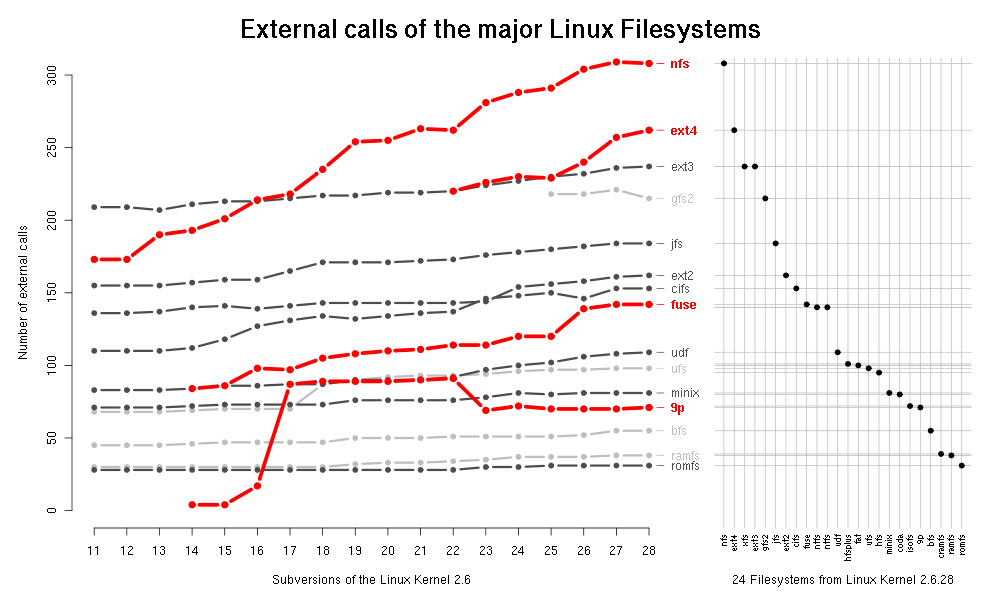
RazvanM writes "Do the OSes really shrink? Perhaps the user space (MySQL, CUPS) is getting slimmer, but how about the internals? Using as a metric the number of external calls between the filesystem modules and the rest of the Linux kernel I argue that this is not the case. The evidence is a graph that shows the evolution of 15 filesystems from 2.6.11 to 2.6.28 along with the current state (2.6.28) for 24 filesystems. Some filesystems that stand out are: nfs for leading in both number of calls and speed of growth; ext4 and fuse for their above-average speed of growth and 9p for its roller coaster path."
What's your argument here? That filesystem code in the kernel shouldn't be growing more sophisticated over time?
This rings of the armchair-pundit argument that the kernel is getting more and more "bloated" and a breath later crying out that there still aren't Linux hardware drivers for every computing device ever made.
Did you know that Linux has limited NTFS support? I usually have to create a FAT32 partition to copy files between Windows XP and Linux. NTFS is usually read only or not available.
Have you heard of NTFS-3G?
The NTFS-3G driver is a freely and commercially available and supported read/write NTFS driver for Linux, FreeBSD, Mac OS X, NetBSD, Solaris, Haiku, and other operating systems. It provides safe and fast handling of the Windows XP, Windows Server 2003, Windows 2000, Windows Vista and Windows Server 2008 file systems.
Mod points: Guaranteed to remove your sense of humor.
Side effects may include gullibility and temporary retardation
Function calls are not free. Especially in kernel space. Everything costs time. You need to do the most you can with the least instructions. 100 lines of inline code will probably run faster than a function call.
Unless I've misread it, TFA's definition of "size" for a filesystem is "how many distinct external/kernel subroutines does it call?"
That seems to be a very strange metric. Seems to me that a well-designed filesystem will have little code and make extensive (re)use of well-defined services elsewhere (rather than reinventing those wheels). This "slims" the filesystem's own unique code down to its own core functionality.
Now maybe, if the functions are hooks in the OS for the filesystem, a larger number of them implies a poorer abstraction boundary. But it's not clear to me, absent more explanation, that this is what TFA is claiming.
Bantam Dominique roosters crow a four-note song. Once you've heard it as "Happy BIRTHday" you can't NOT hear it that way