 Slashdot Mirror
Review: F.E.A.R. 2: Project Origin
- Title: F.E.A.R. 2: Project Origin
- Developer: Monolith Productions
- Publisher: Warner Bros. Interactive Entertainment
- System: Windows, PS3, Xbox 360
- Reviewer: Soulskill
- Score: 7/10
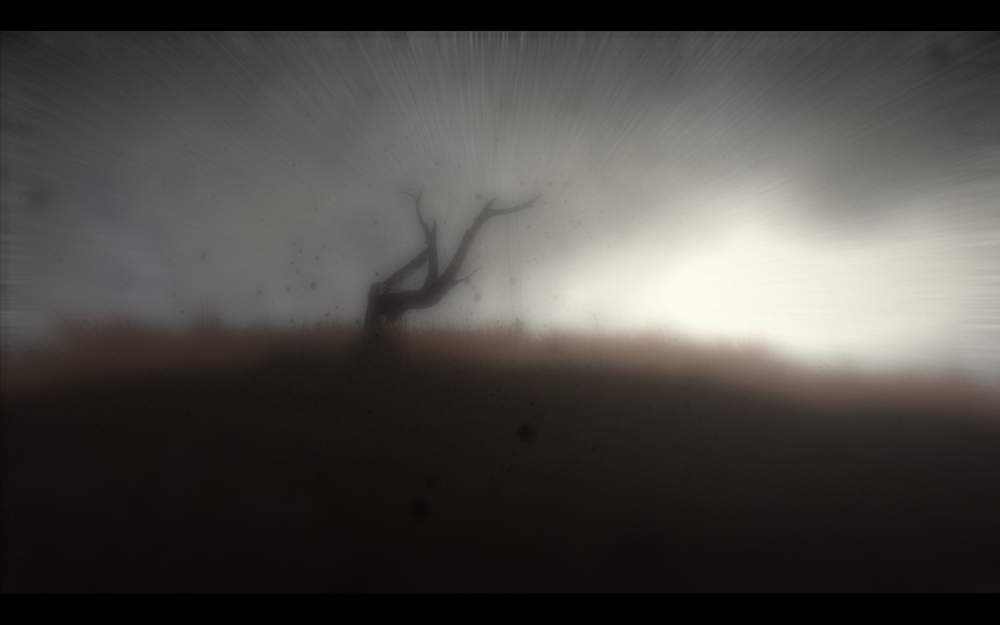
The game starts out with a bang; the first act is extremely well designed. You begin in much the same manner as the first game, given little information and left to wonder what, exactly, is going on. You start in a military transport headed to pick up the president of Armachan Technology Corporation — the typical big, evil corporation developing things they really shouldn't. You're introduced to your squad-mates and then quickly separated from them while being taught some of the gameplay basics. The first serious firefight in the game is located within a room filled with antiques, ceramics, and vases stored in huge glass display cases. It's a brilliant choice in setting — priceless decorations shatter and glass flies everywhere. It's almost theatrical; like being a part of a high-budget action flick. As you shoot your way through the increasingly porous living quarters, hallucinations are induced by Alma, the deranged, telepathic, and telekinetic girl from the first game. The act ends when you witness a nuclear explosion far closer than is healthy, and shortly thereafter struggle to remain conscious as the corporation's doctors do something to you.
It's worth saying again — the first level is incredibly cool. Unfortunately, subsequent levels aren't able to match it. I suppose that's to be expected; after all, it's a horror-themed shooter rather than an epic adventure shooter, but the first level does tend to set expectations. For the next few acts, F.E.A.R. 2 treads mostly on familiar ground. You spend a great deal of time escaping an underground hospital/science facility, and wander your way through broken streets with crumbling buildings. That's not to say it's bad, or even unenjoyable ; the settings are still polished and full of detail, and the plot is continually prodded along in an interesting manner. It's just been done before, and often. If you've played a wide variety of first-person shooters, these levels will probably bring a sense of deja vu . Things pick back up after a while, though. You'll navigate your way through a school that was the site of much violence and destruction, go down into the subway, and even further into a high-tech underground tram. The less you know about any given setting, the more easily it lends itself to creepiness, so the more unique environments in F.E.A.R. 2 keep you focused on the horror aspect much better than the stereotypical science labs.

The visual effects that contribute to the horror theme are integrated quite well into the gameplay. The transition from your normal perception to hallucination is often gradual and seamless. Other times, it's sharp and distinct, using the shock of the immediate change to add an ominous vibe. Sometimes your flashlight will start to flicker in a dark area, and you'll begin to hear your character's panicked breathing and rapid heart rate. I'm on the fence about that; it's used to great effect in a few situations, but since fear in the character isn't mirrored by fear in the player, it also tends to serve as an indicator that something surprising is going to happen — thus negating the surprise. Other horror standards come in to play too. Every so often, Alma will flash into existence somewhere near you, and then disappear. Almost too often... but they find ways of keeping it interesting. The music and sound effects are very well done, laying the foundation for tense scenes, the foreshadowing of a terrible discovery, or giving your fight-or-flight reflexes a little boost.
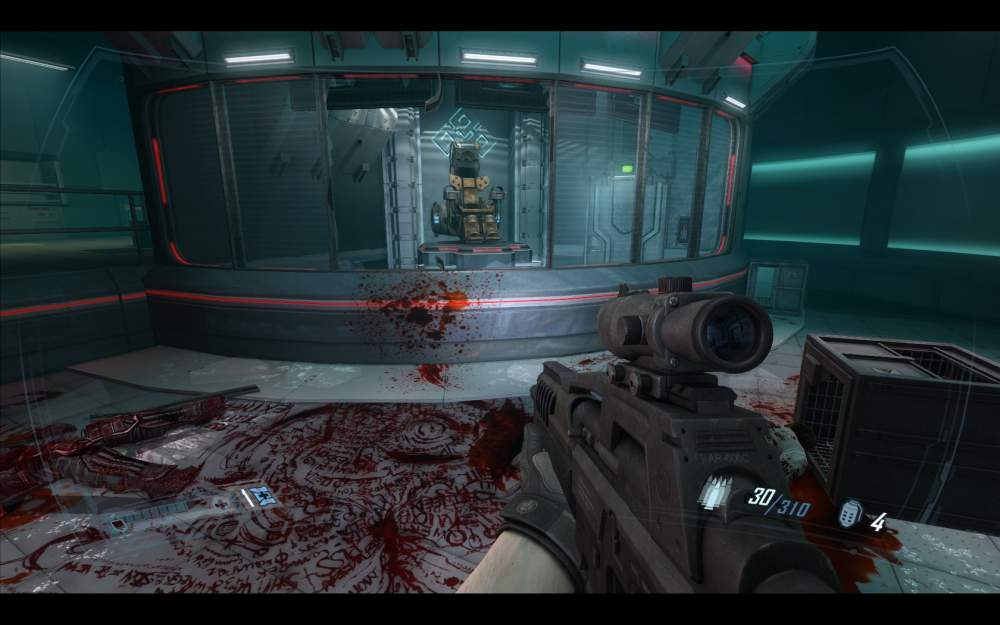
The art team doesn't hesitate to try and scare you with gore, either. The scene I mentioned earlier where you see portions of a medical procedure being performed on yourself is interspersed with hallucinations of zombie doctors tearing out your insides, with gouts of blood flying in every direction. At one point, you sneak up behind a couple of enemy soldiers trying to decipher a huge section of wall that is covered with random words, symbols, and obscenities — all painted with blood. It really does look like something drawn by a psychotic killer, such that I wondered if they contracted the design from a local loony bin. (And presumably, your character feels no cognitive dissonance from gunning down those soldiers, which itself is kind of surreal.) Bloodstains are used liberally, as are all manner of brutal killings. This is definitely not a game for kids or people who faint at the sight of blood. Even aside from the violence and gore, the other artwork is also well done. The attention to detail is refreshing; rooms and objects are correctly proportioned to a greater extent than most shooters. A malfunctioning X-ray machine with throw a series of disjointed X-ray photographs onto a nearby computer monitor. You'll even see T.P.S. reports scattered about an office desk. Everything looks like a real environment, not just an approximation pasted onto an abstract level design.
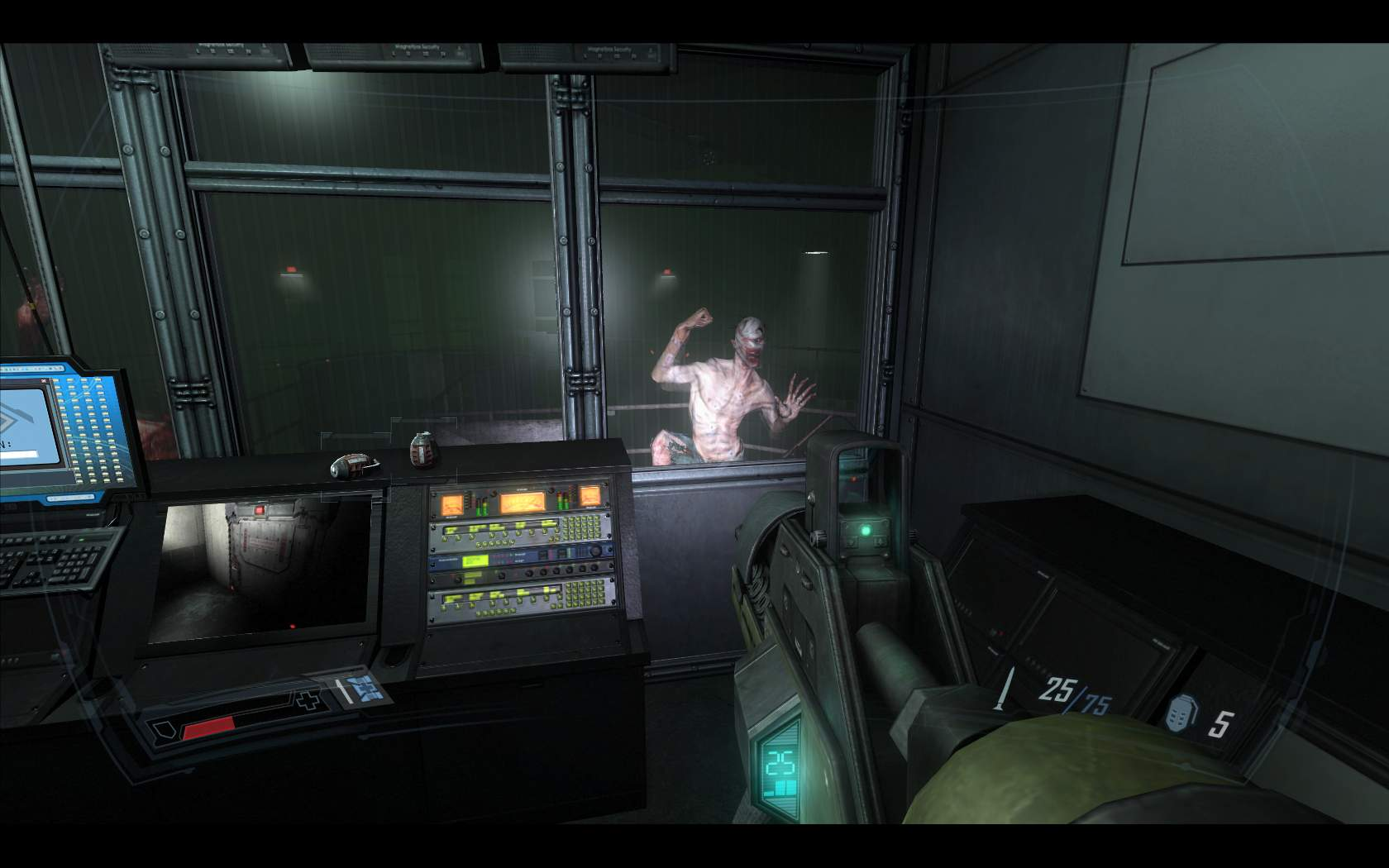
One of the signature gameplay elements of F.E.A.R. 2 is "reflex time," an ability carried over from the first game. Press a button and, for a short duration, time slows down, giving you a massive advantage over your opponents in a fight. The intention is to make the player feel like an action hero, able to dodge and aim with supernatural speed, and it works. It also makes most fights very easy; I'd recommend going through the game on Normal if it's your first FPS, and on Hard if you have any significant experience. The weapons are another area where F.E.A.R. 2 sets itself apart. There really aren't any bad weapons. They all have their strengths and weaknesses, but you won't spend much time wishing you had a different gun. Even the basic pistol and your melee attack are powerful enough to be interesting. There are definitely some weapons that are more fun, like the missile launcher, the napalm gun, and the laser, but in the end you just wind up switching weapons fairly often as ammo runs out, which does a lot to keep the fights from getting boring.
Another instrument they use to keep the fights interesting is the AI, which, as with the first game, is better than average. Enemies are constantly shifting position, finding new cover, and ducking out from behind an obstacle to shoot at you. It forces you to remain active; camping out behind a barrel will get you killed as enemies advance on you. That's not to say it's without flaws; sometimes a soldier will decide to crawl underneath some hanging metal — a very slow maneuver — while you stand five feet away holding a machine gun. The effectiveness of the AI also varies depending on the type of enemy you fight. There are quite a few different kinds, but you wind up fighting the standard soldiers a disproportionate amount of the time, and they handle the AI better than any others. Other enemies tend to be used for dramatic effect. You'll encounter zombie-like creatures that scuttle quickly on all fours, though they are much less scary when you can slow down time. Another type is almost invisible until they attack hand-to-hand. One of the tougher creatures reanimates dead soldiers, and then finds something to hide behind. They take quite a bit of firepower to kill, so you can expect to deal with the revived grunts repeatedly.
Scattered throughout the game are a few situations where you interact with the environment, and a few QTEs. Both are underutilized to the point where they don't really add anything to the gameplay. The QTEs just involve hammering on a button until you win; it's very simple and doesn't really require any effort or brainpower. Granted, most QTEs are added as a way to keep the player connected to a few mini-cutscenes, but the end result isn't very satisfying. The times when you interact with objects are also very shallow; hold down a single button to move an obstacle out of the way, or to close a valve, or to open a set of elevator doors. The added seconds don't really have any affect on what happens to you, so why take the extra time when you can open a regular door with a single click? I'm going to lump the new part of the cover system in with this as well. You can now flip over tables and crouch behind them to shield yourself from enemy fire. It's neat, but there's really no advantage to doing that instead of hiding behind a crate or the corner of a wall. Existing cover is plentiful.
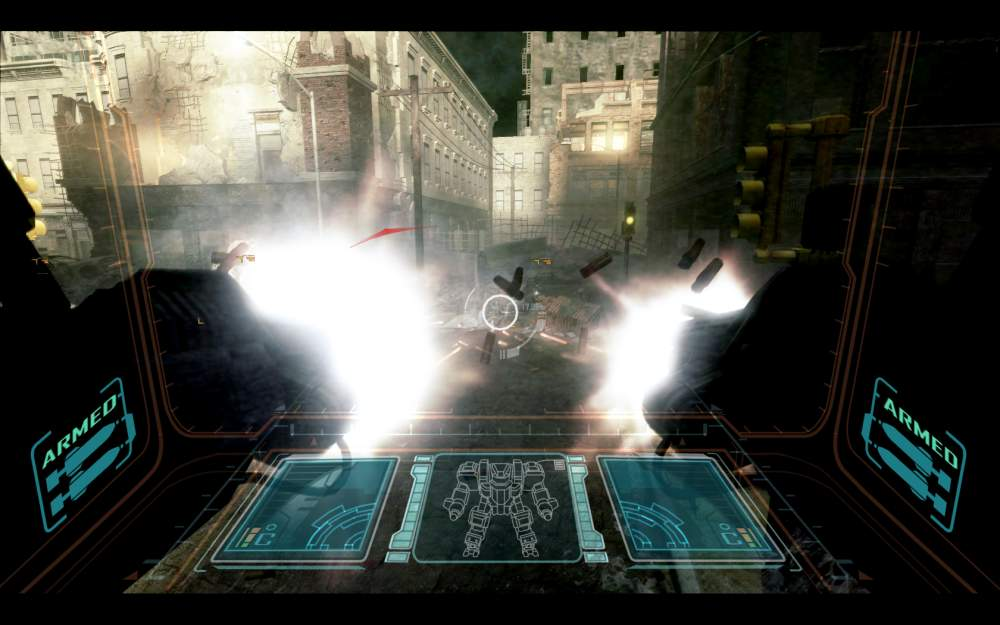
F.E.A.R. 2 infrequently offers a few different ways of fighting. The vast majority of the time, you're on foot holding a weapon of some sort, but you occasionally get to control a turret or a mech. Turrets are very much an upgrade in firepower. Far more enemies swarm than you could normally handle, but the turret cuts them down with ease. Controlling the turret is very easy; some games put silly restrictions like very slow rotation or poor accuracy, but F.E.A.R. 2 gets it right. It's quite fun, and my only complaint is that there aren't more opportunities to use them. The mechs, or "Powered Armor" units are even more powerful, but still very fun and easy to control. You get a couple of mini-guns and a set of rocket launchers, as well as a thermal imaging mode (think Predator). Aside from those two scenarios, there aren't a lot of variations in gameplay. At one point, you're riding on a speeding tram, but you're just walking around on top of it while enemies come to you. There isn't much scenery, and you wouldn't have much time to watch it anyway. The sequence is still fun, but it doesn't hold a candle to similar situations in, say, Gears of War 2.
The game's multiplayer falls into the same trap as the early single-player campaign. It's good, it's fun, and it's interesting, but there's nothing to set it apart from the multiplayer mode of half a dozen other good, fun, interesting shooters. The horror aspect is, of course, completely gone, and the signature time-slowing ability doesn't work because it'd be impossible to code. It has all the standard FPS modes of play (deathmatch, team deathmatch, CTF), and a few other team games that focus on controlling particular points of the map. Armored Front has five such points aligned in a linear manner such that only one is in conflict at a time. You either push the enemy back through successive points or get pushed back yourself. You can use turrets andmechs as well. As I mentioned earlier, all the weapons are relatively powerful in F.E.A.R. 2, and this becomes quite evident in multiplayer games. Players die very quickly without studious use of cover. It may be the case that all the weapons are tuned to be more powerful than they should be. The fights aren't always decided by the first shot, but it happens often enough to be a problem. The maps themselves are, for the most part, very good. There are perhaps a few too many intersections, and a few to many directions you need to watch for enemies, but otherwise they flow quite nicely.
F.E.A.R. 2 is an entertaining game. It's almost exactly what you'd expect out of a triple-A first-person shooter — no more, no less. If you're looking for a quality game and have no problem putting yourself in a state of mind to be creeped out, it will do the job nicely. If you're looking for a title that will push the boundaries of the genre, you're probably better off waiting for another game. There are some great parts to F.E.A.R. 2, and Monolith deserves a lot of credit for making them work as well as they did. This game had the misfortune of coming out after a wave of other, equally compelling titles. It doesn't fall behind, but it doesn't really stand out, either. The bottom line is that if you enjoy horror and first-person shooters, you'll enjoy this game. If your tastes run elsewhere.. well, there's plenty more to pick from.
True...FEAR had great effects, really put you in the middle of a firefight with dust flying, bullets sparking off metal (debunked by MythBusters I believe...), strong soldier AI. But what separated FEAR from most FPSes was the story. Still creeps me out just thinking about what happened to that girl. Almost makes me want to help her.
I reviewed it and gave it a 6/10. The game is simply not worth more, there's nothing new brought to the table from the first in the series. Indeed they take away from it. The difficulty, even on Hard, is bottom rung due to the excessively fast recharge and duration of the slow-motion ability. In the first game you had to figure out some of the encounters, save the slowmo ability and use it and grenades to great effect. In this version I've hardly ever anything but full HP/armor, full all grenades (cause I never need them) and full ammo for most weapons. The scary effects are ALL OVER the place, it's like the developers thought "Oh, hey, this worked in small amounts, let's use HUGE amounts in the sequel, cause more of a good thing is better, right?". Sometimes it is, granted, but not in this case. It desensitises you to the scares, and the oppressive expectant mood of the first game is gone. What it feels like is a console shooter. The pace is slow and the difficulty suitably low for people to play it with gamepads. Using the mouse and keyboard you just plow right through everything like a breeze. Should you fumble the entire place is riddled with healthpickups and armor anyway. It'll still score 9/10 and so on on major gaming sites no doubt. I wouldn't recommend it unless you're a diehard shooter fan. If you're on a tighter budget, don't bother.
Except that if you play the game (at least the demo), you'll notice that you're locked into a D-pad style weapon select system, an inane FOV, a HUD that interferes with vision (why is there a box in the middle of my screen?) and forced widescreen. Also, when you go to click on buttons with the mouse, you often click on the button below it, forcing you to use the keyboard to select menus.
The original F.E.A.R. nailed the interface (only showed it when I was switching weapons, similar to HL2), and was one of the most immersive shooters I've ever played (admittedly, I don't play a lot of shooters).
The demo for this was amazingly fun, and the AI seems better than the original (similar animations and communication, but better use of cover and flanking). However, I'm holding off on buying it until a patch comes out to address the HUD and FOV issues. If anyone knows how to fix these (command line options?), please post below.
Obligatory Soundbite Catchphrase
Speaking of SHOGO, there's a researcher guy in FEAR2 that you meet underneath the Wade Elementary who is wearing a SHOGO 2 tshirt! Silly easteregg, devs teasing, or an early announcement? :D Let's hope for the latter!
I played the demo on Steam a few weeks ago and from that it seems that they've Deus Ex'd it - that is, butchered it for the benefit of Consoles.
Unreasonable large install - Check
Implausably shiny textures, especially on enemies - Check
Weapon "quick menu" - Check
Dumbed down HUD - Check
I blame Halo really - pre-Halo FPS games were generally devloped purely for the PC and benefitted greatly from it. Now, almost every FPS has to be designed for a simultaneous release on PC & console and thus suffers from having to cater to lower resolutions, lack of a keyboard and the rather strange desire to have everything looking shiny.
Yes, but Halo gave people a reason to own X-Boxes. I remember those days... everyone bought an X-Box because it had the best specs (better than PS2 or Gamecube) but no one made games for it.
Suddenly, Halo comes out, it's not only the _only_ FPS at the time for X-Box, it's one of the only GAMES. So everyone who has an X-Box _has_ to play it, and they like it by default.
Halo 1 looked and played better than any other FPS that had been released on a console at that time.
That's great but the reaction has been that now every game has to be limited enough to run on a console. And then people do their best to gloss over the limitations.
If I created an FPS that can be played on a washing machine display, that would be a great achievement. But afterwards should no games ever be made unless they can run on washing machines? No matter how many compromises that required? I know; there's a lot of washing machines out there.
IMO it was about par with HL2.
Maybe in your opinion, but not in fact.
In HL2, you can sit in a doorway waiting for the Combine to come after you. They will. They will keep swarming through like stupid ants even after you've killed 50 of their guys in the same doorway. You can also hold up a barrel and walk right at the guy and he'll continue to shoot at the barrel until you're close enough to crowbar him (or launch the barrel at him from point-blank range.)
Not in FEAR, though. In FEAR they -will- wait for you. They'll also try and go around and flank you if there is any other way. I remember one instance I entered a room and took some cover. I waited for them to come get me. They didn't. I kept waiting. They never popped out. Just as I was about to leave, a guy shoots me in the back. He had traversed no less than four hallways, countless turns and obstacles, and climbed a ladder to reach me. THAT's good AI.
Or another example, there was no way around to reach me. I was on a doorway looking into a room. A guy sprints through the doorway, running too fast for him to shoot me, and too fast for me to shoot him. Obviously I turn and shoot him, he's now behind me and easy prey. But as I turned to shoot him, another guy stepped through the door and capped me. THAT's good AI.
The reason for this is simple: HL2 AI is written into every enemy exactly the same, location unspecific. You can plop 50 combine into a field you created and they'll function just as well as anywhere in game. FEAR2 AI is written using waypoints and maneuvers specific to every location. That one soldier knew how to get around me because there were waypoints telling him to. They knew the specific "rush through the door" maneuver for that one location only. Sure, it's probably more programming intensive, and not as scalable, but as a Player, I don't see any of that. I see only great AI and alright AI.
And instead they innovated in different ways, ones that actually improved the game rather than add pointless fluff.
And please stop acting as if the fact that they didn't invent your "fully destructable environments", "Talking AIs", or "fully interactive environments" that they haven't innovated. What you are missing is that for the most part, all of the innovations you've touted so far in all these comments are about as useful as the fabled flying car and haven't been introduced in games for the same reason we don't have flying cars. I.E. They are pointless and inefficient.
While I agree with you on most points you bring up, I have to ask the question of just what groundbreaking innovation can be brought about at this point? Duke Nukem 3d was groundbreaking because it WAS 3d, and one of the few/first(?) at the time that came about. I can't think of another paradigm-shifting change in video games that has come along since. I saw nothing special in Halo, GOW or many of the games which have come along recently. Sure, some were fun and enjoyable, but nothing groundbreaking. I'm not all that fond of motion control like the WII, but it's an effort. What astounds me is that there hasn't been a real 'jump' in the AI of video games. Personally I'd trade all the shiny reflections and shadows for an ordinary soldier in one of these games that would take half an hour to kill, and not from the usual boss-battle outrageous hit points kind of difficulty, but from tactics and strategy. Of course, I would imagine that this is more to do with the limits of computer science when it comes to 'realistic' AI, and we simply aren't there yet. I think the next 'big' change in video games will arrive when we crack those problems. Until then, more pretty graphics, shiny reflections and the need for outrageously-priced video cards in order to run them.
To me, the original F.E.A.R. feels like the last "PC" FPS built from the ground up, and THEN ported to consoles. The sales of the PC versions and Console versions reflect this. I wish more developers would hire a "pc gamer" to come in before the game ships in order test out their UI and HUD on multiplatform games. This "pc guy" would tell the developers that alot of pc gamers like being able to select weapons with a number key. Also, he would check all menus and get rid of all messages saying "press start to play" on the pc versions. There is no start button. Has anyone played Unreal Tournament 3. Bleck.