 Slashdot Mirror
Sneak Peek At Sun's SPARC Server Roadmap
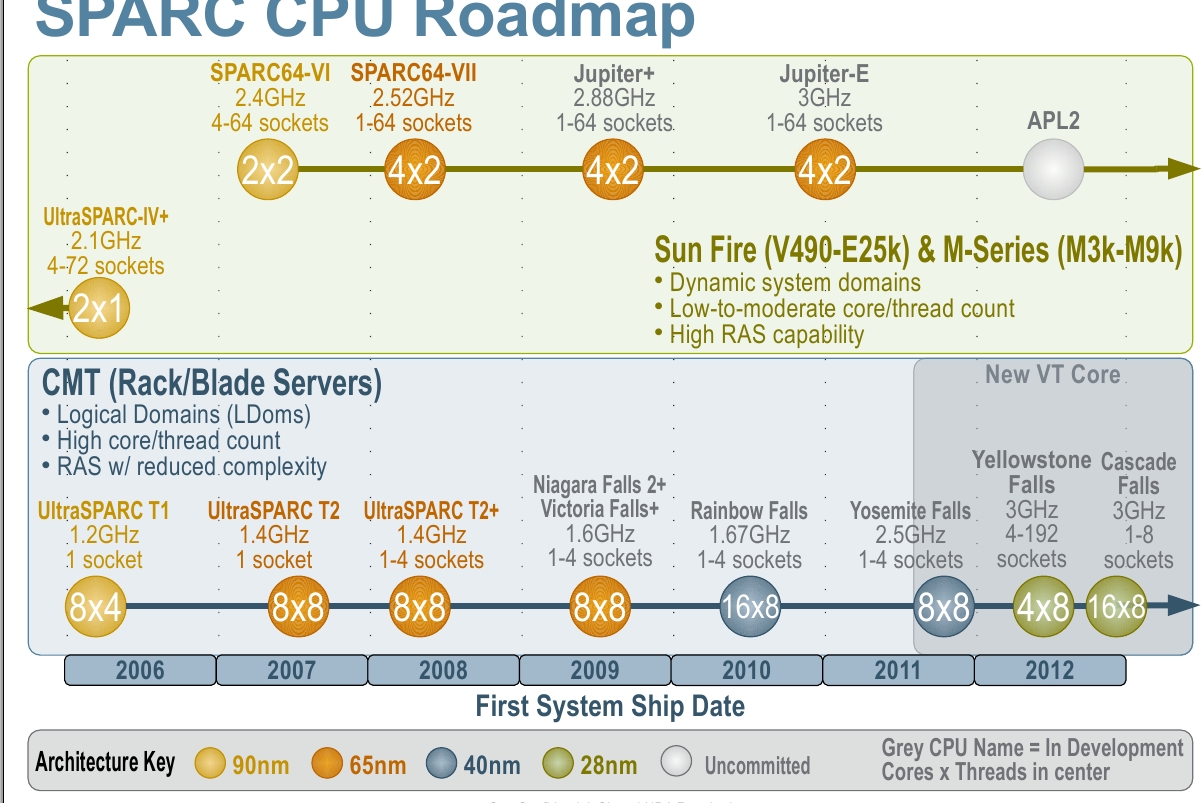
The folks at The Register have gotten their hands on Sun's confidential roadmap from June, which outlines the company's plans for SPARC product lines. The chart has some basic technical details for the UltraSPARC T-series and the SPARC64 line. The long-anticipated "Rock" line is not mentioned. "We can expect a goosed SPARC64-VII+ chip any day now, which will run at 2.88 GHz and which will be a four-core, eight-threaded chip like its 'Jupiter' predecessor. This Jupiter+ chip is implemented in the same 65 nanometer process as the Jupiter chip was, and it is made by Fujitsu, a company that is in the process of outsourcing its chip manufacturing to Taiwan Semiconductor Manufacturing Corp. ... not only has Sun cut back on the threads with [the 2010 UltraSPARC model, codenamed Rainbow Falls], it has also cut back on the socket count, keeping it at the same four sockets used by the T5440 server. And instead of hitting something close to 2 GHz as it should be able to do as it shifts from a 65 nanometer to a 45 nanometer process in the middle of 2010, Sun is only telling customers that it can boost clock speeds to 1.67 GHz with Rainbow Falls."
The only things on Sun's roadmap now are signs to the effect of "Road Closed 1000 feet".
If it's confidential then the Reg shouldn't publish the details. Unless they want to give Sun's competitors a leg-up. I'm sure Sun's competitors marketing teams are happy to have this. [sigh]
Cory Doctorow talking about cloud computing makes as much sense as George W Bush talking about electrical engineering.
I know this is a dark age for literacy, but s/b peek -ya know? like PEEK and POKE???
I'm just sayin'
And it will cost 50x the cost of cheap PCs?
Surely as google does it, its better to have 20 x cheap pcs each running E5400's or anything thats less than $100/cpu with $50 mb's
Everything eventually fails, its not worth spending 50x more for something that lasts 2x longer, when replacement costs are super
cheap, and the replacements are going to be even faster.
Liberty freedom are no1, not dicks in suits.
How'd they get this roadmap? More than likely from someone inside Oracle. Now when Oracle gets Sun and the SPARC chips are better than this, Oracle will get the credit for "saving Sun".
Or am I too cynical?
Sun have been providing theses details to their Partners at the Sun Partner Advantage Summits, I got this info last month.
Plus Sun Partners just have to contact their Sun Sales managers and just ask for a Roadmap Session(Under Signed NDA)
The Register are just publishing what already is pretty common knowledge amongst most people working with Sun/SPARC hardware already, it won't give their competitors a huge advantage at all, the fact that Sun are already revealing this stuff to their wide partner network means that the development of it is well and truly in its final stages, and if their competitors are finding this out through The Register, then they really are not doing their jobs properly.
Sun had a 486i workstation roadmap, too. They never built a single one. Marketing dreams on a PowerPoint slide doesn't mean squat.
Stick a fork in 'em!
By contrast, though Sun Microsystems often boasted that it has -- actually, had -- the largest microprocessor team after Intel, the team could not design a chip that sold to hundreds of millions of customers. They numbered only several hundred thousand. That sell rate could not pay the salaries of the 2nd largest microprocessor team in the world.
Here is another example of Sun arrogance. In the 1990s, Sun could have easily built their company on the unglamorous ARM RISC processor, but Sun management wanted to exhibit the "pride" (and arrogance) of homegrown technology. So, the management spent billions of dollars on designing one of the worst microprocessors in the industry. The UltraSPARC III was overbudget, was late (to market), and underperformed its peers.
The Sun has set. Good riddance to arrogance.
P. S.
Yes. The UltraSPARC I and II were okay. However, they were not stellar. What helped their sales was mating them to the server box, E10000, that Sun luckily acquired from SGI/Cray. However, starting from the UltraSPARC III (an utter fiasco), the processors were so horribly underperforming that even an outstanding server design could not compensate for the mediocre performance of its processor.
is not good. They make lots of promises and just don't deliver. SPARC is RIP... too bad but I just don't see it doing anything but losing market share.
x86 gives Windows, Linux, and Solaris flexibility, all with decent performance. Plus there is VMWare... It is really hard to make a case for further investment in SPARC in the data centre.
The T series are still wonderful machines but SPARC still looks like a dead end.
The SPARC VII chips are expensive, live in big ugly boxes (power hungry, space hungry) and do not deliver a performance premium over Intel and IBM.
I don't see how Oracle (a s/w company) will save a h/w company.
Can anybody give real life examples where the CPU multi-threading brings anything?
And please only real life examples: no theory, no official PR - I know them well myself.
All hope abandon ye who enter here.
Sun, if this is the best you can do -- 4 cores, 8 threads, arriving at 45nm just as everyone else is getting to 32nm -- just give it up now instead of asking us to watch a slow, agonizing, death.
"It's the height of ridiculousness to say for those 9 lines you get hundreds of millions."
On the first day I worked for Sun, an x86 implemented emulator of a SPARC ran at 2-5 % the speed of the SPARC of the day. Within 4 years, the same emulator on x86 of the day ran at about 50% the speed of SPARC of the day. By now, it may well be 1.2 times SPARC of the day. That is the nature of commodity electronics.
The story isn't SPARC vs x86; it is low-run specialized electronics vs huge commodity production. There is no craftsman-like advantage to the low-run specialty; this isn't furniture, it is etchings on polished sand.
At this point, it looks pretty much the same as a (DEC) Alpha or Itanium roadmap.
But why? 10 years ago I thought sharing an 8 CPU Sun with a big devel team was a privilege. Now any decent Dell workstation has that. What does SPARC have over Intel? (No vague claims of superior "throughput", please!)
It has throughput. Back in 2006, when the first T2000 was released, a dual Xeon could handle 980 req/s from Apache and the T2000 could handle 15,000 req/s:
http://www.stdlib.net/~colmmacc/2006/03/23/niagara-vs-ftpheanetie-showdown/
http://www.stdlib.net/~colmmacc/2006/03/27/niagara-benchmarks-update/
At the same time the Xeon used a peak of 2.2 Amps, while the T2000 peaked at 1.2 A. Things have only gotten faster.
Throw-in on-board crypto, and you can do AES-128 at 38.9 Gb/s with a single socket (eight core) T5220:
http://blogs.sun.com/bmseer/entry/ultra_fast_cryptography_on_the
A T5440 can do 22,932 MB/s (183,456 Mb/s = 179 Gb/s):
http://blogs.sun.com/yenduri/entry/t5440_crypto_performance_numbers
If you're a site that cares about SSL/TLS, how many x86 machines would need to buy, maintain, and cool to handle that load? How many F5 load balancers/SSL accelarators would you purchase? According to F5's own data sheet, the 8900 (with dual 850W P/S) can handle 9.6 Gb/s--and you still have to buy web servers on top of that (more power)
So the T5120 can do roughly four times the raw encryption rate, uses dual 720 W P/S, and also do work as web servers. You're also using less rack space.
Let's also compare to AMD-based systems (which Sun also sells):
http://blogs.sun.com/bmseer/entry/web2_0_consolidation_sun_sparc
Now the Niagara (UltraSPARC-Tx) CPU isn't good for every work load out there, but if it's highly parallel then it's something that you should be looking.
IBM seems to do ok keeping POWER up with and ahead of Intel/AMD. Sun just rested on their laurels and kept selling essentially the same very expensive product as the rest of the computer world was rapidly advancing around them. The only truly cool thing I saw come out of Sun was the T2 and Oracle killed it for me when they dropped the per core price break when T2 started getting too fast. Perhaps now that they own Sun the pricing will go back to reasonable but I'm certainly not holding my breath.
There are 4 boxes to use in the defense of liberty: soap, ballot, jury, ammo. Use in that order. Starting now.
IBM seems to do ok keeping POWER up with and ahead of Intel/AMD.
Yeah but Sun never was IBM even though they seemed to think so themselves. IBM has a much broader range of products so they can prop up other business lines for a while if they have too. What's more they can sell during a downturn (buying IBM always being the safe bet) which is something Sun never could. Sun is very much a "boom" company, every time there's an economic slump they collapse like a bad souffle.
If all else fails, immortality can always be assured by spectacular error.
> Now the Niagara (UltraSPARC-Tx) CPU isn't good for every work load out there, but if it's highly parallel then it's something that you should be looking.
:). Or Intel could decide to use some transistors to do it - they have lots of transistors to play with on their chips, it's just a matter of priorities.
If Oracle still charges per core, the Niagara approach of many core CPUs could be more expensive.
Looking at the roadmap they seem to be going fewer cores, or at least sticking with 8.
As for power consumption, I wouldn't bet on the Intel x86 always consuming more power than a SPARC for the same performance. They are a scary competitor. They keep introducing consumer grade x86 cpus that are more powerful and yet consume less power.
Can Sun/SPARC keep ahead of them? They might only be ahead in SSL/TLS. And if that becomes a big enough demand, some taiwanese/chinese company start producing cheap pcie cards to do that
The Ultra 27 was released with 2 PCIe x16 slots .... and it wasn't until we'd bought the damn things that we found out you can't put two FX-5600s in there- the case was designed to prevent it.
What's that got to do with their SPARC roadmap? Next x86 box we buy will be intel reference design. It's cheaper.
(not to mention there are bugs with the XVR-300 and the FX series of cards where you can't turn on 3 heads- it's 2 or 4 only)
IBM seems to do ok keeping POWER up with and ahead of Intel/AMD
Depends on your metric. Raw performance? Sure. Performance per Watt? Maybe. Performance per dollar? Not for most workloads. And don't forget that IBM's latest POWER chips use the same execution engines as the SystemZ CPUs, just with different instruction decoders and a few specialised parts unique to each design; the majority of both chips is the same. When you have customers who think $1m is cheap for a machine, this helps subsidise your workstation processors.
I am TheRaven on Soylent News
However any floating point operations make the T2000 look like Pentium 2.
Apache, lighthttp, nginx, Varnish, Squid, and memcached generally don't use much floating point AFAIK.
Also, the T2000 is set to be retired RSN, and so the smallest box available is the T5120 which has a lot more FP units.
Does it really matter how they do it? Their bigger problem is going to be finding commodity customers if they don't continue providing processors for all the consoles. The low end brings them into economies of scale that permit them to upgrade fabs etc.
"You're right," Fisheye says. "I should have set it on 'whip' or 'chop.'"
I'm missing indications about better virtualisation features, like I'm used to them on IBM gear. These days all high end installation I see are running tens to hundreds of virtual machines on a single server. It looks to me that virtualisation in this scale is not even on the roadmap.
Markus
if i take your argument at face value, it would be a no-brainer.
clearly you're presenting half the facts. also a comparison
of 2009 hardware would make more sense.
And don't forget that IBM's latest POWER chips use the same execution engines as the SystemZ CPUs, just with different instruction decoders and a few specialised parts unique to each design; the majority of both chips is the same.
And why do you think that is? Because they have been adding the mainframe ops to Power every generation so they can eventually have 1 single proc line instead of 2 (used to be 3 for servers, 4 if you include the mac stuff).
What is your point with this statement? That having all of the advanced features found on the mainframe CPU is a bad thing?
It doesn't matter, Sun was probably NEVER competitive on a performance per $ basis, but that wasn't their target market. You bought a Sun system because you needed a large, stable, high performance system with good industry support. Sun used to be all of those, but they pissed it away through mismanagement and poor execution. Almost all AIX customer are potential Solaris customers so if IBM can sell them expensive but performant kit then Sun should be able to as well if they are operating well but they haven't been for quite some time, which I find sad as I am actually a bit of a fan of Solaris.
There are 4 boxes to use in the defense of liberty: soap, ballot, jury, ammo. Use in that order. Starting now.
The big power boxes are really nice for a set of problems. we have a couple of big ass ones for oracle servers for very large databases and they work great. They do cost big $, as somebody said in a thread long ago when your data matters you get what you pay for. IBM makes a killing on these and the 'frames because for a lot of businesses it's easier to pay some big bucks now then later when your data is fucked. It's not as hard as you think to sell these guys, plus the virtualization is top noch, and done at the hardware level (I know you get that on wintel, I'm not sure if VMWARE the most popular solution uses it. I think sun also provides hardware assist for virtualization.)
That being said, for a lot of bulk work, I prefer linux/windows. Lots of speed on the cheap, perfect for a farm of app servers.
PHP is the solution of choice for relaying mysql errors to web users.