 Slashdot Mirror
Sneak Peek At Sun's SPARC Server Roadmap
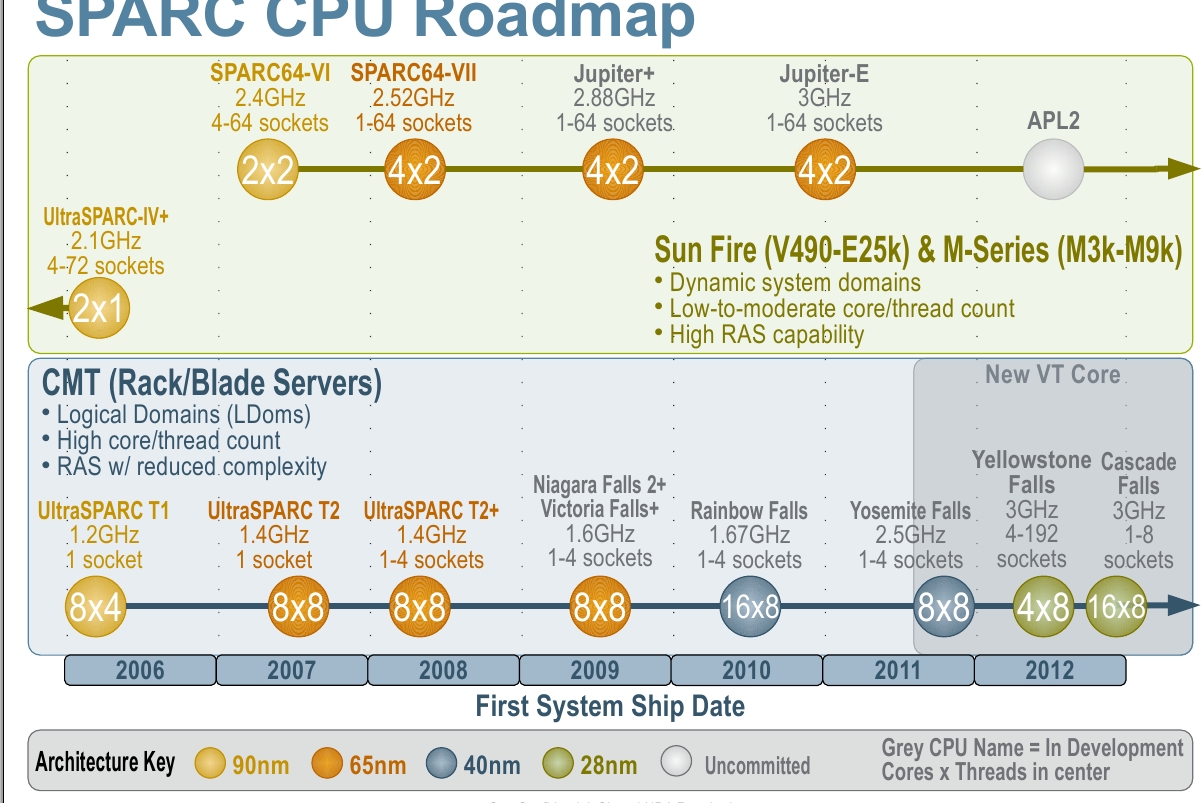
The folks at The Register have gotten their hands on Sun's confidential roadmap from June, which outlines the company's plans for SPARC product lines. The chart has some basic technical details for the UltraSPARC T-series and the SPARC64 line. The long-anticipated "Rock" line is not mentioned. "We can expect a goosed SPARC64-VII+ chip any day now, which will run at 2.88 GHz and which will be a four-core, eight-threaded chip like its 'Jupiter' predecessor. This Jupiter+ chip is implemented in the same 65 nanometer process as the Jupiter chip was, and it is made by Fujitsu, a company that is in the process of outsourcing its chip manufacturing to Taiwan Semiconductor Manufacturing Corp. ... not only has Sun cut back on the threads with [the 2010 UltraSPARC model, codenamed Rainbow Falls], it has also cut back on the socket count, keeping it at the same four sockets used by the T5440 server. And instead of hitting something close to 2 GHz as it should be able to do as it shifts from a 65 nanometer to a 45 nanometer process in the middle of 2010, Sun is only telling customers that it can boost clock speeds to 1.67 GHz with Rainbow Falls."
If it's confidential then the Reg shouldn't publish the details. Unless they want to give Sun's competitors a leg-up. I'm sure Sun's competitors marketing teams are happy to have this. [sigh]
Cory Doctorow talking about cloud computing makes as much sense as George W Bush talking about electrical engineering.
I know this is a dark age for literacy, but s/b peek -ya know? like PEEK and POKE???
I'm just sayin'
Sun have been providing theses details to their Partners at the Sun Partner Advantage Summits, I got this info last month.
Plus Sun Partners just have to contact their Sun Sales managers and just ask for a Roadmap Session(Under Signed NDA)
The Register are just publishing what already is pretty common knowledge amongst most people working with Sun/SPARC hardware already, it won't give their competitors a huge advantage at all, the fact that Sun are already revealing this stuff to their wide partner network means that the development of it is well and truly in its final stages, and if their competitors are finding this out through The Register, then they really are not doing their jobs properly.
Google goes for the lowest watt per processing, the actual hardware cost is probably negligible compared to the cost of years of electricity for powering the systems and cooling the surroundings.
Unfortunately, that's looking more true every day. I remember running a network of Sparcs and bragging to my family members about how they (the Sparcs) were sooo much more powerful than PCs that we had in our homes. Seven years later I was replacing all our Sparcs with x86_64 Linux boxes... too bad Sun just couldn't keep up with hardware development. It would be nice if Oracle really did ramp up hardware R&D for Sun, but I can't see those announcements being anything more than reassurances to nervous enterprise customers.
Yeah, lots of the original Samba code was written on Sun 386i's. Ah, memories :-).
Jeremy.
Sun, if this is the best you can do -- 4 cores, 8 threads, arriving at 45nm just as everyone else is getting to 32nm
Sun's performance as a chip vendor is far better that your performance as a Slashdot troll. According to Sun's roadmap, a 16 core times 8 threads processor (128 threads just to be clear) at 40 nanometers arrives in 2010. That would be four sockets per blade, 48 blades per chassis for a respectable 768 multithreaded processors per chassis. As Sun says, it comes down to the TPC-C numbers. I'm no Sun fanboi, far from it, but I could be convinced by the right performance/heat ratio.
Have you got your LWN subscription yet?
But why? 10 years ago I thought sharing an 8 CPU Sun with a big devel team was a privilege. Now any decent Dell workstation has that. What does SPARC have over Intel? (No vague claims of superior "throughput", please!)
It has throughput. Back in 2006, when the first T2000 was released, a dual Xeon could handle 980 req/s from Apache and the T2000 could handle 15,000 req/s:
http://www.stdlib.net/~colmmacc/2006/03/23/niagara-vs-ftpheanetie-showdown/
http://www.stdlib.net/~colmmacc/2006/03/27/niagara-benchmarks-update/
At the same time the Xeon used a peak of 2.2 Amps, while the T2000 peaked at 1.2 A. Things have only gotten faster.
Throw-in on-board crypto, and you can do AES-128 at 38.9 Gb/s with a single socket (eight core) T5220:
http://blogs.sun.com/bmseer/entry/ultra_fast_cryptography_on_the
A T5440 can do 22,932 MB/s (183,456 Mb/s = 179 Gb/s):
http://blogs.sun.com/yenduri/entry/t5440_crypto_performance_numbers
If you're a site that cares about SSL/TLS, how many x86 machines would need to buy, maintain, and cool to handle that load? How many F5 load balancers/SSL accelarators would you purchase? According to F5's own data sheet, the 8900 (with dual 850W P/S) can handle 9.6 Gb/s--and you still have to buy web servers on top of that (more power)
So the T5120 can do roughly four times the raw encryption rate, uses dual 720 W P/S, and also do work as web servers. You're also using less rack space.
Let's also compare to AMD-based systems (which Sun also sells):
http://blogs.sun.com/bmseer/entry/web2_0_consolidation_sun_sparc
Now the Niagara (UltraSPARC-Tx) CPU isn't good for every work load out there, but if it's highly parallel then it's something that you should be looking.