 Slashdot Mirror
Black Soot May Be Aiding Melting In the Himalayas
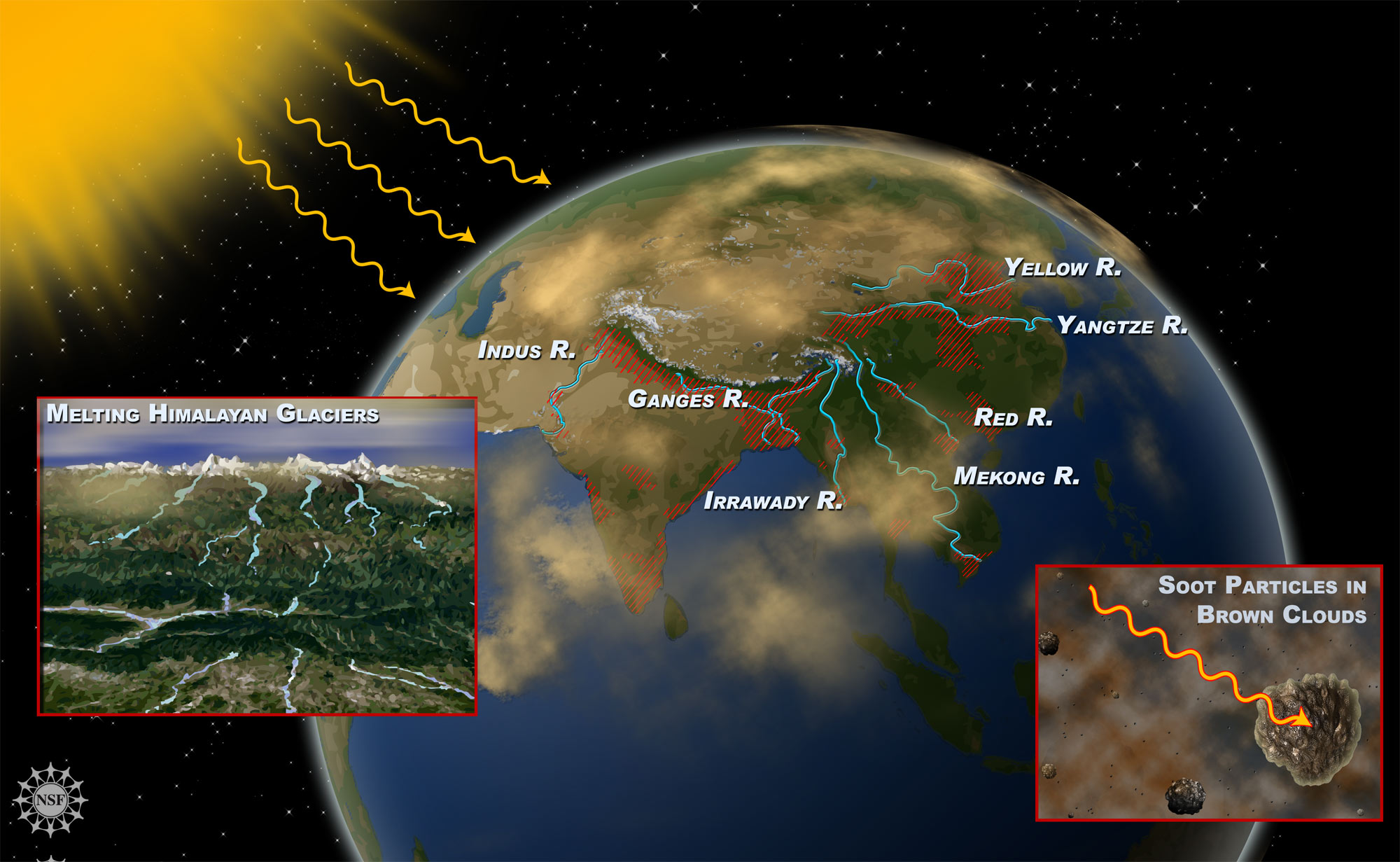
Hugh Pickens writes "The Himalayas, home to some 10,000 glaciers, are the main source of replenishment to lakes, streams, and some of the continent's mightiest rivers, on which millions of people depend for their water supplies. Since the 1960s, the acreage covered by Himalayan glaciers has declined by more than 20 percent with a rate of warming twice the global average over the past 30 years. Now Live Science reports that tiny particles of pollution known as 'black carbon' — and not heat-trapping greenhouse gases — may be causing much of the rapid melting of glaciers in the Himalayas. 'Tibet's glaciers are retreating at an alarming rate,' says James Hansen, director of NASA's Goddard Institute for Space Studies in New York City. 'Black soot is probably responsible for as much as half of the glacial melt, and greenhouse gases are responsible for the rest.' The circulation of the atmosphere in the region causes much of the soot-laden air to 'pile up' against the Himalayas. The soot mixes with other dust from nearby deserts, creating a massive brown cloud visible from space that absorbs incoming solar radiation. As this layer heats up in the Himalayan foothills, it rises and enhances the seasonal northward flow of humid monsoon winds, forcing moisture and hot air up the slopes of the mountain range."
We have already noticed problems with soot. In fact I recall reading books about terraforming where soot was sprinkled on an ice cap, so the idea is pretty old.
"You're right," Fisheye says. "I should have set it on 'whip' or 'chop.'"
Galciers are essentially a water battery. There is very heavy seasonal precipitation high in the mountains. This precipitation becomes glacier ice, which slides downward and melts.
The sliding process and melting however happens perennial, and thus turns high seasonal percipitation into a dependable perennial water source. Without glaciers, all the water simply comes gushing downhill - which can be very damaging on its own, and leaves the people without a dependable water source for the rest of the year.
There are two possibilities how a glacier can "die" - either the yearly precipitation dries up (therefore, melted ice is not replenished), or the temperature gets warmer and the "melting zone" goes up the mountain, ultimately leaving no glacier. We observe the latter across the globe.
So when we see scientists trying to come up with excuses for why ice packs are melting without a huge increase in global temperatures, we need to question both their motives and their data.
A few simple points that are (surprisingly, still) worth mentioning. Scientists are not coming up with "excuses" for the melting of ice packs. They are observing it and developing explanations based on models. You may personally believe that the melting of ice packs would require "huge" (conveniently unquantified) temperature increases to happen, but I'm willing to bet you personal beliefs in this matter are not based on rigorous observation and mechanistic explanations of the system. The questioning of the data used by scientists to come up with the said explanations has to be addressed in an individual basis. I'm certainly supportive that not only data from global warming research, but all publicly funded research be openly available, but it is utterly naive to think that the all conclusions presented in published peer-reviewed articles would not be supported if these data were available (and it's deceptive, at the least, to question their conclusions without even knowing their contents). The questioning of the motives of the scientific community to fabricate the conclusion of ice packs melting due to anthropogenic climate change is, in my opinion, one of the weakest arguments of denialists. Conspiracy theories abound, but no one seems to find the underlying motives that lead this entire scientific community to take on the daunting task of misleading the world's population, while doing it under the public's scrutiny and very aptly covering its tracks. Staging the moon-landing is child's play compared to this.
Yes, we can see oceanic water levels rising *in certain localized areas*, but we aren't seeing the massive deluge that was predicted.
Hopefully we can finally put to bed the reality of global warming and focus on the real problem of global pollution.
How on Earth the oceanic water levels will rise *in certain localized areas* is beyond me. Unless your theory accounts for a substantial increase in oceanic water viscosity as well, although that might explain why the current rises in ocean levels have failed to meet your expectations. And, according to recent EPA definitions, the problem of global warming caused by CO2 emissions *is* "the real problem of global pollution".
Incidentally, everyone is naturally entitled to their opinions, but I prefer anthropogenic global warming denialism when it's devoid of blatant logical inconsistencies.
Calling it melting is prejudicial (because it implies melting due to warming), it's termed glacial retreat and in most cases, there are valid reasons for this not associated with "Global Warming". For instance, the glaciers on Kilimanjaro are retreating because the rain forest at the bottom was destroyed which drastically reduced the amount of precipitation on the mountain's slopes. Less precipitation == less liquid to freeze, so the water lost to the summer temperatures was simply not replaced.
Interestingly, the cost of replacing the stoves causing the Himalayan pollution (it is believed that most of the soot is not from large scale generation, but from household stoves - individually they're not that significant, but there's a hell of a lot of people in that part of the world) has been estimated at $15 billion. This seems like a good use of resources to me, rather than fantasy schemes like cap and trade.
Rational thought is the only true freedom