 Slashdot Mirror
Black Soot May Be Aiding Melting In the Himalayas
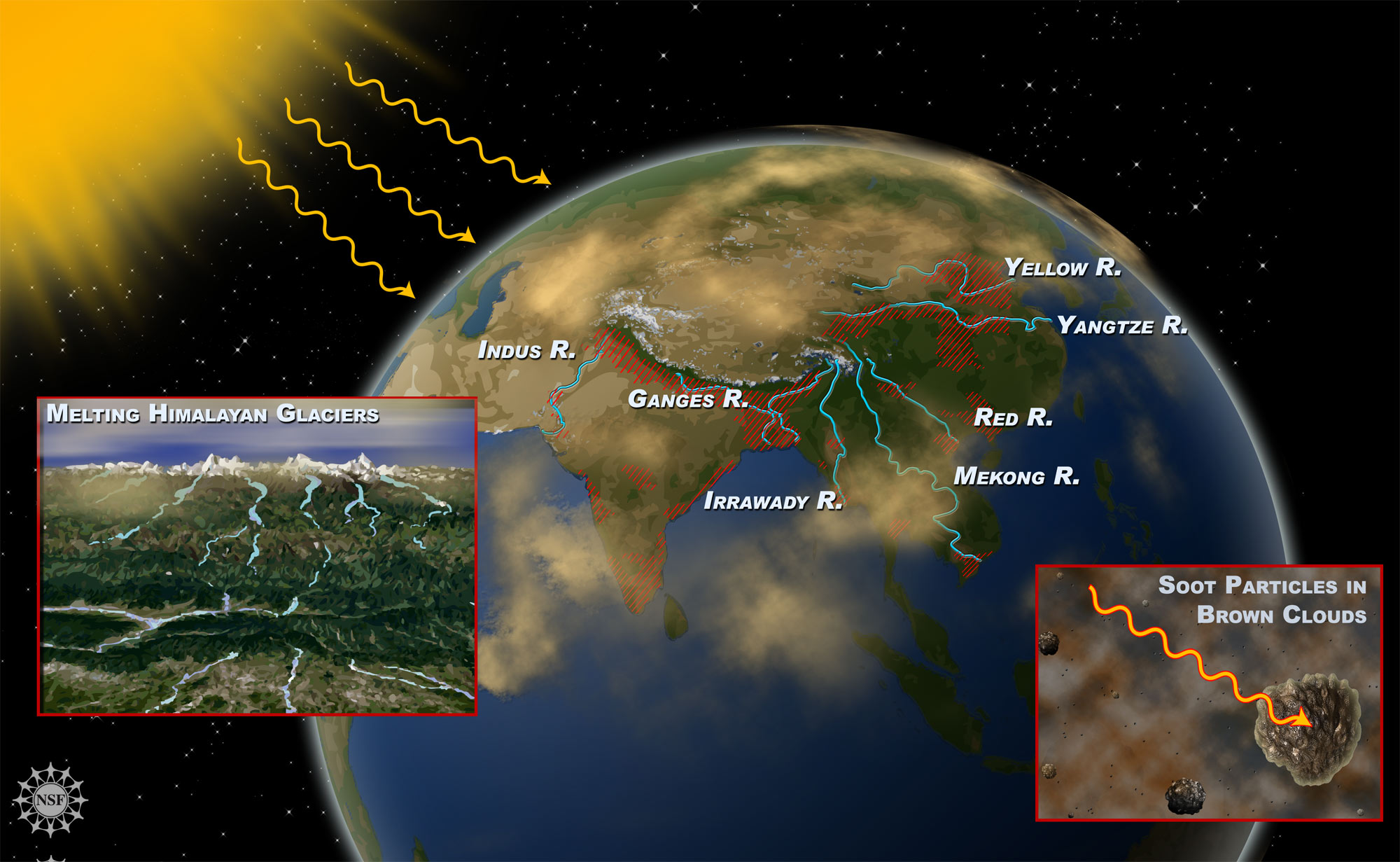
Hugh Pickens writes "The Himalayas, home to some 10,000 glaciers, are the main source of replenishment to lakes, streams, and some of the continent's mightiest rivers, on which millions of people depend for their water supplies. Since the 1960s, the acreage covered by Himalayan glaciers has declined by more than 20 percent with a rate of warming twice the global average over the past 30 years. Now Live Science reports that tiny particles of pollution known as 'black carbon' — and not heat-trapping greenhouse gases — may be causing much of the rapid melting of glaciers in the Himalayas. 'Tibet's glaciers are retreating at an alarming rate,' says James Hansen, director of NASA's Goddard Institute for Space Studies in New York City. 'Black soot is probably responsible for as much as half of the glacial melt, and greenhouse gases are responsible for the rest.' The circulation of the atmosphere in the region causes much of the soot-laden air to 'pile up' against the Himalayas. The soot mixes with other dust from nearby deserts, creating a massive brown cloud visible from space that absorbs incoming solar radiation. As this layer heats up in the Himalayan foothills, it rises and enhances the seasonal northward flow of humid monsoon winds, forcing moisture and hot air up the slopes of the mountain range."
Aerosal pollution over India and Bangladesh--2001
Haze over China--- 2003
Haze along the Himalaya Front Range --2004.
Smog over the bay of Bengal-- 2006
Bad example. It's not who left the window open, it's determining that the problem is an open window, as opposed to for instance running the air conditioner in winter. Because fixing the problem the right way (closing the window, or shutting down the AC) is much easier than doing it the wrong way (adding heaters for instance).
If the problem is too much CO2, then it's very possible the easiest fix is to reduce the amount of CO2 instead of starting some sort of planet-wide engineering project.
How is your engineer going to fix the problem without knowing what it is? The solutions to "too cold", "too hot", and "not changing when it should" are different. And depending on the amount of change the scale of your engineering project is going to change quite a lot.