 Slashdot Mirror
ITER Fusion Reactor Enters Existential Crisis
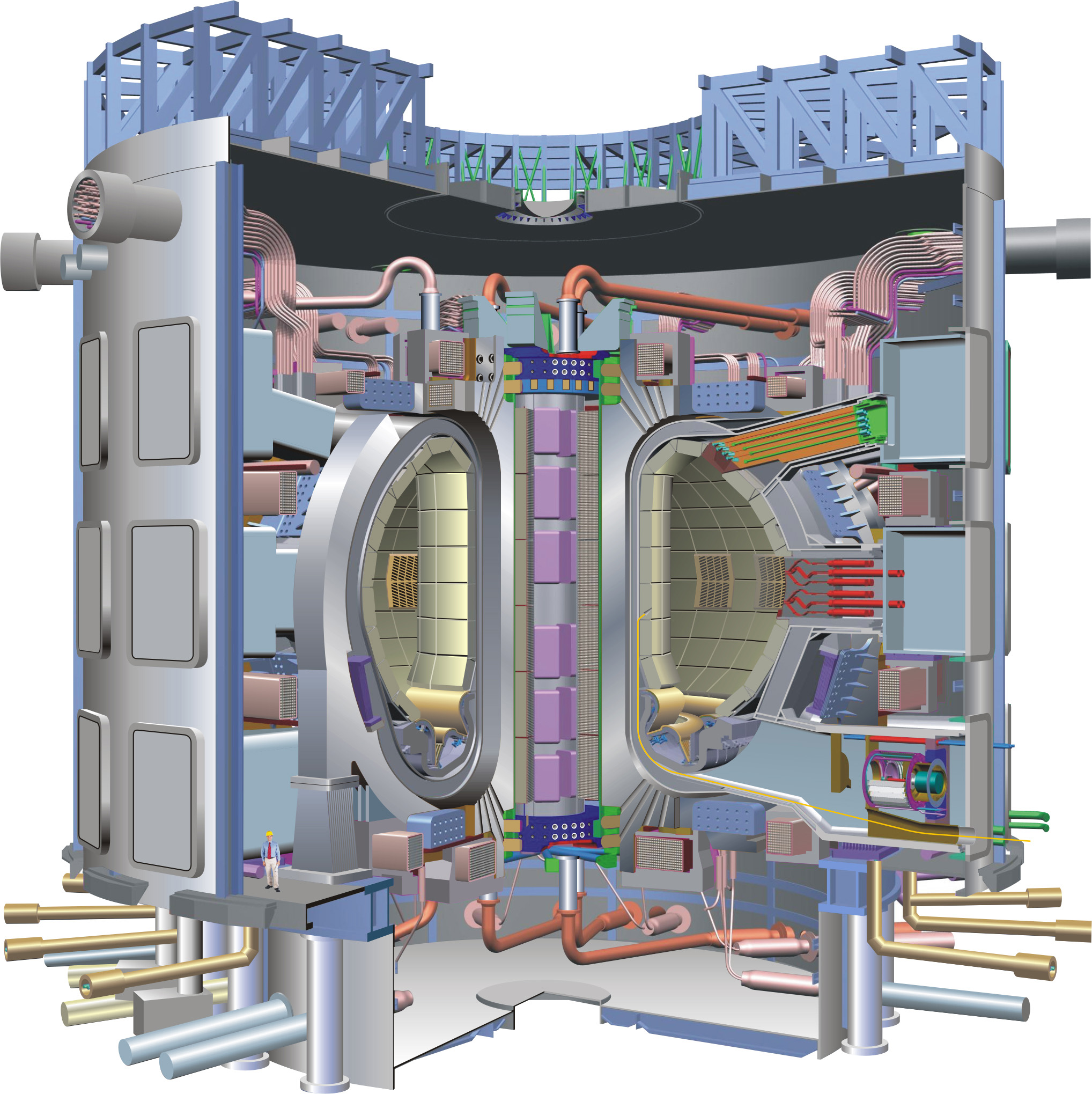
deglr6328 writes "The long beleaguered experimental magnetic confinement fusion reactor ITER is currently in what some are calling the worst crisis of its 25 year history. Still existing only on the paper of thousands of proposed design documents, the latest cost estimates for the superconducting behemoth are soaring to nearly 20 billion USD — roughly twice the estimates from as recently as a few years ago. Anti-nuclear environmentalist organizations have seized upon the moment as an opportunity to use the current global economic crisis as a means to push for permanently killing the project. If ITER is not built, the prospect of magnetic confinement fusion as a technique to reach thermonuclear breakeven and ignition in the laboratory would be in serious question. Meanwhile, the largest laser-driven inertial confinement fusion project, the National Ignition Facility, has demonstrated the ability to use self-generated plasma optical gratings to control capsule implosion symmetry with high finesse, and is on schedule to achieve ignition and potentially high gain before the end of the year."
Now, it's debatable whether the US government is capable of offering such regulation, especially after the BP disaster. But nevertheless, asking for regulation does not make them "anti-nuclear".
Okay, but the problem is that if you think you need successful regulation to prevent a BP spill-like disaster, then you still kinda don't understand fusion power.
The problem with the BP spill is that once a problem occurred and oil leaked, the oil does what it naturally does and continues to be pushed out by the pressure underground. The problem with fission reactors is that when the control rods fail, the enriched uranium does what it naturally does and continues to release neutrons in a chain reaction.
When a fusion reactor fails, the fusion stops on a timescale that to human eyes would be called "instantly". The whole reason nuclear fusion is such a hard thing to make into a power source is that it takes so much damn effort to make the source material actually fuse because that is not it's natural state until you get enough of it in one place that you call it a star. It's inherent in the nature of the power source that it can't go out of control. "Out of control" means "stopped".
I'm an environmentalist, but also pro-fission. Yet I do think concerns about regulation of fission reactors are valid. How worried am I about regulation of fusion reactors? None worried.
The enemies of Democracy are
So, what's the deal with that? Irrational fear or nuclear energy, or just a general hatred for humanity?
(Relatively) cheap oil. Give it another 5-10 years and those same clueless environmentalists will be the first ones calling for fission.
That's right kids, Nuclear power plants are the next 'tech boom' so be sure to bone up on your physics and chemistry and math. There's money in them thar cooling towers!
Linux, you magnificent bastard, I read the fucking manual!
You have out-obtused me, I have little idea what your localities share in common.
Do you mean to insist that they lack the money or stability to operate nuclear plants? That isn't exactly entirely attributable to fission itself. And Toshiba wants to sell them safe, small scale, self contained nuclear generation. The U.S. could be tasked with providing the islands with power, the U.S. Navy has long experience safely operating floating reactors (money is an issue there, but if we want to 'continue living in a civilization', we might have to stop worrying about it so much).
I'm about evenly split on governments spending $20 billion on new fission generation vs fusion research, but I'm not very optimistic about fusion, mostly based on the numbers in a recent Scientific American article:
http://www.scientificamerican.com/article.cfm?id=fusions-false-dawn
The engineering requirements for the jacket on a tritium consuming fusion reactor are 'hilarious'. There is no better word. The targets for laser ignition also present 'interesting' production challenges. Meanwhile, uranium reactors 'fucking work', with political problems preventing them from being built, not fundamental technical challenges.
Nerd rage is the funniest rage.
Sigh, I normally don't want to bother commenting on articles that have to do with fusion, but given the traffic that /. receives, it seems almost irresponsible to let such bullcrap have its way every time it rears its head.
First off, even from the getgo, ITER is arguably more pointless than it is purposeful. It's nowhere near a stepping stone towards an actual powerplant, even if this sucker proves to be able to do pulsed Q>10 fusion, the technology required for heating won't be economically or thermodynamically feasible for energy production for decades to come. While it's politically a great way to blow a large sum of money (we pulled out of this program at first, but went back in because Bush needed to kiss France's ass for the Iraq war), the most useful science coming out of it will be materials science in trying to deal with high TC superconductors and blanket materials constantly suffering neutron damage; blanket materials we won't need until a real fusion powerplant comes along (once again, decades). That aside, since its original proposal of sustained thermonuc. fusion has been thrown out in favor of hour-long pulses, probably 90% of the physics it will undergo is either known predictable. (In other words, this is NOT the plasma physics equivalent of the LHC, which is actually necessary to set boundary conditions on many physical models).
Now that's all a big clusterF* of he-said she-said that political spin gets to amplify 100-fold, but what really gets me is the comparison to NIF. Read the next few sentences very carefully:
1. NIF requires its tiny fuel pellets to be perfectly symmetrical, encased in a gold hohlraum, and perfectly centered, then shot at by the most powerful laser system ever created in earth.
2. NIF is a giant weapons research project, funded mostly by the DOD (Department, of, Defense) because we want to play nice and not test full blown warheads, and are instead simulating their fusion reactions in a laboratory (Go google NIF's funding, or enjoy the tid-bit that hohlraum was a classified word less than 30 years ago, the mention of which could get you interrogated by the FBI)
3. The laser system used to beat the crap out of the carefully assembled perfect heavy-water pellet has less than 1% efficiency. I don't care how big your Q is, the technology to fix THAT problem is way more than decades away.
4. Finally, a real powerplant, using the current studies NIF is undergoing, would require over ~60 perfectly frozen pellets (purpose is for yield, either of turbine-driving energy or more realistically better warhead modeling) per second fusion rate, lasers with a hundred times better efficiency (putting it at, oh say 10%? hah), and quite a bit of gold, that or another mechanism which they aren't studying.
The next time someone talks NIF like we're not trying to figure out a better way to irradiate large plots of people or land, please just look at them like the idiots they are.
I'm sorry fusion power is taking so long, we're working on it, and we're working pretty hard. But hey, and near-infinite supply of power from just centrifuged seawater is worth the wait, right? =P
Citations?
I think it's very likely you've never worked in an environmental organization. I have. Let me tell you what the single thing they spend the most time obsessing about: the impact of degraded environmental quality on the quality of human life.
Yes, it is true environmentalists value the environment for itself more than the general population does. There's a simple explanation for that. If you study something, you care more about it. Birders care more about bird conservation. Hunters care more about game conservation. Wildflower photographers care more about plant conservation. It's as simple as that. Of course, to outsiders, birders, hunters and nature photographers seem a little like crackpots.
Caring about things is not a zero sum game. Just because you care *more* about the forests, or the bottom of the ocean, doesn't mean you care less about people. In fact it works the other way around. Caring isn't a resource, it's a habit of thought. The more you practice it, the better you get at it.
I'll just leave you with a few quotes from a report I participated in developing:
*A sustainable economy should provide for basic material requirements and a healthy quality of life.
* Economic "progress" must be encouraged, measured and gauged in terms of quality of life and development of human potential...
* The behavior of economic systems today should not diminish the potential enjoyment of life for future generations.
* Appropriate market incentives (e.g., full cost accounting) are essential to achieve biophysical and economic sustainability, and subsidies for unsustainable practices should be eliminated.
* The natural and physical environment is the platform which supports all communities and institutions.
In my personal experience, this is mainstream consensus opinion in the environmental movement, although how such ideas apply to specific policies such as trading pollution credits is often a matter of debate. That's because details matter. It might seem like a minority position among environmentalists to you if your knowledge of environmentalists is second hand, through sources that are interested in playing up controversy or equating environmentalism with extremism.
Post may contain irony: discontinue use if experiencing mood swings, nausea or elevated blood pressure.