 Slashdot Mirror
Things That Turbo Pascal Is Smaller Than
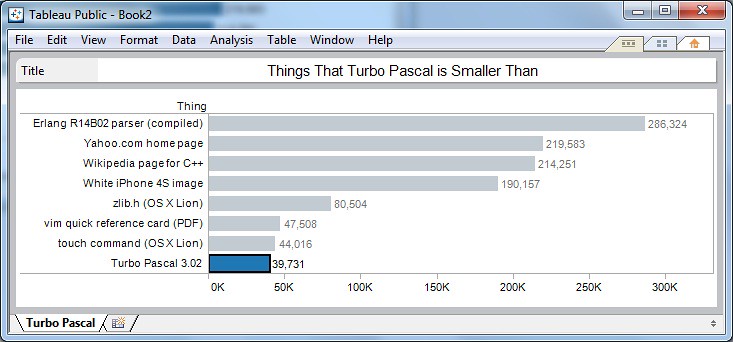
theodp writes "James Hague has compiled a short list of things that the circa-1986 Turbo Pascal 3 for MS-DOS is smaller than (chart). For starters, at 39,731 bytes, the entire Turbo Pascal 3.02 executable (compiler and IDE) makes it less than 1/4th the size of the image of the white iPhone 4S at apple.com (190,157 bytes), and less than 1/5th the size of the yahoo.com home page (219,583 bytes). Speaking of slim-and-trim software, Visicalc, the granddaddy of all spreadsheet software which celebrated its 32nd birthday this year, weighed in at a mere 29K."
Software grows to fill the available ram.
Code is always a tradeoff between codesize, development time and ram needed for execution. I'm fairly sure you can optimize code today to a point that would put those programs (which were optimized 'til they squeaked to squeeze out that last bit of performance) to shame, but why? What for? 30 years ago, needing a kilobyte of ram less was the make or break question. When drivers weighed in the 10kb range and you still calculated which ones you absolutely need to load for the programs you plan to run, where you turned off anything and everything to get those extra 2 kb to make the program run. Today, needing a few megabytes of ram more is no serious issue. And mostly because it just really doesn't matter anymore. Do you care whether that driver, that program, that tool needs a megabyte more to run? Do you cancel it because it does? No. Because it just doesn't matter.
We passed the point where "normal" people care about execution speed a while ago. Does it matter whether your spreadsheet needs 2 milliseconds longer to calculate the results? I mean, instead of 0.2 you now need 0.202 seconds, do you notice? Do you care? Today, you can waste processing time on animating cursors and create colorful file copy animations. Why bother with optimization?
Because, and that's the key here, optimizing code takes time. And that costs money. Why should anyone optimize code if there's really no need for it anymore? And it's not the "lazy programmers" or the studios that don't care about the customers. The customers don't care! And with good reason they don't. They do care about the program being delivered on time and for a reasonable price, but they don't care whether it needs a meg more of ram. Because it just friggin' doesn't matter anymore!
So yes, yes, programs back in the good ol' days were so much better organized and they used ram so much better, they had so much niftier tricks to conserve ram and processing time, but in the end, it just doesn't matter anymore today. You have more ram and processing power than your ordinary office program could ever use. Why bother with optimization?
We used to have a Bill of Rights. Now, with the rights gone, all we have left is the bill.