 Slashdot Mirror
The Phantoms of Google+
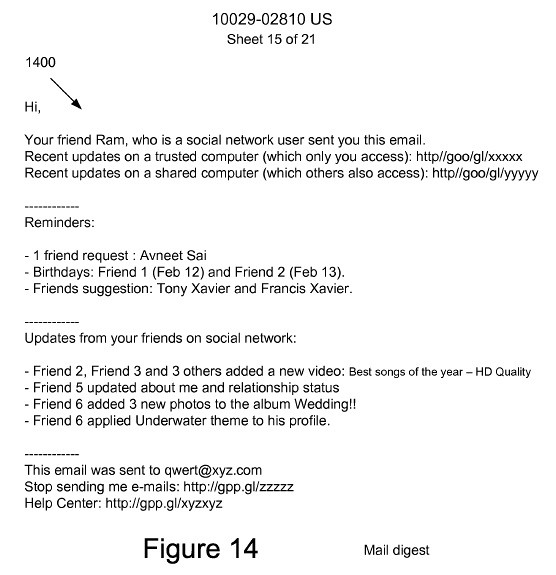
theodp writes "Engadget reports that Google wants a patent on its System and Method for Generating a Ghost Profile for a Social Network. The brainchild of five Googlers, the invention is designed to convert anti-social-networking types to the joys of Google+ and its ilk. From the patent: 'A problem arises when users of social networks are friends with people that are opposed to social networks. The second group misses out on an important social component. For example, many users only share their photos on a social networking site. As a result, users that do not want to join the social network are forced to either join with reservations or miss out on the social component, such as viewing pictures.' By generating an unsearchable 'ghost profile' when a member of the social network invites a Google+ adverse friend to join, Google explains, non-believers get to participate in social networking activities without providing user information."
You already are a data point. You've no idea how sophisticated the software that monitors what you do has gotten. I was recently involved in an integration with some of this sort of software on a site that gets a couple of million hits a day. It's amazing what they can do. If you go to a website, they will, regardless of your desires, browser settings, even proxies, know exactly what you do while there, and if you come back. They then share all this with other companies to build a profile of you. The simple fact that you say you don't want to be tracked ironically gives them an excuse to track you. They have to log your desire to not be tracked right? Then the store all your website activity by other methods, like IP Address, browser, OS, and a hundred other data points.... which builds a profile of you, without building a profile of you. They can claim this is just standard logging for security. Then, if you ever enter your email address or phone number on the site, they make the convenient assumption that you've changed your mind about your privacy. And here's the kicker, they don't just assume you've changed your mind going forward, they assume you've change your mind about the past to! So they drag up all your past traffic and attach it to your email address. Everything you do on the web is tracked and logged in excruciating detail by marketing departments all over the world. So far we're lucky that the government hasn't gotten access to this data yet, but it's only a matter of time.
No they did not. What they did was revoke the requirement to share your real name with everybody else on google+. They still require it internally, they just let you use one or more fake names for interacting with other people. That's only a marginal improvement because the database is still just as much a risk to your security.
When information is power, privacy is freedom.
I find social networking to be most useful not so much with friends (though it's great there, allowing me to stay in touch with many more people than I could without it), but with family. Perhaps you don't come from a large family, but I do, and my wife does, and our combined extended families exceed 200 people. We're only close to maybe 50 of them, but sufficiently close to all of them that keeping updated about important life events -- jobs, kids, illnesses, etc. -- is of great value to all of us. And with social networks we can have much more frequent interactions than that. I have cousins I wouldn't normally speak to for more than a few minutes per year at family reunions, but with Google+ I "talk" to them multiple times per week.
I also find it to be a great way to keep in touch with old acquaintances. Over the course of my 40+ years of life, I've accumulated a lot of friends who've since moved of my life, but I like them and am interested in what they're doing and thinking.
By lowering the effort required to connect and communicate, social networking applications make it feasible to be connected to more people -- and lots of people like that! You may prefer to have only a very small circle of very close friends and avoid others, but if so you're the exception, not the rule. I have a small number of friends that I talk to daily, one way or another. But I keep in touch with a much larger group of people, and social networks make it possible for me to keep in touch with even more.
Note to ACs: I usually delete AC replies without reading them. If you want to talk to me, log in.