 Slashdot Mirror
Teaching Fractions: The Tootsie Roll Is the New Pie
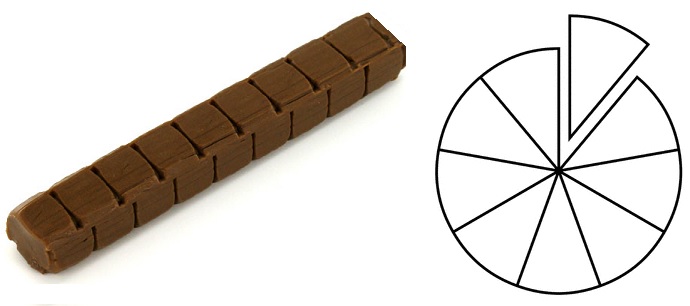
theodp writes "Following up on a WSJ story, data visualization author Stephen Few illustrates why using lines or bars may be sweeter than pie when it comes to teaching kids fractions. 'Although the metaphor is easy to grasp (the slices add up to an entire pie),' explains Few, 'we know that visual perception does a poor job of comparing the sizes of slices, which is essential for learning to compare fractions. Learning that one-fifth is larger than one-sixth, which is counter-intuitive in the beginning, becomes further complicated when the individual slices of two pies — one divided into five slices and other into six — look roughly the same. Might it make more sense to use two lines divided into sections instead, which are quite easy to compare when placed near one another?' So, is the Tootsie Roll the new pie?"
What the fuck is a tootsie roll?
The pie chart is counter intuitive? Anyone who has ever fought over pizza slices knows very well that 1/5 is larger than 1/6, even kids.
Here's a simple classroom script to teach kids about fractions:
1) Buy 2 pizzas, slice one in 8 pieces, the other in 12 pieces.
2) Take 20 students in the classroom and tell them to choose a piece from any of the pizzas.
3) Watch as war ensues
... and somebody read a school textbook.
Seriously. Textbooks have used multiple representations of fractions for years, one of which is linear, because the education research has indicated that different children learn better with different representations of fractions.
Well, at least we now know how long it takes for education research to trickle into the classroom: decades.
Just last night I was helping my elementary age son study for a test on fractions and percents. We went through all concepts and he was still not getting it. Finally, he drew a line and started segmenting it. The teacher had shown the class "another way" to conceptualize this topic. He completely understood this approach. He then told me that his teacher told them about learning styles and tried to present the topic in multiple ways. So, while it seemed simple from one perspective to most of the class, others needed a different conceptualization.
I see no problem with exploring different approaches to learning. And, finding a better visualization for those types of learners is more than appropriate.
Where all think alike, no one thinks very much.