 Slashdot Mirror
A Math Test That's Rotten To the Common Core
theodp writes " The Common Core State Standards Initiative," explains the project's website, ""is a state-led effort that established a single set of clear educational standards for kindergarten through 12th grade in English language arts and mathematics that states voluntarily adopt." Who could argue with such an effort? Not Bill Gates, who ponied up $150 million to help git-r-done. But the devil's in the details, notes Washington Post education reporter Valerie Strauss, who offers up a ridiculous Common Core math test for first graders as Exhibit A, which also helps to explain why the initiative is facing waning support. Explaining her frustration with the intended-for-5-and-6-year-olds test from Gates Foundation partner Pearson Education, Principal Carol Burris explains, "Take a look at question No. 1, which shows students five pennies, under which it says 'part I know,' and then a full coffee cup labeled with a '6' and, under it, the word, 'Whole.' Students are asked to find 'the missing part' from a list of four numbers. My assistant principal for mathematics was not sure what the question was asking. How could pennies be a part of a cup?" The 6-year-old first-grader who took the test didn't get it either, and took home a 45% math grade to her parents. And so the I'm-bad-at-math game begins!"
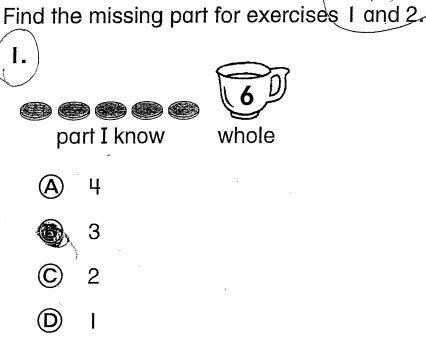
The question is clearly ridiculous. The problem lies there and solely there though, unlike as the article suggests. Expecting 5 or 6 year olds to be able to do basic addition and subtraction of small quantities of physical items is not a problem at all –that's exactly what I'd expect a 5 or 6 year old to be able to do. Writing crappy questions like pearson has is absolutely a problem though.
I don't see the Common Core standards as the problem, this is just a poorly written test made by people who were not the authors of Common Core. Unless I misunderstand, Common Core simply defines what skills a student should be proficient at by the end of school years. It doesn't define these test questions, Pearson Education did.
There do not appear to be any coins in the cup. It appears to be full of liquid with the internal liquid level line.
There is a number 6 under the cup, it does not say 6 coins. Why would there be coins in cap anyways? You put liquid in cup.
"Find the missing part?" is a bad question. If anything it should ask about coins, not parts.
There are no parts missing all the coins are whole so is the cup.
The whole thing is not clear and misleading.
You are assuming the question is asking about the sum of coins. That is not indicated by the question.
Having to make assumptions about a question is very very wrong when it is not a written test where one can explain the assumptions one has to add to a question.
What strikes me about this test is the utter alienness of its language and symbology.
Okay, it's been half a century since I took a test intended for children entering elementary school. I recognize a few of the sentence forms. Somebody has a certain number of guitar picks and gives some away, no problem. But the bizarre pennies to coffee cup equivalence, what the fuck is up with that? Who thought it was a good idea to assume that young children would know that the sentence in "number sentence" means what the rest of the world generally calls an "equation", or that a "subtraction story" conversely means a word problem? What is a "related subtraction sentence" and how does it differ from an ordinary subtraction sentence? Why are you using passive voice to ask questions of a five-year-old? Why do you think we need cubes to solve a linear equation?
What's meant by the fragmentary term "part I know"? Dude, I have no idea what you know. Try speaking in full sentences, like we're taught in school. Oh, right.
In short, this seems substantially to be a test of cultural indoctrination whose arithmetic pales in comparison to the challenge of getting inside the parochial mind of whoever developed the test. I'd be proud if my child failed this test. It's beyond absurd; I find it positively bigoted. These people need to get out and see more of the world.
Parity: What to do when the weekend comes.
If you've listened to the instruction that goes along with the test, it would be clear what to do. My first grader has no problem with these problems. He's told me that the teacher has explained the technique and he recognizes it from the questions that are asked.... Without understanding the context in which things are taugh, you can't judge the tests that are used. This test is not ridiculous when you look at it in proper context.
when you ask a simple question in a simple way, you test a child's ability to understand concepts. When you ask a simple question in an overly convoluted and distorted way, you test a child'a ability to follow directions. The school district makes clear which kind of test this is supposed to be.
honestly people, a test for first graders that is hard to understand for many slashdot readers, including myself??? "you can't take it out of context, there are accompanying teaching segments, etc". I'm going to go out on a limb and say that you should be able to isolate a math question of "6 - 5 = ?" and be able to understand it outside of context.
This demonstrates why problems should be tested by real kids before being released on the masses.
One, albeit simplistic, test is to determine if particular questions are more likely to be answered "incorrectly" by kids who did well on other questions than by kids who didn't do well on other questions. If the problem is supposed to be hard, smart/more mature kids should do better on it than other kids. If the problem has been made hard by unintended ambiguity, smarter/more mature kids are sometimes more likely to get it wrong as they try to make sense out of the chaos that they are more likely to detect.
Although it may be too complicated for first graders, the "test group" might also be asked to mark each question with "how sure are you that you got the right answer (certain, somewhat sure, quite unsure)" to detect when kids feel they had to assume facts not in evidence to try to answer the question.
Sort of like politics - simplistic people come up with simplistic answers because they often fail to see the underlying and more subtle issues.
Why is there an "insightful" mod and why isn't it "-1"? If I wanted insight, I wouldn't be reading