 Slashdot Mirror
Zuckerberg To Teach 10 Million Kids 0-Based Counting
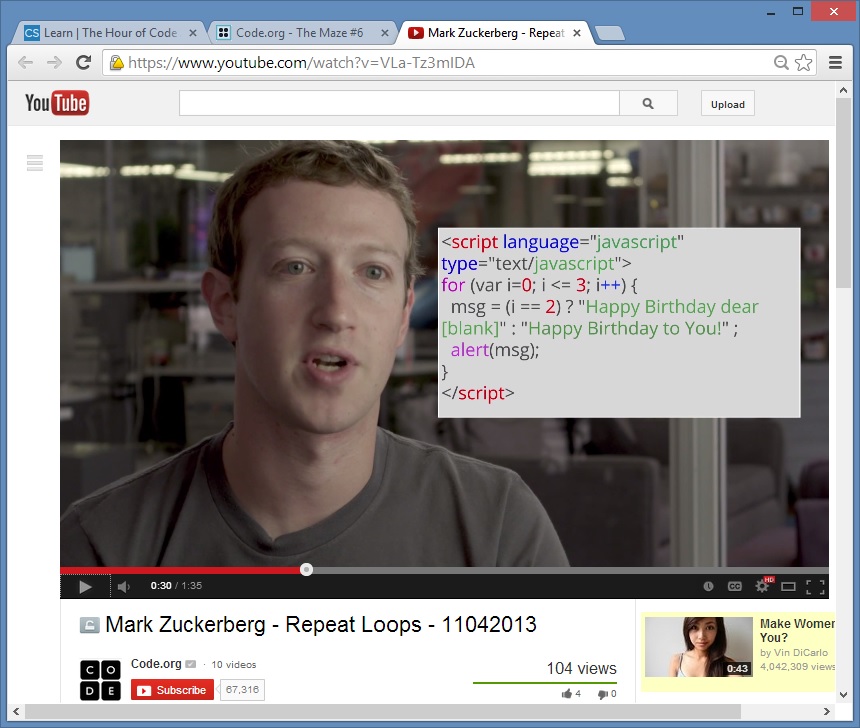
theodp writes "'Why do programmers start counting at zero?' wondered Mike Hoye, questioning the conventional programming wisdom. Code.org will soon introduce the practice to a hoped-for audience of 10 million schoolchildren as part of Computer Science Education Week's Hour of Code. In a tutorial created by engineers from Microsoft, Google, Twitter and Facebook that's intended to introduce programming to kids as young as six years old, an otherwise breezy lesson featuring look-ma-no-typing Blockly and characters out of Angry Birds and Plants vs. Zombies, a Mark Zuckerberg video introducing the concept of Repeat Loops includes an out-of-place JavaScript example that shows kids it's as easy as 0-1-2-3 to generate 4 lines of lyrics from Happy Birthday to You by using zero-based numbering with a For-loop and ternary If statement. Accompanying videos by Bill Gates on If Statements and basketball star Chris Bosh on Repeat Until Blocks show the Code.org tutorial is still a work-in-progress. That's no big deal, since CSEdWeek has pushed back the delivery date for final Hour of Code tutorials from its prior little-time-for-testing due date to Dec. 9th, the first day of a five-day period during which teachers are expected to deliver the lessons to 10 million students."
Iterating through offsets beginning with zero is simply not counting. The writer is confused.
Those who would give up essential liberty to purchase a little temporary safety, deserve neither liberty nor safety.
Why do programmers start counting at zero?
We don't. We start indexing at zero (in some languages), because that's usually the offset of the first useful location in an array (ie, addr + 0).
Careful there, Z -- that might count as a "public performance" of Happy Birthday. I know you're rich, but the payment for and audience of 10 million might be kinda high.
Dear Slashdot: next time you want to mess with the site, add a rich-text editor for comments.
Even well into adulthood, people are still confused by, e.g., the difference between "the early 1700s" and "the early 17th century" (which is actually the 1600s). Turns out, whether you like it or not, the first place value of 10^2, 10^3, 10^4, etc. you count through is always the 0th one. It's only in the very specific circumstance of counting the 10^1 place and when all the other 10^x place values are zero that the 0 gets skipped. Why not be consistent?
Besides being more consistent, I also think it is more intuitive (barring the fact that we are culturally inducted into thinking that it isn't). If you were counting *backwards,* say, starting with ten cookies and removing one cookie off a plate each time, it would be perfectly intuitive to you that you should count down to zero cookies, taking the very last cookie off the plate. The zero cookie limit is enforced by physical reality, while the one cookie limit is enforced by your arbitrary decision to interrupt your process of removing cookies and leave one cookie on the plate. Likewise, in the reverse process, you should also start your counting at an empty plate.
When things get complex, multiply by the complex conjugate.