 Slashdot Mirror
Average HS Student Given Little Chance of AP CS Success
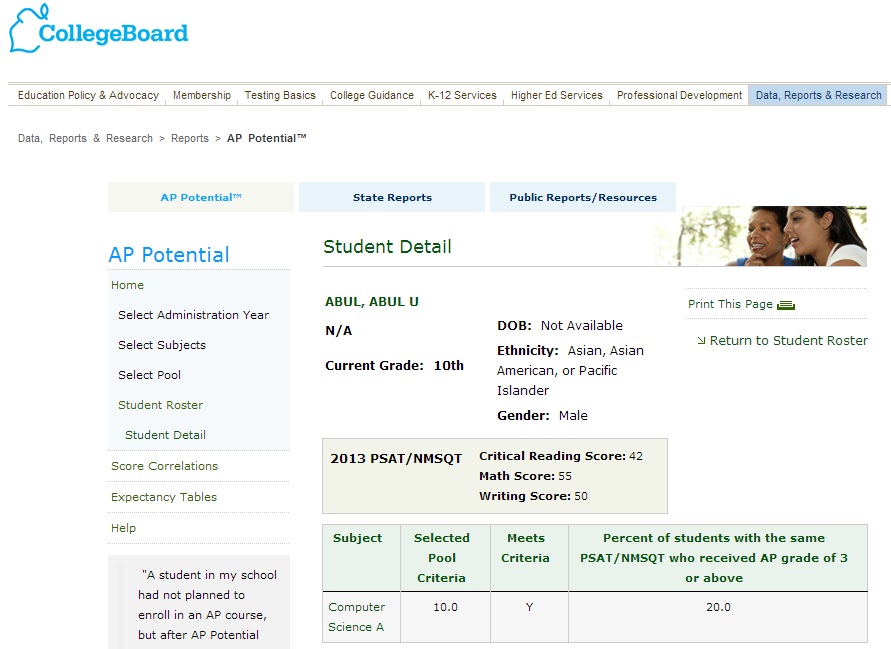
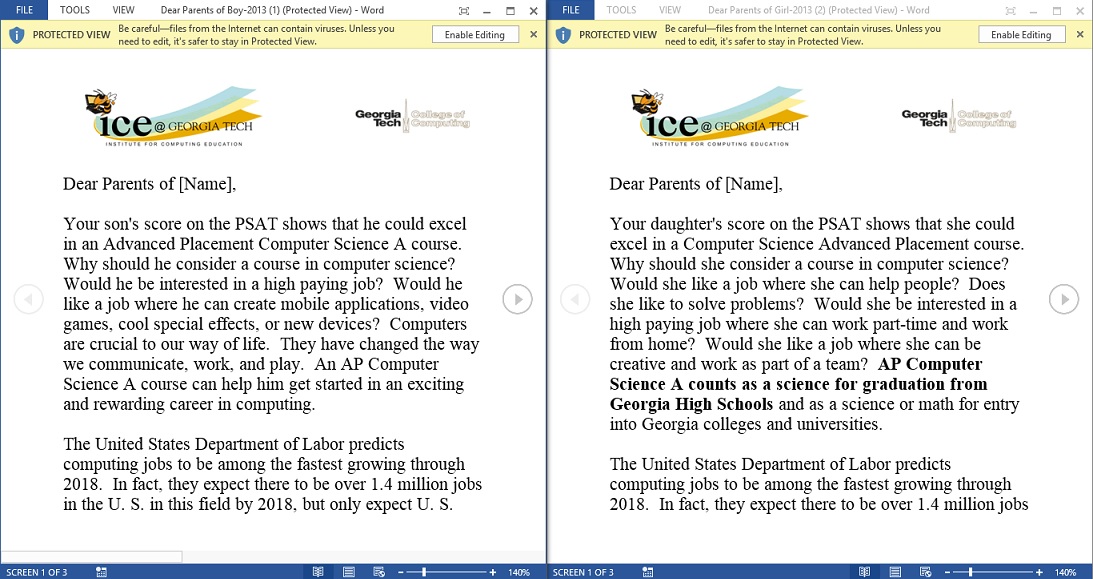
theodp (442580) writes AP Computer Science is taught in just 10% of our high schools," lamented The White House last December as President Obama kicked off CSEdWeek. "China teaches all of its students one year of computer science." And the U.S. Dept. of Education has made the AP CS exam its Poster Child for inequity in education (citing a viral-but-misinterpreted study). But ignored in all the hand-wringing over low AP CS enrollment is one huge barrier to the goal of AP-CS-for-all: College Board materials indicate that the average 11th grader's combined PSAT/NMSQT score of 96 in reading and math gives him/her only a 20%-30% probability of getting a score of '3' on the AP CS exam (a score '4' or '5' may be required for college credit). The College Board suggests schools tap a pool of students with a "60-100% likelihood of scoring 3 or higher", so it's probably no surprise that CS teachers are advised to turn to the College Board's AP Potential tool to identify students who are likely to succeed (sample Student Detail for an "average" kid) and send their parents recruitment letters — Georgia Tech even offers some gender-specific examples — to help fill class rosters.
So you're suggesting that a K-12 focus on self-esteem doesn't result in outstanding academic ability?
This just in: difficult things are hard, and most people can't do them.
-Styopa
College Board materials indicate that the average 11th grader's...
The "average" 11th grader isn't going to be taking AP classes. There is a reason they call it ADVANCED placement. It's supposed to be hard. It's supposed to be for the top end of the bell curve.
They should integrate programming with math classes. They should start students using Mathematica or Sage as early as possible. Programming math problems would teach both math and programming. Students would see programming as a problem solving tool, and not just another burden of something else to learn. If they integrated programming into math classes they wouldn't have to worry about adding programming classes to their curriculum. They could also integrate programming into other classes like science, or even English.
Waaaayyy back in the mid-90's, I took the AP CS test my junior year of HS. The test was scheduled right after I took the AP US History test in the AM (I rocked that test with a 5 and passed out of 2 semesters of history for it) and as my brain was fried, I staggered into the principal's conference room to take the AP CS test with another dozen or so kids from my class.
I completely bombed the test (a 2)... my brain was so scorched from the history exam that morning I couldn't make heads or proverbial tails of the essay questions. I got a 2, and I'm glad I did. Why? Because that was when the test was still being administered in Pascal, and by the time I got to college, my school had shifted over to C++ as their main "teaching language". It's no fun taking an advanced CS class when all your assignments take extra time while you give yourself a crash course in C-style syntax everybody else is taking for granted.
That said, despite the fact I flunked the test, my actual high school CS class was excellent. It meant that when I had to re-take intro-to-CS in college all I had to do was learn new syntax for the concepts I already knew; the overlap of the theory was pretty complete.
On another note, why would we expect the average high-schooler to pass a college-level CS exam? It's a hard test, just like it's supposed to be. And it's a subject that many students, no matter their other virtues, don't have much aptitude in. (I'd be interested to know what this one year in "Computer Science" that all Chinese kids are given actually consists of...)
All that said... yes, waaayyyy more than 10% of our high schools need to be offering the class. Every high school surely contains some students with both the aptitude and desire to take such a class.
All those jobs will be going to H-1B visa owners.
When Fascism comes to America, it will call itself Anti-Fascism, and tell you to give up your guns.
They are not taking college courses in high school. The student is not going to a local college and taking the course there. They are taking a "college like" course in high school. The two are not the same, not even close. High Schools like to say AP courses are the real thing but they are not. College professors laugh at you when you tell them you took a AP class.