 Slashdot Mirror
Despite Push From Tech Giants, AP CS Exam Counts Don't Budge Much In Most States
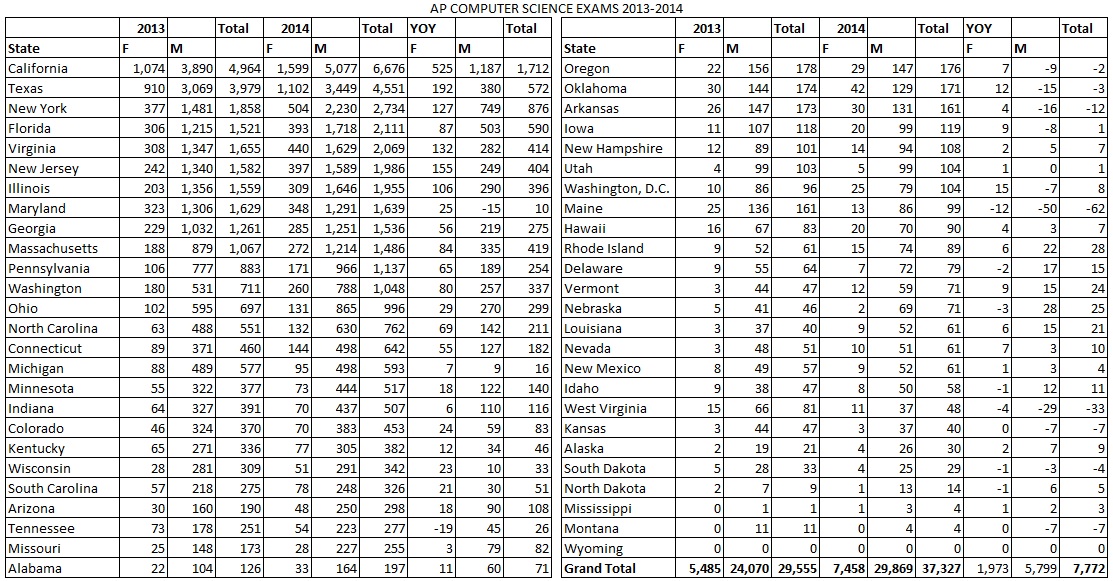
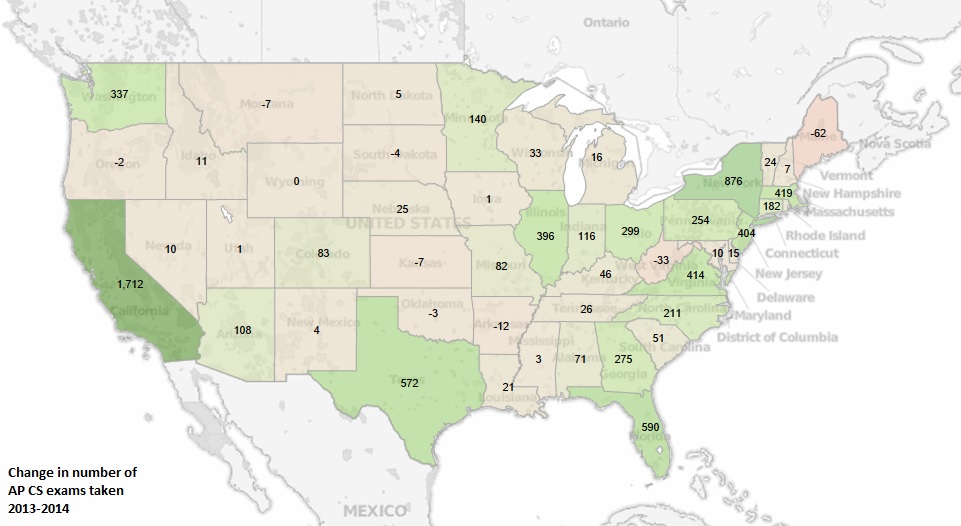
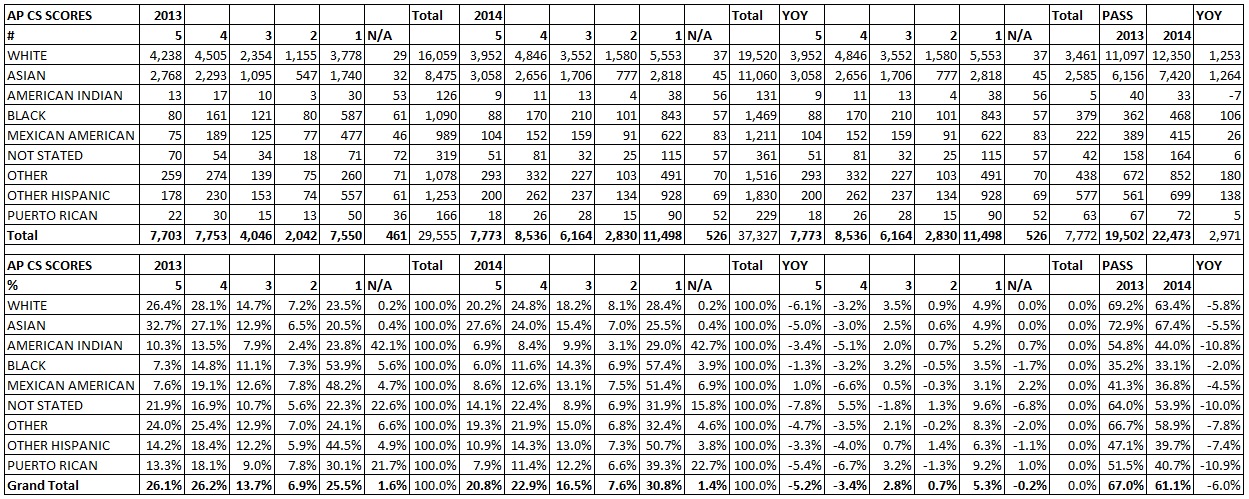
theodp (442580) writes "Well, the College Board has posted the 2014 AP Computer Science Test scores. So, before the press rushes out another set of Not-One-Girl-In-Wyoming-Took-an-AP-CS-Exam stories, let's point out that no Wyoming students of either gender took an AP CS exam again in 2014 (.xlsx). At the overall level, the final numbers have changed somewhat (back-of-the-Excel-envelope calculations, no warranty expressed or implied!), but tell pretty much the same story as the preliminary figures — the number of overall AP CS test takers increased, while pass rates decreased despite efforts to cherry pick students with a high likelihood of success. What is kind of surprising is how little the test numbers budged for most states — only 8 states managed to add more than 100 girls to the AP CS test taker rolls — despite the PR push by the tech giants, including Microsoft, Google, and, Facebook. Also worth noting are some big percentage decreases at the top end of the score segments (5 and 4), and still-way-too-wide gaps that exist between the score distributions of the College Board's various ethnic segments (more back of the envelope calcs). If there's a Data Scientist in the house, AP CS exam figures grabbed from the College Board's Excel 2013 and 2014 worksheets can be found here (Google Sheets) together with the (unwalkedthrough) VBA code that was used to collect it. Post your insight (and code/data fixes) in the comments!"
Obvious for some, but what does AP stand for???
Associated Press?
Please avoid unnecessary acronyms - this is an international site.
If builders built buildings the way programmers wrote programs, then the first woodpecker would destroy civilization.
...if you're going into a CS program. This holds in general with AP tests, don't take the ones in your intended major, because you're unlikely to get useful credit for them. This varies from school to school of course, but it's generally true.
If women want to be in IT/Engineering/Math/Whatever then they'll be in IT/Engineering/Math/Whatever. The idea that there needs to be an exactly equal amount of all groups in every field is patently absurd. People are different. All of us. Even the ones who are in the same ethnic/religious/chromosome group. Quit trying to put people in neat boxes, it doesn't work. Let this issue die. Please Slashdot. It's for your own good.
Apparently those who are capable of taking the AP CS exam are also those who are interested in taking the AP CS exam. Getting outside pressure to increase interest does not increase capability. Color me shocked.
Took the exam last year, and scored a 5 (New York City - in fact, Bronx HS of Science)
-- 73 de KG2V For the Children - RKBA! "You are what you do when it counts" - the Masso
I believe it is 'Advanced Placement.'
As an employer, I would care far less about how people do on a test then I do about actual projects they've worked on or finished programs they can demonstrate. IMHO, STEM jobs are far less about theory and more about practical applications.
Maybe my recollection is bad, but, wasn't the big PR push just in the last year? I know at my high school (granted, almost 20 years ago now) you had to take 2 years of CS to get into the AP course and even attempt the test. So at a minimum I would expect the PR push to show up in next year's numbers. Its going to take more time and effort than 1 year of google handing out cash to make a significant change in numbers, and its going to take a long time to really improve pass rates. You can't just throw a CS book at your average HS student and expect them to get a 5 in 6 months time.
Its going to take at least a decade to get female numbers up to parity, changing culture is hard. Its going to take at least a decade to improve pass rates because you have to start teaching CS earlier in order to have a foundation. We start teaching math in kindergarten, how many students take the AP test in calculus and how many pass?
Also, in my experience each year the tests are vastly different and have vastly different pass rates, so one year does not really mean much. My AP Chemistry test was an example, we only had a few students pass (with 3s) out of a class of 30, where the year before, 75% of this same teacher's class passed, and more than 50% got 4 or 5. The teacher after the test read through it and said our year was the hardest test she'd ever seen.
I'd like to think that the brightest US high school students would be smart enough to avoid going into a field that is being outsourced overseas and go into something like Medicine that pays better and is more secure.
If the goal is getting people interested, implying a lack of interest, you can't measure it yet.
Going from not interested to being in an AP class is not a reasonable expectation in a school year. Being in the class does not imply being remotely capable of passing. And the tests cost money. Some states have conditional reimbursement, but I don't see it working out well for people otherwise disinterested a year prior.
People have some idea of the classes they will take entering high school. While that may change, it won't change much due to outside influence like this.
I would not expect numbers to change much for another two years. I planned my AP tests for maximum benefit, and even with 6 years experience under my belt, I would not have signed up for the class, and had I gone that far the test would have given me no real advantage. I made sure I got AP math, English, and foreign language, for college credit. I took AP physics but skipped the test because it didn't fit the plan.
All of this was a pre ordained outcome based on the classes I took freshman year. You have to consider the first four years building years, as each year has a less specific plan in place that this effort has to fight against.
Would more people, maybe even girls, be interested in this test if employers stopped shipping in visa workers and started to increase pay?
Let's try it, for science.
You don't usually "go into" CS with the goal of getting some kind of tech support job.
Mod me down, my New Earth Global Warmingist friends!
Medicine eh?
Well you are far more certain to get sued in that profession than if you are in CS.
You are also more certain to start out your medical career with say a $300,000 debt.
So, before the press rushes out another set of Not-One-Girl-In-Wyoming-Took-an-AP-CS-Exam stories, let's point out that no Wyoming students of either gender took an AP CS exam again in 2014
There are 31 CITIES in the US with a larger population than the entire state of Wyoming. It's the least populated state in the US. It's most populous city is the capital of Cheyenne with 60,000 people. Heck, the District of Columbia which doesn't get 2 senators and a voting representative in the House has more people than the state of Wyoming. The fact that AP technology classes aren't exactly hugely popular there should surprise no one. I imagine their school budgets are tight enough trying to keep the lights on with populations that small.
(Parentheses) for (half) of the headline are (annoying)
We would all love to see a radical uptick in high school students excelling in CS. But expecting a one year initiative to have a dramatic effect on an advanced course is irrational. Hour of code teaches extremely rudimentary material. If students get support at school and take it a little further, and if their schools start offering advanced placement CS, then it will eventually have an impact. Obviously, doing hour of code is not going to create AP computer science classes where none existed before. We would all love to see a silver bullet, but education is a hard problem, and thus far no one appears to have "solved" it.
There are a lot of factors in play here. As noted above, the effects of the Hour of Code and other pushes to get more into programming won't be felt in the first year. My anecdotal situation - AP CS classes at my school increased from about 40 students to over 60 this year. I don't know if this trend is seen throughout the US or not.
There is also the issue of preparation. Not every school has a teacher who is "qualified" to teach the rigorous material in AP CS. My guess is the vast majority of AP Calc teachers have successfully finished Calc 3 and beyond, but that's not true for many AP CS teachers who might be a Business teacher or a Math teacher with a couple of CS courses. There are some schools that require students to take the AP test if they are enrolled in the course (and I believe the schools pay for them), which may account for many 1's.
Additionally, not all schools have a program that leads into AP CS. Unlike subjects like AP Calc where there is past curriculum that builds from past years, AP CS might be the first experience to coding that many students have ever had. I think efforts that are getting younger kids into coding will eventually lead to a very nice bump in AP scores in the future.
When the AP CS Principles curriculum starts being implemented more broadly, there should also be a positive effect on scores. Students who might have struggled in a more theoretical class like AP CS will gain a great deal of foundational knowledge in the Principles course. It will be a great way for kids to find out what CS is all about before deciding whether to choose the AP CS course.
James Tiberius Kirk: "Spock, the women on your planet are logical. No other planet in the galaxy can make that claim."
When folks are complaining about women in tech, they always look at engineering and software. Medical is never brought up. Why is that? I think it's because the lobbyists - the Silicon Valley people - are making a big deal out of nothing to boost the supply of labor.
Look at the 'M' part of STEM and you'll see a much different story - even amoung medical school enrollments - when it comes to women. Maybe women are a bit smarter in picking careers for longevity and pay?
I tell young people, unless you really really really love engineering and programming, you'll have a much better future in medicine - and a longer one at that.
Why bust your ass 60+ hours a week for $80K per year -if that - and have your job sent overseas to India when you could be making as much working 36 hours a week as a nurse practioner - over $100K when you get about 4 years of experience.
The STE part of STEM sucks unless you absolutely cannot do anything else because of love or lack of talent. It's too much work and stress for too little rewards.
Really? I've been on the wrong end of 4 patents. On the other hand, my sister is a pathologist. Her patients never sue.
When I was a kid, computers were these neat little things that looked like an electric typewriter that you could plug into the tv and program in basic. And its where a lot of kids became programmers. Success was easy to achieve. Now everything is bolted down. We dumbed it all down for the masses, and made it harder. Now its something you do like going to the dentist, or taking your dog to the vet, or take an AP test in because some plutocrat thinks you should. And the numbers have barely budged. Imagine that.
I feel bad for CS majors. On one hand you have outsourcing suppressing wages and making job security unpredictable. Even if outsourcing is a mistake for most companies, some naive CxO's still think it's a good idea. On the other hand you have Mr. Suckerburg and the heads of most tech. companies trying to suppress wages by flooding the labor market through campaigns like this.
At least this article is a bit of good news. It's good to know that their marketing campaign is failing either because they're ineffective or because students are more intelligent than they assume.
The answer is simple: Pay more.
The salary of a tech worker strait out of community college is $30k around here. You can make that much at Walmart, easilly. Why on earth would someone go into a profession that requires difficult classes and pays shit? You can get a nursing degree with a hell of a lot less effort and they start at $45k, the demand for workers is huge and there's no possible way you'd ever get outsourced.
If this is due to the public perception that technology as a profession is one that is likely to be outsourced or given to foreign workers with H1B visas. It could also be due to perception that careers in technology are unstable, feast and famine. I left technology as a career because I'm sick of having my job held over me with a looming threat of being easily replaced. I'm sick of the vendor certifications and being evaluated for potential based on them. Also, I grew weary of performance-based metrics and evaluations. The MBA mindset has killed IT. I traded in my cube,for a tractor trailer 6 months ago and haven't looked back. Truck driving isn't likely to be fully automated any time soon and we aren't importing foreigners .... yet. It's nice being in demand instead of a commodity to be disposed of. The BLS sees massive shortages in labor predicted over the next 10 years in the trucking field.
Hardware breaks. Cables need replacing. As long as these are true, technicians can't be outsourced. Programming on the other hand, that can be done anywhere in the world. Why pay an American 80,000 when you can pay an Indian that went to the same college as the American a mere 10,000? Any rational mind would say hiring a western programmer for western rates is clearly foolish.
In K-12 education, changes in policy, curricula, and other interventions such as supplementary classes (in this case) don't show much effect on learning outcomes until they've been in effect for at least 10-15 years. So, if Google, Faccebook, Microsoft, et al. can maintain their coding instruction projects for the next 10-15 years, they'll see what's possible with those approaches. So far, extra-curricula interventions in other subjects don't appear to show significant differences in learning outcomes. It's safe to ignore all the marketing B.S. from private and commercial after-school providers and heart-rending case histories from parents... that's the road that leads to snake-oil and quackery.
So, before SLASHDOT rushes out another set of Not-One-Girl-In-Wyoming-Took-an-AP-CS-Exam stories
FTFY
who in their right mind would go into computer science in America right now? At the same time Tech Giants are pushing for more CS majors their campaigning hard to bring in more H1-B visa holders. Meanwhile outsourcing continues to eliminate jobs.
Maybe if the gov't would get serious about promoting small software businesses (small 50 employees, and be careful they're not just shill companies for Microsoft et al) and if we had some protectionism I'd say go for it. But right now is not a good time to be a CS major...
Hi! I make Firefox Plug-ins. Check 'em out @ https://addons.mozilla.org/en-US/firefox/addon/youtube-mp3-podcaster/
It's clear you don't understand business.
The stable jobs will be IT and not CS. Why would somebody bound for IT take the CS AP certification?
The AP system is almost pure BS. What a joke. Their metric for measuring the number of majors is by how many high school children ignorant enough to take the AP for it? If it were offered to me when I was in school I would not have taken it and I knew far more than it covered... I still learned something in taking CS courses in things I already knew; not as much as I paid for, but it was still useful information that filled the gaps.
I attack the AP BS system because I did it for calculus. Tested out of 2 semesters but I took them anyway and saw first hand just how incredibly poor the AP system was and my math high school teacher's negligence by only teaching to the AP exam-- no wonder we did well on the exam, we had only been preparing for it instead of actually learning the subject.
This is what happens in a meritocracy! The metrics and systems are gamed by the superior human brain which can always out smart a static system lacking active intelligence. (the only solution is to be evaluated by another human brain who can adapt as quickly as you can.. and who knows the topic better than you do. They are only somewhat susceptible to politics, blackmail, bigotry, hypnosis, etc. on an individual level. )
Democracy Now! - uncensored, anti-establishment news
Most young people do not regard CS or IT as an attractive career. If my daughters had any interest in either, I would actively discourage them. My biggest mistake was switching from Mechanical Engineering to IT. IT paid more but was far less satisfying and sucked to be blamed for the consequences of decisions made by those casting the blame.
If you want to be in CS or IT, great. If you don't, that's a wise choice.
... more like...
So you're an 'employer', but you still think the word 'then' means 'than'?
Here's a clue. It's MORE THAN, you fucking American cretin. What is it with Americans writing 'more then' all the fucking time?
People interested in programming in high-school probably had some nerdy interests as adolescents. Interests that weren't squashed by teachers, peers, or parents as so often is the case.
By the time they are 16 or older it's probably too late. Granted there are certainly exceptions, but don't look for a shift in numbers so soon. It takes a concerted effort over at least a decade to begin moving the needle, then a slow ramp up over the following decade to shift the cultural pressures and expectations. Look at how long it took for geekdom/nerdiness to become accepted.
There's also the whole unique snowflake issue where the first girl to show up at the clubhouse is likely to attract a lot of attention, which can go in a negative direction fairly quickly because young kids are so scared and unsure of themselves (on both sides). Once you regularly have girls/women in programming meet ups, comp-sci courses, etc it becomes much less of an issue.
We know this is just cultural and not some bullshit "maybe girls don't like programming" garbage because the ratio of women in the field was much higher in the past.
Natural != (nontoxic || beneficial)
Comment removed based on user account deletion
...if you're going into a CS program. This holds in general with AP tests, don't take the ones in your intended major, because you're unlikely to get useful credit for them. This varies from school to school of course, but it's generally true.
Totally disagree. I took 5 AP classes in High School in ~1980. I was the first person in my High School to achieve this number of AP classes, and I was able to skip my freshman year of college and immediately begin taking more advanced math, physics, chemistry, honors English, and when I discovered them, CS courses. I was well on my way to multiple degrees, while most of the people I went to High School with were still deciding what to major in.
Testing out of a class is a more iffy proposition. I found that CLEP testing, at least for information learned as an autodidact, rather than in a classroom and labs, as the AP credit was, tends to give you spotty coverage of a subject, unless you are going to read the textbook for the course you intend to CLEP out of from cover to cover, and do the exercises. It also can somewhat rob you of a year in college; it's actually quite easy, by combining CLEP and AP testing, to drop your distance to a Bachelor's degree to two years. Less, if your college/university administration allows you to carry ~20 credit hours, rather than the "normal" 12-14 (admittedly, this can still be a deal, if you are there on academic scholarship, and your parents wouldn't be able to pay your tuition for you otherwise). This will generally translate to one fewer internship, and one fewer year of college social life, such as it is.
Practically speaking, I'd say that piling on the AP classes is a great way of saving money in the long term by front-loading the costs of college credit onto the state, rather than having it come out of your, or your parents, pockets, especially if you can't afford it. Assuming you apply yourself and do well on the tests, it's also exactly the thing that a college or university is going to want to see, should you apply for an academic scholarship, and between that, and a Pell Grant (now called BEOGs), it can cover your tuition, books, and living in the dorms, which is, for a poor person from a poor family, your entire opportunity for a higher education.
The Slashdot hated coal mining industry and oil industries (and a few other mineral concerns) contribute a lot to the budget. We do better than most due to that. A lot of kids take the IB route at one of the high schools in Casper (which also offers several AP courses). It's tough to do both IB diploma and AP. There aren't enough hours in the day for IB and much of anything else.
The small population does factor in greatly though. Only the larger cities (large being relative) have enough students to be able to provide a very wide range of AP and IB high school classes. A lot of kids make use of a BOCES program to take college courses during high school. The credits earned count in both high school and college. It's a good deal for some of the smaller towns and as long as you get a decent grade the cost is free to the student. Some of the advanced kids may not get to take an AP exam, but they may graduate high school with the equivalent college credits already under their belt due to that.
And this is my problem. There is nothing in AP CS that I would need for my time in engineering programming computers to solve problems. I think that the class is somewhat irrelevant to someone who want to pursue CS because most hopefully already have the basic skills taught in the class by the time they are a senior.
One real issue is people who can teach is class. It was only 35 years ago that I was sat down on a computer and taught to write basic programming. It will take time for the pipeline to fill with qualified teachers. One hopeful sign is that we have a lot more introductory engineering classes than when I was high school, made possible because we have been cranking out engineers in this country since the end of WWII. So in another 20 years, we might have CS teachers.
"She's a scientist and a lesbian. She's not going to let it slide." Orphan Black
At my school the only way to get your undergrad in CS in four years is to start your freshmen year in Calculus for Engineers. This means you had to take College Algebra, Trigonometry and Pre-Calculus in high school. So if you're looking to get a head start on a CS degree don't bother with high school CS classes, go for math.
Just thought I'd throw that in there cause it really upsets me that they still call this a four year degree when thats only possible with three AP math courses in high school. From my college placement exam they put me in Intermediate Algebra to start. So I had four math classes before I could take what they say should have been my freshman class. Don't get discouraged tho, obviously I'm no math wiz and from my humble start I made it through Calculus for Engineers III with high marks.
The takeaway; if you wanna get a head start on a CS degree take AP math.
To expect the average medical practitioner to have 4 patents over their careers is ludicrous.
I suggest trying to avoid holding a given belief just because you like it.
The kind of dev. I'm interested in doing isn't being outsourced. The type of jobs being outsourced aren't the ones I had in mind when I chose to pursue a C.S. degree.
Credit where it's due - at least he's concise.
--
Bonehead Assholeton
AP CS exams assume people actually want to be programmers in high school. I didn't. I changed majors. Not to mention taking AP CS isn't going to teach you anything or prepare you in the first place.
I took this in high school and was far advanced from just about everyone in my college CS courses. We covered all data structures linked lists, stack, queue, trees, etc (using both arrays and pointers), searches/sorts big O, etc. all of this included when and why to pick the algorithm, etc We did recursion, crazy hybrid structures, you name it we did it. It was a great course. The best course I have ever had in my life. It was an entire school year in length and started with about 25+ kids and ended up with about 8. I took the official test and did very well and received 3 college credits. All year we turned in actual code projects, and every one of our tests was to write code (on paper) On the final test (for college credit) you had to write code on this test. Most of the the questions required you to use recursion and things like doubly linked lists, nothing easy. Stuff like that is hard when you just write it on paper.
CS is a character builder but a really tough major for an uncertain reward.