 Slashdot Mirror
Philae Lands Successfully On Comet
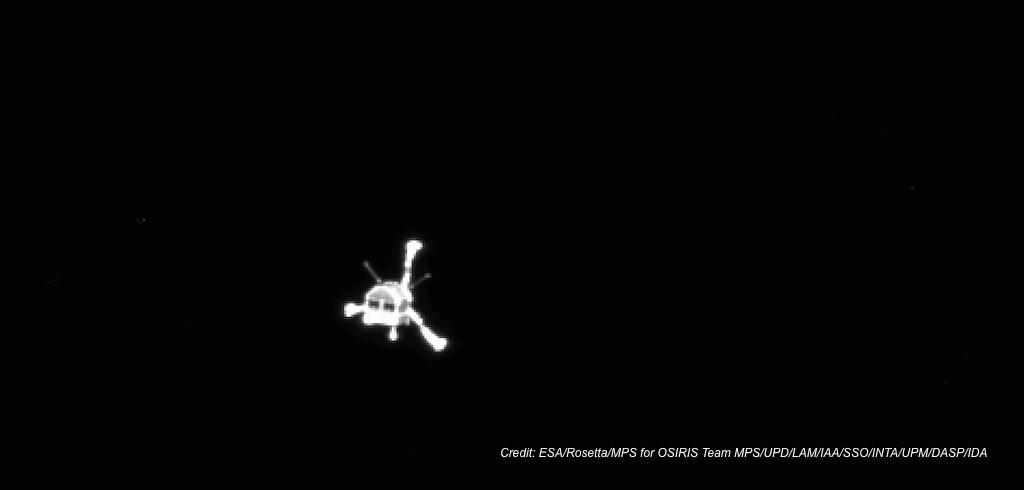
The European Space Agency has confirmed that the Philae probe has successfully landed on the comet 67P/Churyumov–Gerasimenko and established contact with headquarters. The harpoons have deployed and reeled in the slack, and the landing gear has retracted. (Edit: They're now saying the harpoons didn't fire after all.) There are no photos from the surface yet, but the Rosetta probe snapped this picture of Philae after initial separation, and Philae took this picture of Rosetta. Emily Lakdawalla has a timeline of the operation (cached). She notes that there was a problem with the gas thruster mounted on top of the lander. The purpose of the thruster was to keep the lander on the comet after landing, since there was a very real possibility that it could bounce off. (The comet's local gravity is only about 10^-3 m/s^2.) The pins that were supposed to puncture the wax seal on the jet were unable to do so for reasons unknown. Still, the jet did not seem to be necessary. The official ESA Rosetta site will be continually updating as more data comes back.

Harpoon did not fire. https://twitter.com/esaoperati...
It all starts at 0
The second picture was taken from the probe itself after it detached. According to the ongoing conference, the picture was taken exactly (their words) 50 seconds after the probe was released.
The Sun is the bright spot in lower middle. Rosetta itself is in the upper right. Because the probe was spinning when released, there is a slight blurring of the picture.
We will bankrupt ourselves in the vain search for absolute security. -- Dwight D. Eisenhower
The blur in the center is a sunbeam -- ignore that. The boxy shape on the top right is the Rosetta probe itself. Extending to the left is Rosetta's solar panel. Here's an artist's conception of Rosetta to give you a better idea of what you're seeing. The stuff around the bottom corners and very left side of the images are just reflections/lens artifacts.
Rosetta solar panels at the top of the image, with the main body of the probe top right. The sun was causing lots of straylight in the image and it was quite saturated, so they had to do some major fix-up work to get anything sensible, hence the wierdness that you see on the left hand side.
Please remain calm, there is no reason to pani... wait, where are you all going?
https://twitter.com/Philae_MUP...
https://twitter.com/Philae2014
https://twitter.com/esa_rosett...
http://blogs.esa.int/rosetta/
The mission in it's entirety, including the planning stage, took around 25 years. Or so they said during the post-landing press conference.
If a train station is a place where a train stops, what's a workstation?
Rough crowd tonight.
Faster! Faster! Faster would be better!
I loaded XKCD late in the game an thus missed some of his humorous updates regarding the landing. Luckily, XKCD1446.org has compiled all of them and you can flip through them from the first (blank) image to the most recent.
My sci-fi novel, Ghost Thief, is now available from Amazon.com.
Not only the simple age of the devices, but modern space electronics are made using exotic SOI processes (Early era devices had features so large that radiation-induced avalanches from single particle didn't matter, but then Moore's Law happened and an insulator substrate became necessary) and in terms of feature size and speed run far, far behind the state of the art commercial devices at the time of design
Last I checked, the most powerful general purpose spaceflight-rated computer is still a rad-hard MIPS R3000 running around 300MHz with 128MB of memory. It cost a quarter million dollars, but it's also multiple redundant everything and it wouldn't even fart at a radiation dose sufficient to kill a thousand people.
Look at the specs on New Horizons: One megapixel camera. 16GB onboard SSD... And after fifteen years cruising through space colder than a cryogenic refrigerator it wakes up and tells mission command "Ready for Pluto to come at me, bros!". Fuck yeah, science.