Slashdot Mirror


In-Flight Service Gogo Uses Fake SSL Certificates To Throttle Streaming

Amanda Parker writes In-flight internet service Gogo has defended its use of a fake Google SSL certificates as a means of throttling video streaming, adding that it was not invading its customer's privacy in doing so. The rebuttal comes after Google security researcher Adrienne Porter Felt posted a screenshot of the phoney certificate to Twitter. From the article: "The image clearly shows that Gogo signed the certificate, not Google, thus misleading customers and opening the door to malware on users' devices. It also serves as a way to throttle data and limit traffic on its networks. 'Gogo takes our customer's privacy very seriously and we are committed to bringing the best Internet experience to the sky,' CTO Anand Chari said in a Monday statement."
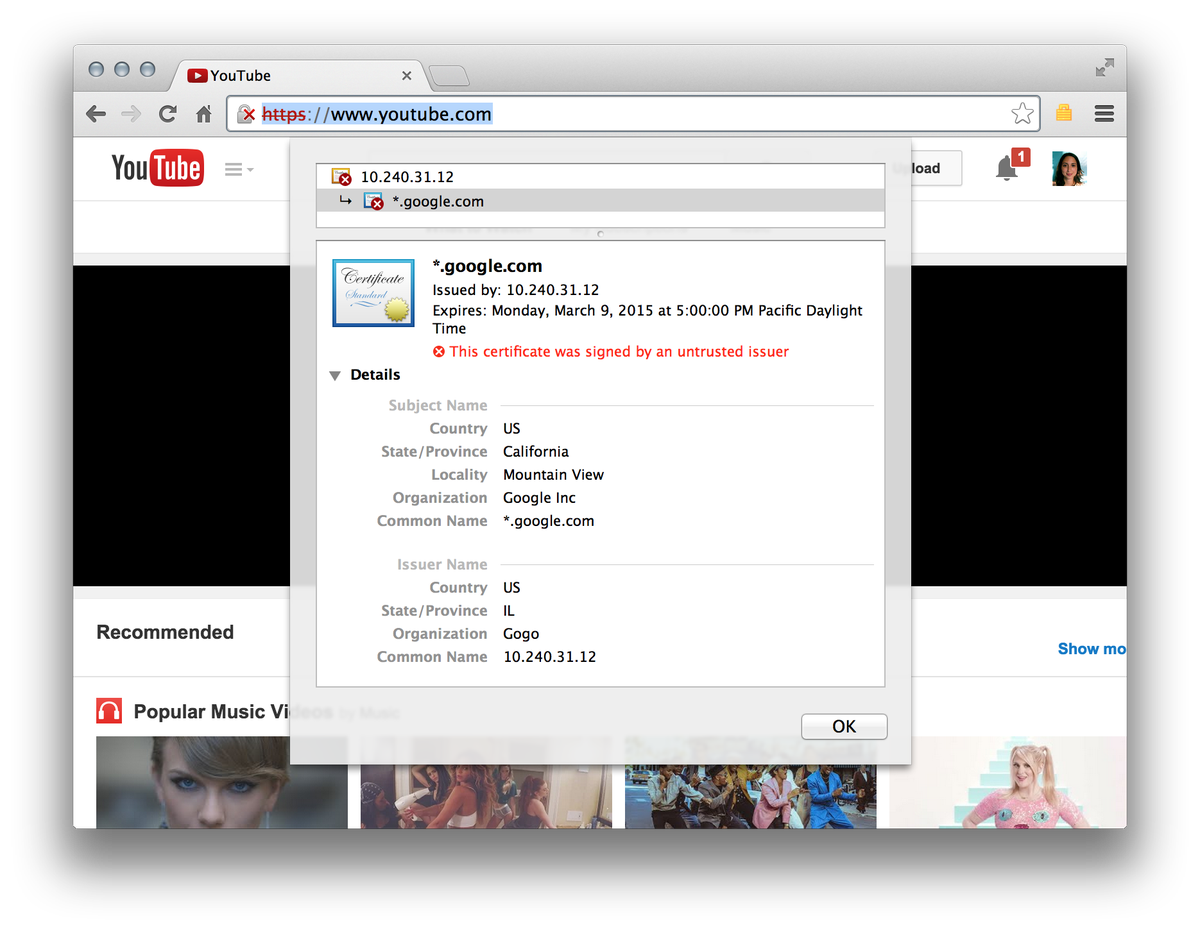
163 comments

  1. Get What You Pay For by sycodon · · Score: 1, Insightful

    These fuckers need to stop selling shit they can't support. If I pay for band width, I need to have it when I want it, for whatever I want it for.

    And don't give me any of this "Up To" bullshit. They should be required to indicate what the average speed you are buying is.

    --
    When Fascism comes to America, it will call itself Anti-Fascism, and tell you to give up your guns.
    1. Re:Get What You Pay For by AuralityKev · · Score: 4, Insightful

      There's no competition there - I think it'd be fine to be perfectly up front to say something like "While we're screaming across the earth defying gravity at 750 miles per hour, we do not have the ability to provide enough bandwidth so that everyone may watch Netflix. Streaming video sites are not accessible. You don't like it, don't buy it."

    2. Re:Get What You Pay For by danbob999 · · Score: 2

      I'm OK with ISPs offering speed variation through the day, based on demand. Why limit my speed to 10 Mbps at 4am if you can offer 100 Mbps at no additional cost? Just don't limit the speed according to the service/application/port number/web site I use. An ISP is a dumb pipe and my bytes should get the same priority as anyone else's.

    3. Re:Get What You Pay For by jonnythan · · Score: 2

      I paid for some GoGo on a flight recently. The signup page made it pretty clear that data speeds were pretty limited and I wasn't allowed to stream video. I don't know why they need to spoof certs for that as opposed to just blocking sites or protocols though. Maybe they do some sort of data compression on the ground before transmitting to the plane or something?

    4. Re:Get What You Pay For by sycodon · · Score: 5, Insightful

      You lied when you sold it to the second user.

      --
      When Fascism comes to America, it will call itself Anti-Fascism, and tell you to give up your guns.
    5. Re:Get What You Pay For by Anonymous Coward · · Score: 0

      I don't understand. How is faking/hijacking SSL have ANYTHING to do with limiting streaming or a persons bandwidth? In all of my years of being a network engineer, I've never heard of managing bandwidth that way and can't think of why someone would mange bandwidth that way.

    6. Re:Get What You Pay For by Anonymous Coward · · Score: 0

      I want better than that. I want to the speed to be the speed I get better than 95% of time. With an average speed, they could be slower 50% of the time. :-(

    7. Re:Get What You Pay For by Anonymous Coward · · Score: 0

      They break SSL so that they are able to "transparently" proxy all connections to throttle some things and cache more than they could if traffic were opaque to the proxy. It's the difference between something like deep packet inspection and just looking at IP addresses and ports: Finer grained control and less guesswork. Their explanation is plausible. But that company previously also boasted how much information they can give to law enforcement, so the bandwidth management explanation probably isn't the whole truth.

    8. Re:Get What You Pay For by Anonymous Coward · · Score: 0

      this has nothing to do with bandwidth, and everything to do with the airlines protecting their
      in-flight video monopoly.

    9. Re:Get What You Pay For by Anonymous Coward · · Score: 1

      They limit you to a 1mbps 802.11b connection. They perform further rate limiting on packets going in and out of the plane, however I was able to transmit voice clearly and low bandwidth (~384kbps) video on my last gogo flight. The price hikes have been enough for me to put away the laptop while flying, but for 4+ hour flights i still break out my raspberry pi and offer streaming video to others on the plane

    10. Re:Get What You Pay For by IamTheRealMike · · Score: 1

      In all of my years of being a network engineer, I've never heard of managing bandwidth that way and can't think of why someone would mange bandwidth that way.

      Me neither but we have no idea what kind of filtering system you can install onto a plane.

      My guess is that they can't filter by DNS lookup for some reason (people's devices have cached answers?) but they can do SSL rewriting, and for big sites like anything Google runs IP address blocking isn't useful because all their sites share IPs. They know browsers and apps won't accept their fake certs, it's just a way to create an unbypassable error.

    11. Re:Get What You Pay For by dszd0g · · Score: 1

      ISPs are like all you can eat restaurants. In your example it would be like an all you can eat restaurant making enough food for one person and letting 1 million through the door. They have to estimate what the average person eats and make sure there is enough food for everyone they let through the door.

      The difference is that most all you can eat restaurants will start turning people away at the door when they know they are going to run out of food. ISPs just keep selling to more customers even when they know they don't have enough bandwidth.

      --
      This message is encrypted with Quad ROT-13 to protect the author's copyright under the DMCA.
    12. Re:Get What You Pay For by StikyPad · · Score: 1

      I wish they went 750! Unfortunately, it seems most travel at about ~450 these days to save fuel. Maybe that will change with falling oil prices, but as long as ticket price is king, probably not.

    13. Re:Get What You Pay For by jonnythan · · Score: 3, Informative

      They could say something like this:

      Bandwidth at 30,000+ feet is inherently limited, and heavy-load activities like streaming videos from the ground can weigh down our network. That means playback is subject to poor video quality, buffering, and slower connection speeds for your fellow passengers.

      Oh wait. That's exactly what they say. They're very up-front about not being able to stream video.

    14. Re:Get What You Pay For by nblender · · Score: 1

      What the average person eats is much smaller than when a few people come in with coolers full of Tupperware containers and start raiding the 'all you can eat' saying "But you said all I can eat! You didn't say I had to eat it here and all in one sitting!"

      A restaurant would quickly go out of business if they had to cater to a steady stream of people with big coolers..

    15. Re:Get What You Pay For by Anonymous Coward · · Score: 0

      feel entitled much? fuck off. this is IN FLIGHT internets, you have no fucking right to expect to stream video or even audio on a fucking airplane. don't like it, don't take the damn flight.

    16. Re:Get What You Pay For by Anonymous Coward · · Score: 0

      ISPs are like all you can eat restaurants.

      So where how does doing a man-in-the-middle attack fit with your restaurant analogy? They need to spy on what I'm eating to make sure I'm not going into the kitchen and eating stuff not on the buffet?

    17. Re:Get What You Pay For by SuricouRaven · · Score: 1

      More flights means moving more passangers per plane - money saved on plane rental, staff, maintenance.

      No-one expects oil to stay this cheap forever though. It's just a matter of how long.

    18. Re:Get What You Pay For by SuricouRaven · · Score: 1

      There's always a perverse incentive. The obvious solution for a restraunt would be to start lowering the quality of the food to people consuming too much. On your fourth plate of prawns? Time to crank up the oven and serve the fifth overcooked and dry. The ISP counterpart would be to degrade service to heavy users - which is exactly what they do.

    19. Re:Get What You Pay For by Anonymous Coward · · Score: 0

      ISPs are not like all you eat restaurants. ISPs are like providers of internet service.

      any billing or throttling or maximum users would be based on usage, and until you know what mean and median or 95th percentile usage looks like, you have nothing to base your assumptions on. this is a brand new network. never before used. no QoS is claimed... just the average speed as demanded by the original idiot poster, "They should be required to indicate what the average speed you are buying is." if you make a law that requires that, the networks will just change their name and flush the books and keep make the same "average" claims on their "new" network.

      "net neutrality" is doomed. the people for it unknowingly argue against it, and the people against it unknowingly argue for it. you can't legislate morality.

    20. Re:Get What You Pay For by Anonymous Coward · · Score: 0

      They would, because you are a liar.

    21. Re:Get What You Pay For by puzzled_decoy · · Score: 1

      If everyone saw a commercial for a Big Mac at McDonalds for only $1, McDonalds couldn't first make everyone pay for it, and then give everyone their burger- they would run out of burgers, but still have money for unfilled orders.

      No matter whether it is a burger or bandwidth, you will have an order of sale and order of fulfillment. For physical goods, fulfillment comes immediately after sale. For something like bandwidth, the current mechanism is to continue to sell even if you cannot fulfill. This is wrong.

      It doesn't matter that you receive orders all at the same time, you can only process those orders one at a time. Because of this, you *do* lie as soon as you sell to your second user, because you can no longer fulfill that order.

    22. Re:Get What You Pay For by puzzled_decoy · · Score: 2

      Should they? If you're playing an online video game, should your bytes have the same priority as someone who is trying to download a 10Gb file? Or someone who's computer is performing an automatic update? Or someone who's streaming music?

      If your answer is yes, I have to ask, why?

    23. Re: Get What You Pay For by Kyogreex · · Score: 1

      That's blatant misrepresntation of the problem and of what GP said. There's a difference between blocking completely and throttling uaing shady methods.

    24. Re:Get What You Pay For by Charliemopps · · Score: 1

      There's no competition there - I think it'd be fine to be perfectly up front to say something like "While we're screaming across the earth defying gravity at 750 miles per hour, we do not have the ability to provide enough bandwidth so that everyone may watch Netflix. Streaming video sites are not accessible. You don't like it, don't buy it."

      Everything people hate about business is Marketings fault in my opinion. Honesty doesn't make sales.

    25. Re:Get What You Pay For by number17 · · Score: 1

      You haven't provided any context in your examples. Is the 10Gb file being downloaded by Jack Bauer in an attempt to save the world? Is the video game part of a global world championship? Which one is more important and to who?

    26. Re:Get What You Pay For by Anonymous Coward · · Score: 0

      There is actually insurance that can be purchased for those offering games which may be won too many times....

      I worked in the past on a major drink makers superbowl ad. It was a square game that let each person "play" to win prizes. The official major drink company demanded that the company hosting the "game" purchase this insurance which essentially covers strange scenarios like every single person winning.

      If we say that those who guessed right win an Xbox, we are still on the hook if 5 million people more than we thought end up winning the game.

      Thus your argument is purely coming off like a kid in someone's basement who hasn't done any real work.

    27. Re: Get What You Pay For by tysonedwards · · Score: 1

      Each *user* believes their use is important and essential to them. The idea that someone gets a better experience downloading updates just because their device is an Xbox versus a Playstation versus a SteamBox, versus a PC, versus someone trying to watch Netflix or YouTube, versus someone trying to Skype call someone else, versus someone trying to ScreenHero someone else or browse the web for that matter is irrelevant. Each person feels that their money entitles them to equal service to their neighbors who are paying the same amount for their service. Hence the rub. The idea that game consoles should get better service or prioritization because they're more latency sensitive than some other arbitrary use case shouldn't factor into the discussion as if a vendor is unable to meet said demand, it is their obligation to either adjust pricing to reduce customer utilization, ergo demand, or increase supply. Hence, why there is a discussion at all regarding Net Neutrality.

      --
      Thirty four characters live here.
    28. Re:Get What You Pay For by BitZtream · · Score: 1

      They do.

      They make it very clear that streaming video is unacceptable and not allowed.

      --
      Persistent Volume manager for Kubernetes - https://github.com/dwimsey/openshift-pvmanager
    29. Re:Get What You Pay For by Damarkus13 · · Score: 1

      And they can't identify streaming video in any way other than breaking SSL for their users?

    30. Re:Get What You Pay For by Chandon+Seldon · · Score: 1

      Absolutely, because everyone paid the the same for the same service.

      It's perfectly possible to do per-user load balancing. If you advertised "up to 100 Mbps, speeds may be lower at peak times" and then oversold a 1 gig link to 100 people, then prioritize the first 10Mbps of each user's packets. Everyone's online games, VoIP traffic, streaming music, web browsing, and email will work perfectly. That one guy who's streaming 5 HD Netflix movies will have to suck it up. The guy who's torrenting will get 50Mbps of low priority traffic and probably not even notice

      --
      -- The act of censorship is always worse than whatever is being censored. Always.
    31. Re:Get What You Pay For by pepty · · Score: 1

      These fuckers need to stop selling shit they can't support.

      Before you pay for it Gogo asks you not to use it to stream video or use other high bandwidth applications.

    32. Re:Get What You Pay For by dbIII · · Score: 1

      I don't know why they need to spoof certs

      Because outright fraud was more convenient than blocking.

      If it wasn't happening on a computer we'd be seeing people getting dragged into court instead of the casual acceptance of fraud we see around a lot of SSL issues.

    33. Re:Get What You Pay For by Anonymous Coward · · Score: 0

      If you're playing an online video game, should your bytes have the same priority as someone who is trying to download a 10Gb file?

      If your answer is yes, I have to ask, why?

      Presumably I pay the same amount for my bandwidth regardless of the content. If I want to use it for sending cat images or playing games is none of your business.
      If I pay for 10Mbps then that is what I should get, regardless of content and it should be available to me, regardless of if I use it or not.

      Think of it this way: What if you rent a limousine to drive you to an event. Instead you get a moped. You don't get there as fast and in a different way than you intended but you still get there. Would you find it acceptable? Would you accept it even if that wasn't part of the agreement and would you be willing to pay full price?
      Now. What if the event just is that you are going to the closest post box to post a letter? It doesn't really matter, does it? If I pay for it I get to do whatever I want.

    34. Re:Get What You Pay For by danbob999 · · Score: 1

      Yes. And why not? If I pay the same price for the same service, why should I get a different priority for my packets? In the end, if we all use 10GB over the same amount of time, we each cost the same to the ISP.

    35. Re:Get What You Pay For by Anonymous Coward · · Score: 0

      Unfortunately, it seems most travel at about ~450 these days to save fuel.

      That, and the minor fact that there aren't any airliners that can fly much faster than 450 mph under normal flight conditions (i.e. not in a screaming dive). Not since the Concorde left service, anyway.

    36. Re:Get What You Pay For by Anonymous Coward · · Score: 0

      There's always a perverse incentive. The obvious solution for a restraunt would be to start lowering the quality of the food to people consuming too much. On your fourth plate of prawns? Time to crank up the oven and serve the fifth overcooked and dry. The ISP counterpart would be to degrade service to heavy users - which is exactly what they do.

      Let's assume, for the sake of the argument that all-you-can-eat implies a buffet because most are buffets. That said, how do you place those overcooked and dry prawns in the buffet, accessible to all customers, the pigs and reasonable ones alike to deter the pigs without unfairly screwing the reasonable ones? The pigs are the buffet's problem not the reasonable customer's problem. The buffet is just shifting the cost of their least valuable customers on to their most valuable customers. Businesses who do this sooner or later loose their most valuable customers.

    37. Re:Get What You Pay For by Anonymous Coward · · Score: 0

      not when youtube defaults to https they can't...

      granted, the provider would be better off just blocking youtube and other streaming sites completely instead of inserting their own ssl cert into the mix... but that wouldn't stop proxies or other ways around ip-based blocks.

    38. Re:Get What You Pay For by buchanmilne · · Score: 1

      DPI doesn't need to berak SSL. Most broadband networks use DPI for managing traffic, and you don't get certificate validation problems when watching youtube.

    39. Re:Get What You Pay For by binarybum · · Score: 1

      Yes. your question has only a few limited scenarios - there are many many more that could be listed - trying to reasonably rank those without context is completely unreasonable. Even looking at your examples I'm having a hard time figuring out what order to try to rank those options in - I'm sure there would be as much agreement as with selecting pizza toppings.

      A good ISP (there aren't many) should announce their average upload download rates and paying users should expect to experience those numbers regardless of how they choose to use the bandwidth. Sliding scale charges for very high usage isn't unreasonable in my mind - shady throttling is.
      Go-go charges a lot for their air service, and every time I have used it I can barely tolerate basic web-page load times. My prodigy dial-up account was faster than their wifi. They should probably be offering it as a free teaser for now and charge more when they have a reasonable service to offer.

      --
      ôó
    40. Re: Get What You Pay For by Anonymous Coward · · Score: 0

      You are a cow!! Moooooooooooooo! MooooooooooooooO!

    41. Re:Get What You Pay For by Anonymous Coward · · Score: 0

      And similarly, foodstuff manufacturers should have to put every single ingredient on the label, and not be allowed to hide behind terms like "Natural flavors" and "Artificially flavored". Never mind that that means anyone would be able to copy their formula exactly with very little effort and almost no research.

      Have you considered the possibility that they're not trying to hide this information from YOU, or from ONLY YOU, but also from their competitors? There's more people in the world than just YOU. It's not all about YOU and your petty desires, dude. If I ran an airline, this is what I'd say to people like you saying what you just said. I'd be very polite, considering, and informative, rather than merely berating you. It would go like this:

          "Our ability to provide you service is fundamentally limited. We can plan for every user on the plane streaming in full, 4K high definition picture with 7 channel stereo while downloading the library of congress in the background, on their smartphones, while using FaceTime or Skype with their bestie in Taipei, and triple the cost of your ticket! OR... we can plan for the TYPICAL use we actually see, ensure that NO ONE gets a "sorry, can't connect error," because the schmuck in seat 3B is downloading the entire Game of Thrones series, Lord of the Rings, and every Dr. Who episode ever made, etc. and playing Halo 7 or Star Hammer 3 on the new Xbox Vision!"

          "We can't tell you how much bandwidth will be available to you because the PLANE has a finite amount of bandwidth, based on the EQUIPMENT ON THE PLANE, and we can't just slap a few extra routers in, for a plane that seats 380 people. We can only GUESS at demand. Should we err on the side of caution, assume everyone needs 1+GB/S downstream AND upstream, and have to put about 5 or 10 extra racks-full of blade servers in the belly, reducing the plane's cargo capacity, range, etc., increasing its weight, altering its center of gravity and balance, and at the same time putting another 10kW power demand onto the engines, increasing fuel consumption by 3 - 6%? Then there's the fact that there isn't a Cat 5e cable or fiberoptic long enough to spool from the back of the plane to the airport, and not many cell-towers at 37,000 feet in the middle of the ocean between Nova Scotia and Greenland, which means all that bandwidth you're so desperate for has to go over a SATELLITE, which... I don't suppose you have priced that lately, have you? OR, just maybe...

          "Can you maybe, just maybe, just look out the goddamned fucking windows at God's green earth, blue sky and vast oceans, ponder the majesty of it all, drink a few tiny bottles of Vodka, try to join the mile-high club with the hot little redhead in seat 7A, and just shut the fuck up about your fucking petulant bandwidth demands you whiny fucking CUNT?!? You're ON A GODDAMNED AIRPLANE! If you're important enough to need all that bandwidth, maybe you should also be rich enough to buy your own fucking plane, and fly THAT, and leave us the fuck alone! Then you can fill that bitch with servers and equipment so you can jack off to super-high resolution porn, while you should be thinking about how amazing it is that only a few generations ago, your ancestors would have thought you were a GOD for being able to do all the shit your overindulged ass takes for granted!

          "So thank you very much for choosing our airline, please enjoy the flight!

      Or something along these general lines. Y'all feel me?

    42. Re:Get What You Pay For by Anonymous Coward · · Score: 0

      Do you need the 6th grade English version of my comment? No big words, short sentences?

    43. Re:Get What You Pay For by Anonymous Coward · · Score: 1

      They however forgot to add they're hijacking your ssl connection to do so. You know, like a mitm attack...

    44. Re:Get What You Pay For by thegarbz · · Score: 4, Interesting

      People are getting their panties in a twist about the contract rather than the real kicker. There are many more suitable ways to prevent streaming like QoS, blacklists etc. Instead they choose to MITM an encrypted connection.

      I don't care what they say. They are completely in the wrong and I'm sure if you read the laws carefully enough what they are doing is likely illegal as they have more than 3 letters in their name.

    45. Re:Get What You Pay For by Anonymous Coward · · Score: 0

      How else do you block video? Prohibit all SSL?

    46. Re:Get What You Pay For by Anonymous Coward · · Score: 0

      the best part is that they fucked up everyone's privacy while reading gmail and are not even limiting videos... users can still hog down the network by watching vimeo, using a vpn, a proxy, etc...

      I'm guessing they have a more nefarious goal and are hiding behind the bandwidth excuse, just like any other isp.

      maybe the want your email content, or Google search info. who knows? they clearly have access and are showing the intent. we just need the fbi to stop going after pot growers and 12yr old script kiddies and do some actual work.

    47. Re:Get What You Pay For by Anonymous Coward · · Score: 0

      I think the even bigger question is ‘How is this possible at all?’ Which CA signed those certificates? Why are they still in business? Why aren't they blacklisted yet?

    48. Re:Get What You Pay For by Anonymous Coward · · Score: 0

      But.. why do they need to use fake SSL certificates in order to throttle traffic? I'm fine with dividing the available bandwidth equally among all passengers that are using it, I just do not understand the need to use fake SSL certificates to do so.

    49. Re: Get What You Pay For by david_thornley · · Score: 1

      It's not really a matter of "more important", it's a matter of latency (think "ping time").

      If I'm using VOIP, or playing an online game, then it's important that I get low latency. If I'm downloading 10GB or a game update, latency doesn't matter. Therefore, when there's a batch of packets ready to go, it makes sense to send the low-latency ones first, and give priority to following low-latency packets. There does have to be some way to prevent a high-bandwidth operation from having uniformly low latency, or that user will clog the channel. (Those of you ancient enough to remember early mainframe multitasking might have been told that the foreground app should have intermittent activity while the background app can be just a straight crunchfest, and you should never run a compiler in the foreground.)

      If everybody has the same right to get reduced latency for certain things, the system remains fair.

      --
      "When you have eliminated the unacceptable, whatever is left, however improbable, must be the truthiness" - Holmes
    50. Re: Get What You Pay For by danbob999 · · Score: 1

      If everybody has the same right to get reduced latency for certain things, the system remains fair.

      No it's not. My 10GB download shouldn't be slowed down by someone else doing 10GB of video game. If the latency is too bad so that online games are not playable, then the network should be upgraded. Also it's impossible to implement. You can't detect if trafic is gaming or not. You can't detect if it's VoIP or not. Don't tell me that you only have to whitelist xbox live and SIP as there are thousands of game and VoIP protocols.

    51. Re: Get What You Pay For by Anonymous Coward · · Score: 0

      Throw a small service charge to the folks who are streaming your content! Then you'll be certain that you're breaking at least two federal laws. A dollar should do it.

    52. Re:Get What You Pay For by Agripa · · Score: 1

      The photo shows that Gogo issued the fake certificate which is why the browser flagged it.

      https://twitter.com/__apf__/st...

  2. Why? by JamesRing · · Score: 2

    Why do they need to see the decrypted packet payloads? Surely throttling could be done based on a device's behavior (e.g. bandwidth used) without having to know exactly what the user is doing.

    1. Re:Why? by Anonymous Coward · · Score: 0

      Because they want to spy on you.

    2. Re:Why? by Anonymous Coward · · Score: 0

      this

    3. Re:Why? by IamTheRealMike · · Score: 1

      You're not thinking like someone who has to deal with the general public.

      People who read slashdot can easily rattle off some semi-accurate estimates for how much bandwidth a particular online activity consumes. Load BBC News? Less than 1mb (I hope). Listen to a streamed MP3 of a pop hit? Probably 3-4mb. Watch a 40 second video? Maybe 5-8 megabytes. Windows update? Errrmm ..... maybe 20-30? Stream a full TV episode. Multiple gigabytes.

      None of this means anything to your average flyer. They don't think in units of bits. Telling them they have 300 megabytes of transfer quota is just meaningless nerd speak to them. What they understand is watching youtube, browsing the web, downloading TV episodes, etc. This is the fundamental problem all brokers of bandwidth have: their customers don't really understand what they're buying.

      So now we come to the question of why GoGo is serving bogus SSL certs. The most obvious reason I can think of is that doing so breaks both websites and apps in such a way that they will stop immediately, rather than switching to alternative hostnames or IP addresses or constantly hammering away and retrying stuff. If you're trying to selectively kill off YouTube and other video sites so you can tell people "Sure, browse the web and play with your phone, have fun" in a massively bandwidth starved environment, causing unbypassable errors for specific websites is probably not the worst way to do it. People will be happier this way than thinking they're gonna surf for an hour before going to sleep, and then getting a quota exceeded error after five minutes because they accidentally clicked on a YouTube vid.

    4. Re:Why? by LessThanObvious · · Score: 1

      It seems like a bad precedent to allow a company to impersonate another. I'd rather they throttle people to 256K each and let the performance lag weed out the excess usage naturally.

    5. Re:Why? by bobbied · · Score: 1

      Why do they need to see the decrypted packet payloads? Surely throttling could be done based on a device's behavior (e.g. bandwidth used) without having to know exactly what the user is doing.

      My guess is that they want to control the advertisements you see, even on encrypted pages and that the CTO is blowing smoke because he doesn't want to tell you this (and/or really doesn't know how all this works). If they *really* are trying to filter https bandwidth, this was a sorry way to do it. Not only is it ineffective and not very simple, it is risky for the customer.

      Right now, GoGo needs to have it's certificates yanked by the authority they use, or if they are self signed, GoGo needs to be removed from everybody's trusted authority lists. Then, if they INSIST on doing this they will need to be sure to include verbiage in their contracts with users to allow them to do it and then require an opt in action for a user to install a temporary CA which is good for a limited time (say the duration of the flight).

      Short of a full understanding that GoGo would then have the ability to snoop on your https interactions (say with your bank or broker) they should NOT be doing this kind of thing.

      --
      "File to fit, pound to insert, paint to match" - Aircraft Maintenance 101
    6. Re:Why? by Anonymous Coward · · Score: 1

      Airplanes. Engineers preparing presentations on new R&D. Accountants with financial data. Executives. All working on the flight. The potential for industrial espionage must be tantalizing.

      I foresee a new directive in a lot of IT policies regarding laptops and travel and never using wifi on the plane (at least not without a VPN), not that the C-levels will pay attention.

    7. Re:Why? by IamTheRealMike · · Score: 1

      They aren't allowed to impersonate another company, I suspect that's rather the point. Look at the screenshot: the HTTPS indicator was crossed out. I guess you have to click through a big fat warning to get there ..... and I'm surprised it's even possible at all. I thought YouTube was SSL pinned. Maybe it's just google.com

    8. Re:Why? by lister+king+of+smeg · · Score: 1

      You're not thinking like someone who has to deal with the general public.

      People who read slashdot can easily rattle off some semi-accurate estimates for how much bandwidth a particular online activity consumes. Load BBC News? Less than 1mb (I hope). Listen to a streamed MP3 of a pop hit? Probably 3-4mb. Watch a 40 second video? Maybe 5-8 megabytes. Windows update? Errrmm ..... maybe 20-30? Stream a full TV episode. Multiple gigabytes.

      In my experience a episode of 20 minutes at 720p is about 700mb and 480p of same length it 350mb but varies with format and encoding.

      --
      ---Saying gnome 3 is better than windows 8 not so much a compliment as it is damning with light praise.
    9. Re:Why? by pete6677 · · Score: 1

      "I foresee a new directive in a lot of IT policies regarding laptops and travel and never using wifi on the plane"

      I don't.

      "not that the C-levels will pay attention"

      For this exact reason.

    10. Re:Why? by Antique+Geekmeister · · Score: 1

      Very few people pay attention to the 'invalid SSL' warnings.

    11. Re:Why? by TheGratefulNet · · Score: 1

      one word (well, maybe two):

      STINGRAY

      god damned fucking cops enjoy using fraud to spy on us. they could not care less about our little laws and rules.

      and yet, this company is doing pretty much the same thing. they are not cops so they will not get away with it.

      but it stinks, no matter WHO does the frauding.

      oh, and almost every company that gives employees laptops also frauds them, as they install custom mitm certs so they can spy on your comms while you use their laptop.

      when will all this shit end???

      --

      --
      "It is now safe to switch off your computer."
    12. Re: Why? by Anonymous Coward · · Score: 0

      You are ptetty much insane. Neither of your examples are a case of fraud.

    13. Re:Why? by l0n3s0m3phr34k · · Score: 1

      Multiple gigs for a TV episode? Even a ripped HD Blueray is 4-9GB, a 720 HD show might be around 800-1000mb. Most shows I download are around 200-400mb. Even an entire season of normal resolution TV is around 7-10gb. If I was GoGo, update.microsoft.com would be blocked permanently, since it's just stupid for anyone to update critical files while in an airplane. Some updated are up to 500gb in total, especially when its DirectX, .net, etc. But I guess if your streaming full HD, non-compressed video then sure, several gigs.

    14. Re:Why? by IamTheRealMike · · Score: 1

      That was true 10 years ago. These days browsers make them un-ignorable and in some cases like with HSTS unbypassable.

    15. Re:Why? by Antique+Geekmeister · · Score: 1

      It's true today. Many of have to deal with internal corporate web services that do not have a signed SSL key, or deal with intervening proxies which we have no choice but to use in our environments.

    16. Re: Why? by Anonymous Coward · · Score: 0

      Fantastic idea... Do Windows updates while in flight. That way I can't use my computer when it decides to reboot and install them all for 30 minutes or so..... Good thing I'm smart enough to never want to run Windows in use first place. Only for gaming dear.... Only for gaming.

  3. Routing? by gatfirls · · Score: 2

    Why would they do all that instead of just put access lists at the edges?

    1. Re:Routing? by Anonymous Coward · · Score: 0

      because you're lying about why you really did it, and who ordered you to do it?

    2. Re:Routing? by jfmiller · · Score: 1

      YouTube / Google makes this particularly hard for them. Google uses the same IP range for most of its services. Blocking Google Search is a non-starter. But that means that you cannot block YouTube by IP address. Ok, so you simply block requests to youtube.com (and its other country specific variations). There are two issues however, getting around this is as easy as `nslookup youtube.com 8.8.4.4` and assuming you do catch the DNS request, you cannot send back an error response because YouTube is now completely over encrypted connections. Thus the fake Cert. They are using it to send the use an explaination of why they cannot reach YouTube. The fact that they could use this Cert to steal private information "never entered our minds."

      --
      Strive to make your client happy, not necessarly give them what they ask for
    3. Re:Routing? by AmiMoJo · · Score: 1

      Since YouTube switched to HTTPS it has become hard to block/throttle just the videos with an access list. They could invest in some DPI to do it, but they found a cheaper way. Send a bogus certificate and MITM the connection, throttling only the video stream while leaving the rest of the site responsive.

      YouTube automatically adjusts the video quality based on the available bandwidth. This way they can keep the site loading quickly, but throttle the video down to 240p.

      --
      const int one = 65536; (Silvermoon, Texture.cs)
      SJW, n: "Someone I don't like, and by the way I'm a fuckwit" - AC
  4. Well it's okay when WE do it... by AuralityKev · · Score: 4, Insightful

    Come on, just set QoS so that nobody can stream anything if you're concerned about bandwidth. Don't do some shady impersonation black hat shit to appear that it's not YOU being a bandwidth miser. It's not like there's a whole lot of competition inside each aircraft. AT&T or Verizon isn't following in a jet 2 nautical miles back with a signal booster just asking your passengers to log in to them for a nominal fee.

    1. Re:Well it's okay when WE do it... by danbob999 · · Score: 2

      what's wrong with streaming? Why should a user using 1GB visiting web pages should get more priority than another user streaming a 1GB video?

    2. Re:Well it's okay when WE do it... by sycodon · · Score: 1

      Ya well, they want the COMMERCIALS to stream.

      Fuck, most of the time the commercials are the only things that do get through throttling schemes.

      --
      When Fascism comes to America, it will call itself Anti-Fascism, and tell you to give up your guns.
    3. Re:Well it's okay when WE do it... by Feral+Nerd · · Score: 5, Insightful

      what's wrong with streaming? Why should a user using 1GB visiting web pages should get more priority than another user streaming a 1GB video?

      There is nothing wrong with streaming, but is there something wrong with bandwidth rationing to ensure that all the customers on your plane have the same same share of a a limited resource? The guy using web pages trying to plan activities at his destination is never going to download 1Gb of data during a flight just browsing websites, while a dozen streaming users might hog all the bandwidth over a limited connection ruining the experience for everybody else on the plane. Gogo claims they are doing this in order to be able to prevent bandwidth hogs from using encrypted connections to bypass their bandwidth rationing mechanism but I don't really get why that is necessary. Surely you can bandwidth limit an encrypted connection without having to know what is being transmitted over that connection, so if somebody is streaming a video on full HD over SHTTP they'd simply get a poor frame-rate without GoGo ever needing to know what they were viewing.

    4. Re:Well it's okay when WE do it... by AK+Marc · · Score: 1

      There is nothing wrong with streaming, but is there something wrong with bandwidth rationing to ensure that all the customers on your plane have the same same share of a a limited resource?

      In practice (under a system like Gogo is using), the guy FTPing a 1GB video from home will see better performance than someone watching the same thing on Youtube. You are defending that practice, while saying equality is good. I can't figure out what you actually mean.

    5. Re:Well it's okay when WE do it... by coofercat · · Score: 1

      I would imagine they're using some sort of bandwidth optimisation between ground and plane (something like a Riverbed, perhaps). They could do the same with encrypted packets, but the hit rate on those is practically zero, so they'd get no gain. Instead, they decrypt on the ground, compress the stream and send it up to the plane, which uncompresses the stream, re-encrypts whatever it needs to and sends it out the clients. They obviously can't use the original cert for that re-encryption, so they use their own self-signed one.

      It seems to me this is the first generation of such services. It's got so many compromises it's pretty awful. When they crack the bandwidth to plane, then they won't need to do so much traffic molesting and the service gets a lot more interesting.

  5. Why would you need this for throttling? by phorm · · Score: 5, Insightful

    Why would this even be needed for throttling? If you don't want a customer downloading at more than 256kbps, then throttle him or her to 256kbps (or whatever).
    If you don't want a given connection at more than 256kbps, then throttle each connection at 256kbps

    Hell, if you *just* want to throttle youtube, then have your DNS hosts respond with an address you control for all youtube requests and throttle that one (then NAT through the actual traffic without breaking encryption).

    There seems to be very little benefit in decrypting SSL for throttling purposes, and a lot more benefit in viewing users' private correspondence (emails, G+, whatever else uses that certificate chain).

    1. Re:Why would you need this for throttling? by Anonymous Coward · · Score: 0

      You wouldn't really.

    2. Re:Why would you need this for throttling? by jonnythan · · Score: 1

      I'm guessing the real reason is so they can do some sort of compression between the ground and aircraft. Lossy compression of Facebook and Google images could save a good bit of bandwidth, and they can't do that without intercepting the unencrypted data using this method.

    3. Re:Why would you need this for throttling? by bobbied · · Score: 1

      I like your idea, but why don't they just say that? There is also the prospect of inserting their own ads, which seems likely too.

      As it stands that CTO guy sounds like a buffoon who is trying to hide something.

      --
      "File to fit, pound to insert, paint to match" - Aircraft Maintenance 101
    4. Re:Why would you need this for throttling? by SuricouRaven · · Score: 1

      Compression and/or caching.

    5. Re:Why would you need this for throttling? by Anonymous Coward · · Score: 0

      As a former WISP Engineer, we did IP based throttling all day long. There's no reason they couldn't put both upstream and downstream throttling per connection on a flight!

      In short, any reason they have is bullshit!

    6. Re:Why would you need this for throttling? by rwa2 · · Score: 1

      This. Yes, the "right" way is just to block YouTube.com entirely.

      The way they've implemented it allows you to still read YouTube for the comments (snicker), or maybe edit videos or search and bookmark links to view later. I suppose now they're sorry that they tried to do you a favor.

    7. Re:Why would you need this for throttling? by slazzy · · Score: 1

      I guess they want to allow faster speed so that webpages load quicker and such. Another way to approach that would be to throttle at 256kbps or so, but allow bursting for a few seconds to a higher speed.

      --
      Website Just Down For Me? Find out
    8. Re:Why would you need this for throttling? by Anonymous Coward · · Score: 0

      Yes... the odds that everyone clicks on a new website at once is rather low.

    9. Re:Why would you need this for throttling? by AmiMoJo · · Score: 1

      We need to keep reminding people that a VPN is pretty much mandatory for public internet access like wifi.

      --
      const int one = 65536; (Silvermoon, Texture.cs)
      SJW, n: "Someone I don't like, and by the way I'm a fuckwit" - AC
    10. Re:Why would you need this for throttling? by cshay · · Score: 1

      I suspect the special issue here is they don't want ANY of some types of streaming, even if it low bandwidth. So they want to be able to inspect what is being sent across. You can stream audio at relatively low bandwidth, and so if they simply throttled the bandwidth that may allow people to make a phone call, which is a huge no no on most carriers.

    11. Re:Why would you need this for throttling? by phorm · · Score: 1

      And again, this is a service that people are *PAYING* for (usually quite a decent amount, as well). If you're paying X dollars for Y megabytes then they shouldn't be messing with it.

    12. Re:Why would you need this for throttling? by cshay · · Score: 1

      They make it very clear what the restrictions are before you pay.

  6. Why should I care? by Anonymous Coward · · Score: 0

    If you have nothing to hide, you have nothing to fear. Why is there so much hot air about companies invaiding your privacy? Privacy is dead and has been for 10-15 years. Suck it up.

    Actually, I don't belive a word of that. But it's what I hear from non-techies whenever they tell me about a new cloud service or "cloud connected" "smart" devices and I raise my objections. I always respond by saying that since I know what they are doing and how easy it is to protect myself, how could I not? They shrug in apathy.

  7. Editorial (HAH!) Heads-Up by idontgno · · Score: 5, Insightful

    2nd link in TFS ("use of a fake Google SSL certificates as a means of throttling video") is a self-starting video at PCMag. Because, I guess, we at Slashdot can no longer read for ourselves and must be read to (after the advertising plays).

    It used to be customary to warn people of objectionable formats and maybe link to non-crap sources. Kthxbye.

    --
    Welcome to the Panopticon. Used to be a prison, now it's your home.
    1. Re:Editorial (HAH!) Heads-Up by mjwx · · Score: 1

      2nd link in TFS ("use of a fake Google SSL certificates as a means of throttling video") is a self-starting video at PCMag. Because, I guess, we at Slashdot can no longer read for ourselves and must be read to (after the advertising plays).

      It used to be customary to warn people of objectionable formats and maybe link to non-crap sources. Kthxbye.

      This is why no-one reads the article.

      --
      Calling someone a "hater" only means you can not rationally rebut their argument.
  8. This is excuse smells by Anonymous Coward · · Score: 0

    More specifically it smells of bullshit.

    1. Re:This is excuse smells by bobbied · · Score: 1

      I know somebody who works for them up in the windy city, I'll have to ask why they thought this was necessary. Based on my past experience with this person, my guess is pretty much your guess, that they where/are up to no good and got caught. If they really didn't mean anything bad, it just says what I've always suspected, they don't really know what they are doing (which I'm totally sure describes the person who I know that works for GoGo).

      --
      "File to fit, pound to insert, paint to match" - Aircraft Maintenance 101
  9. There is allot of this going on. by Anonymous Coward · · Score: 0

    I have starting seeing this from web sense filters as well. Its caused a bunch of issues for one of our clients since our gear running Linux could not get out to our servers since the certs where bogus. Seems like a big liability issue.

    1. Re:There is allot of this going on. by bobbied · · Score: 1

      Um... IF that's what is happening to you, you are doing it wrong.

      In corporate networks this is VERY common for controlling and monitoring internet access by employees. You have a corporate CA which is invalid outside the company but trusted by clients INSIDE the company. Then you put proxies at the border entry points. Volia, you can monitor and filter what your employees are doing at the proxy. This is how a lot of content filters actually work and with everything getting tunneled over https in a false attempt at being "secure" you have to be able to look at https content to actually filter stuff.

      The problems you describe are likely caused by improper configuration of the clients and what CA's they will accept. Likely you will have to add the internal CA to clients on the inside of your network to make them work and if the client is OUTSIDE your network, you will need a fully vetted PUBLIC cert to be applied when the traffic is headed outside the network. It could also be that the filter appliances don't have trusted CA's signing their certs (as in they are self signed by the device). In which case you are doing it wrong and need to create your own internal CA and issue the appliances certs from it.... Or not, and just blindly accept the self signed cert from the appliance every time it gets updated.

      --
      "File to fit, pound to insert, paint to match" - Aircraft Maintenance 101
    2. Re:There is allot of this going on. by AK+Marc · · Score: 1

      It's also common in schools where content must be filtered. Additionally, once you decrypt at an intermediate security device, you can proxy on that as well, and compress, and do other things that someone operating over an expensive link might want. It's nearly impossible to compress and proxy encrypted data.

  10. Cheap or bad by rjmonna · · Score: 1

    It feels like they're just using a cheap solution to control their bandwith. (Maybe weight of equipment plays a significant role in these applications, too.)

    Or they may be bad. I don't know. Either way it's a no go; think of something better.

    1. Re:Cheap or bad by OverlordQ · · Score: 1

      I dont see why equipment should matter, they could just do the MITM wherever they downlink to rather than in-aircraft.

      --
      Your hair look like poop, Bob! - Wanker.
    2. Re:Cheap or bad by bobbied · · Score: 1

      It feels like they're just using a cheap solution to control their bandwith. (Maybe weight of equipment plays a significant role in these applications, too.) Or they may be bad. I don't know. Either way it's a no go; think of something better.

      My bet is that they think #1 is true, but given my experience with them it really is that they are that bad at network management... Well that and they thought nobody would notice them doing this when they tried to get away with something.

      --
      "File to fit, pound to insert, paint to match" - Aircraft Maintenance 101
    3. Re:Cheap or bad by Anonymous Coward · · Score: 0

      MITM at the aircraft would enable on-aircraft caching of content which is supposed to be in an encrypted session.

      Not sure how much caching they really expect to do on the aircraft for performance reasons. Maybe it makes a difference.

      I agree with parent that for snooping purposes or for "throttling" (by deep inspection) purposes, MITM anywhere would work about as well.

    4. Re:Cheap or bad by AK+Marc · · Score: 1

      Reading some of the comments, I think that they are doing it to "control bandwidth" in that they have proxy or compression happening on the plane. And the traffic must be unencrypted for that to work. And the CTO is an idiot for not knowing what it's doing and why, making his company look bad.

  11. "The image clearly shows... thus misleading..." by Anonymous Coward · · Score: 0

    Surely if the image "clearly shows" then they are not "misleading".

    The system is working as designed. If users do not understand that MITM attacks can occur if you accept untrusted certificates (and with trusted certificates, unless you are putting 100% trust in the CA) then the issue here is one of education.

    I'd be much happier with some small outfit watching a few packets of my data while I'm using a specific service than Google collecting, well, pretty much fucking everything about behaviour on the Internet except the content of SSL-encrypted packets.

  12. How about simply throttling data rate as normal? by thisisauniqueid · · Score: 3, Informative

    There's no reason they need to decrypt connections to throttle them. Throttling after a threshold data burst rate over a sustained period of time would be sufficient.

  13. I think this is where the obligitory.. by Anonymous Coward · · Score: 0

    fuck beta comments are supposed to reside, but the dice editors took care of that already with the -1 ban hammer.

    (won't be surprised if this comment is permanently marked at -1, flamebait)

  14. Identity theft? by Anonymous Coward · · Score: 0

    At what point does impersonating a certificate (primarily used for identification purposes) count as identity theft? Surely some existing laws can be applied to prevent this sort of nonsense?

    1. Re:Identity theft? by plover · · Score: 1

      While I haven't personally used GoGo, I presume that you have to click "I Agree" after being shown a bunch of legalese that probably includes something like this:

      "By clicking 'I Agree', I consent to having all of my traffic monitored while using this service. This includes traffic I might otherwise think would be private. Furthermore, by clicking 'I Agree', I grant such access and I renounce any claims of improper use of the data."

      If you click "I agree", you pretty much give up any chance of fighting said nonsense.

      --
      John
  15. Now wouldn't this be a violation... by bobbied · · Score: 4, Insightful

    Isn't this a classic man in the middle attack, where somebody is issuing bogus site certs using authority they really don't legally have? Who is their certificate authority?

    Wouldn't this be a violation of their CA agreement? I mean, signing certs for websites that YOU don't own or control is surely a way to get either busted by the authority that issued your signing keys, or if you are your own authority, get yourself removed from everybody's "trusted authority" lists.

    At the very LEAST their certs should be revoked along with their authority to create more... And It should happen NOW.

    --
    "File to fit, pound to insert, paint to match" - Aircraft Maintenance 101
    1. Re:Now wouldn't this be a violation... by Ancil · · Score: 1

      Did you even glance at the linked screenshot?

      The certificate is signed by some random, internal IP address. No browser would think it's a valid in the first place.

    2. Re:Now wouldn't this be a violation... by bobbied · · Score: 1

      Actually, no, the web filters her at work prevent me from looking at that page. We actually DO https proxies here for a valid reason.

      So, then GoGo needs to be summarily slapped and told to stop doing this kind of thing and the CTO needs to issue a statement that actually explains what they thought they could accomplish by USING said scheme.

      In the mean time, somebody should generate a US-CERT warning for this...

      --
      "File to fit, pound to insert, paint to match" - Aircraft Maintenance 101
    3. Re:Now wouldn't this be a violation... by Anonymous Coward · · Score: 0

      The certificate is signed by some random, internal IP address. No browser would think it's a valid in the first place.

      True, but most users will just click "I agree", "let me see the content" and override the security warning.

  16. old news by Anonymous Coward · · Score: 0

    i thought everybody knew this by now

    1. Re:old news by Dop · · Score: 1

      Yeah, don't understand how this is news. It's not a security flaw, it's how your browser is supposed to warn you. Sure bandwidth on the plane sucks... YOU'RE ON A PLANE.

      https://www.youtube.com/watch?v=uEY58fiSK8E

  17. Cert Pinning by steelfood · · Score: 2

    This is why we need cert pinning. I use CertPatrol on Firefox currently. Even if I can't do anything about MITM proxies, I know about it at least and adjust my surfing behavior accordingly.

    Unfortunately, there's currently no way for a site to say, "hey, I just changed my cert from an old one to a new one, don't mind the difference." I have to take it on faith that the new cert is replacing an old, expiring cert (or a few months back, a SHA2 cert replacing a SHA1 cert). That, and Twitter and quite a few other sites use 50 different certs, distributed across five or six domain names. The constant pop-up gets real annoying, especially when their servers are slowly phasing to a new cert from an old one.

    --
    "If a nation expects to be ignorant and free in a state of civilization, it expects what never was and never will be."
    1. Re:Cert Pinning by WaffleMonster · · Score: 2

      Unfortunately, there's currently no way for a site to say, "hey, I just changed my cert from an old one to a new one, don't mind the difference."

      Or hey my cert got hacked and I need to install a new one...please believe me. I think what we need to do is push this out to the CAs probably using something similar to in-band OCSP to at least allow for unexpected changes while still locking down the hierarchy.

    2. Re:Cert Pinning by petermgreen · · Score: 1

      The approach taken by the http key pinning draft is to require sites using it to have at least one spare key. The spare key can then be used to order a new cert in the event that the main key is compromised.

      Of course if you were stupid/careless enough to get your spare key lost or stolen too then you have a problem :(.

      --
      note: i'm known as plugwash most places but i screwd up registering that here somehow in the past and now can't register
    3. Re:Cert Pinning by Anonymous Coward · · Score: 0

      The video doesn't mention that a cert error would have/did appear. They didn't use a CA that was in anyone (except maybe their own) trusted certificate stores, so this was flagged even without full-on cert pinning.

  18. How is this not fraud? by Anonymous Coward · · Score: 0

    I don't understand why presenting yourself as another company isn't fraud? This not only dishonest, but seems to be illegal as well.

  19. Here's gogo's statement by Anonymous Coward · · Score: 0

    Let them know what you think. http://concourse.gogoair.com/t...

  20. Better customer service through fraud. by Anonymous Coward · · Score: 0

    OK, I guess I stay off-line next plane trip. *Completely* unacceptable....and hopefully leading to prosecution.

  21. Forgery? by laughingskeptic · · Score: 3, Interesting

    Under civil law, this is certainly a trademark violation. Is this a forgery under criminal law?

    1. Re:Forgery? by Anonymous Coward · · Score: 0

      How?
      Is gogo claiming they are google? Nope.
      Are gogo using any google trademarks? Nope.
      All they are doing is signing a ssl certificate for a domain they don't own.

    2. Re: Forgery? by Anonymous Coward · · Score: 1

      How?
      Is gogo claiming they are google? Nope.
      Are gogo using any google trademarks? Nope.
      All they are doing is signing a ssl certificate for a trademarked domain they don't own.

      FTFY

    3. Re:Forgery? by Anonymous Coward · · Score: 0

      Actually, a certificate is an attestation that you are indeed a specific entity. By issuing a certificate claiming to come from google.com, they are indeed presenting themselves as google. All by itself this could be a case of fraud or forgery. However, there's the pesky EULA: "By clicking 'I Agree' I agree that I will accept forged certificates as legitimate, and that I will have no legal recourse...blah blah blah". If you click your agreement, you are legally saying "yes, it's OK to lie to me, because you told me you were going to lie to me."

  22. This sabotages user education by roca · · Score: 4, Insightful

    One big problem here is that when "legitimate" services present invalid certificates, it teaches users to accept browser-provided "broken SSL" UI as a normal thing that they should just ignore. This is very harmful to Internet security in general.

  23. Just block it instead of messing with it by jonwil · · Score: 1

    If Gogo doesn't have the bandwidth to handle streaming video, they should just block the sites outright. Better to do that than to mess with it in this way.

  24. DMCA? by Loconut1389 · · Score: 1

    I have to wonder if their essential decryption and interception of content couldn't be construed as a DMCA violation and wiretapping.

    1. Re:DMCA? by Anonymous Coward · · Score: 0

      In before Google's convoy of buses packed full of lawyers sue Gogo into chapter 11.

  25. interesting by superwiz · · Score: 1

    I was wondering why ALA stopped offering them altogether after the New Year's. I guess they knew something was coming ahead of time and didn't want their name to be pushed into the mudslinging to come.

    --
    Any guest worker system is indistinguishable from indentured servitude.
  26. Now wouldn't this be a violation... by Anonymous Coward · · Score: 0

    I was thinking the exact same thing. More to the point, spoofing a google cert would not prevent someone from using an encrypted proxy to communicate with a home server or somewhere else and still stream video. The only reason anyone would do this (that I can think of) is if someone (NSA?) would like to make sure they can track and read all (most) communication occurring using the flight connection. Doesn't this also violate the DMCA in some way due to circumvention of encryption mechanisms?

  27. There's only this one ISP in the plane, see by davecb · · Score: 1

    Unregulated monopoly? Aren't they illegal, or was that only in the '30s?

    --
    davecb@spamcop.net
    1. Re:There's only this one ISP in the plane, see by Aighearach · · Score: 1

      Unregulated monopoly? Aren't they illegal, or was that only in the '30s?

      No, neither. Monopolies are (and were) only barred from leveraging their position to harm competition, or customers. If they just keep operating normally after they become a monopoly, and don't "pull anything," then there is no problem.

  28. When were you last a network engineer? by beanpoppa · · Score: 1

    If you've been a network engineer in the past few years, you'd know exactly why you'd need to break SSL. Traffic prioritization used to just require looking at the TCP/UDP port- SMTP and FTP could be low priority, while HTTP was medium priority, and RTP was high priority. Then users started using non-standard ports, so you needed to look deeper- you start looking at the content-type header in HTTP. By doing this, you could still make the octet-stream and application-pdf low priority (file transfer) while the text/html would be higher priority and audio content-types the highest.

    This was all well and good, but then the web moved to SSL. Not just for email or banking, but even sites like Youtube and Facebook. Now, QoS devices (which are critical in bandwidth limited situations like zooming across the sky near Mach 1 at 30k feet) need to peer deeper into the packets. In an enterprise environment, this is done the same way Gogo is doing it, except we control the list of trusted CA's on the computers, so we can tell our users to trust the (fake) certs that we are signing.

    It's not a great solution- it's essentially a man-in-the-middle exploit. The better alternative would be for sites like Youtube to honestly set the DSCP header, but that's not going to happen...

    1. Re:When were you last a network engineer? by Chandon+Seldon · · Score: 1

      Nonsense. Comcast figured this out ages ago. For each TCP stream, you set the first 64k to be high priority and everything after that to be low priority. You declare UDP packets with the same (source, dest) to be a stream and do the same with those.

      If you want to be more clever than that, you can favor constant rate low-bandwidth streams. This makes VoIP and gamering users happy.

      Finally, you also track per user usage. The first X megs in an hour is default priority, and anything after that is progressively lower priority or even throttled. For airplane internet, I'd make X like 50.

      --
      -- The act of censorship is always worse than whatever is being censored. Always.
    2. Re:When were you last a network engineer? by Anonymous Coward · · Score: 0

      Nonsense. With SPDY your cute trick doesn't work anymore. Neither does it with HTTP/2.

    3. Re:When were you last a network engineer? by buchanmilne · · Score: 1

      Most Network Engineers I know work with routers, switches, load balancers and firewalls, and want to run the latest Cisco/Juniper etc. and haven't worked in detail with DPI-based traffic management solutions, so they still think you need to MITM the traffic to identify it.

      This is taken from a production DPI-based traffic management device for my traffic while the kids are watching youtube on XBMC (still need to upgrade to Kodi), and clearly shows that youtube on port 443 is easily identified.

      (Tried to paste it here, but the filter keeps telling me to use fewer junk characters, even after I removed all brackets, plus signs etc.)

    4. Re: When were you last a network engineer? by Anonymous Coward · · Score: 0

      You are clearly confused. The thought that COMCAST cares if ANYONE is happy is just silly. All they care about is an efficient billing office to make sure people are paid up. Then they'll secretly add $30 a month to your bill like the just did on the first of Jan. I suppose the notice could have been in 2pt font on one of my bills (still do paper with them just for that reason), but I never saw it.

    5. Re: When were you last a network engineer? by Anonymous Coward · · Score: 0

      I thought we established this above, but commercial airlines do not travel anywhere near Mach 1 as you suggest. At 30k ft they still only go about 3/4 of that speed.

  29. You don't need to run a MITM for Quotas by s.petry · · Score: 1

    Good grief, I have no problem with rationing bandwidth. Especially as you state, because the plane is going to have limited bandwidth and lots of connections competing. There are very effective ways of rationing bandwidth without hijacking user sessions without their knowledge, which is what this service is doing. Their method is not the cheapest, nor the easiest way to do this. It's like Motorola, who did the same thing and got busted. I will never, ever, buy a motorola device because of it. Just like I will never, ever use a Gogo product/service because of this.

    --

    -The wise argue that there are few absolutes, the fool argues that there are no probabilities.

  30. Liars. by Opportunist · · Score: 2

    By slipping phony certificates into a user's appliance you do compromise his security. Saying that you take it seriously is a blatant lie.

    So why the fuck should I believe anything else you said?

    --
    We used to have a Bill of Rights. Now, with the rights gone, all we have left is the bill.
  31. Truth in Advertising by Tokolosh · · Score: 1

    They cannot call their service "Internet". This goes for any company that messes with packets, discriminates, blocks ports, or in any way defeats standard protocols.

    --
    Prove anything by multiplying Huge Number times Tiny Number
  32. How is this not identity theft? by sinrakin · · Score: 1

    I see no problem in limiting bandwidth when necessary. The real problem is the mechanism, which is essentially fraud. It would be very surprising if Google couldn't legally stop another company from certifying themselves to be Google if they really are not. After all, corporations are people now, right?

  33. If that's what you are selling - yes by dbIII · · Score: 1

    If you're playing an online video game, should your bytes have the same priority as someone who is trying to download a 10Gb file?

    If that's what you are selling - yes, whoever gets in first clogs the pipe. As for why, if you promised raw bandwith and not details it's about keeping a promise.
    However if you tell the customers that certain traffic gets bumped up in priority and they agree to remain your customers then go for whatever QoS scheme you want. It's perfectly acceptable in workplaces for instance if the people running the workplace agree.

    1. Re:If that's what you are selling - yes by buchanmilne · · Score: 1

      No consumer broadband ISP promises raw bandwidth without prioritisation on their cheapest ($/GB, $/Mbps) prices.

      Why? Because it's impossible to ensure everyone can get DNS responses while 20% of the users are flooding the network with as many P2P packets as they can.

  34. Yes, but there shouldn't be any of it going on by dbIII · · Score: 1

    The above poster has pointed at implementation but not implications.
    The whole idea sucks in a massive way for everyone. Your company now has people with full access to the internet banking details of any employee that logged in from the workplace. Now you've got an extra level of potential fallout from disgruntled employees or an outright criminal that has wormed their way in. Being a man in the middle with SSL is a liability for anyone law abiding in the middle - so counter those fools that want to put in "SSL accelerator" devices with the possibility of having to go toe to toe with lawyers from a major bank.
    Then there's the less than zero possibility that the vendor of the device can see that traffic that you are so conveniently letting the device see in the clear. Can you trust their employees? Can you trust anyone they are giving access to? Is some government contractor two steps removed like Snowden going to have access? It appears that sort of thing has already happened, I think it was some Cisco devices with backdoors but it may have been another vendor.

    This sort of fucking stupid breakage of what is supposed to be trusted communication just for the sake a of a bit of convenience goes against the entire point of the communication and is an accident waiting to happen. The sort of controlling pricks that make their staff wear voice recorders at work may like it for voyeristic reasons, but it's stupid on a variety of levels. If a workplace is large enough for an SSL proxy to have any effect you can notice on performance then it large enough that multiple people will have access to the traffic and the risk of abuse increases dramatically.

    So yes, becoming very common, but very stupid and the wet dream of identity thieves, NSA etc

  35. We used to have this by Anonymous Coward · · Score: 0

    Unfortunately, there's currently no way for a site to say, "hey, I just changed my cert from an old one to a new one, don't mind the difference." I have to take it on faith that the new cert is replacing an old, expiring cert

    20-25 years ago, you would just sign your new key with your old key. And that wouldn't be a problem at all, because of course, a PGP key can have many signatures.

    All we need is for tech to progress from the early 1990s, instead of regress.

  36. Actually you're getting more than you pay for. by Anonymous Coward · · Score: 0

    Your tickets are subsidized, did you know that? If you had to pay what your seat actually cost, you wouldn't be able to afford to fly. The entire industry would COLLAPSE, leaving a few burned-out shells of what were once airlines, trying to eek out an existence alongside private carriers who would cater to the very rich. That said...

    What, blatantly, would you consider a NON shady method? Go back to internet 101, learn how it works, realize that the only other way to do it would be to use routers that had a maximum throughput and bottleneck you between your device and the plane. Go look around, try and find a router that lets you SLOW THINGS DOWN. Let us all know when you find it. Then find one that lets you slow things down DYNAMICALLY in realtime. Don't expect us to wait up. You're asking the airline to buy something that doesn't exist, and the economy of scale wouldn't make cheap enough for them to buy to provide you with additional, unnecessary services.

    You all seem (those of you bitching about this,) that YOU'RE ON A GODDAMNED AIRPLANE! It's job is to get you safely and expeditiously from A to B, not play patty cake with you during the duration. Do you also think the stewardesses should blow you if you feel lonely during the flight? If the airlines really wanted to, they could, (and should) make the planes into Faraday cages, cut off ALL commo with the outside world, give you NO internet, tell you you can't use your stupid little fucking electronic devices in flight, and if you take your seatbelt off, we're turning this MF around, and you'll be carted off to JAIL when we land!

    Then after 6 months to a year of that, put things back the way they are now, and say, "bitch some more. See what happens."

    1. Re:Actually you're getting more than you pay for. by Anonymous Coward · · Score: 0

      Yeah, yeah, I know. I forgot "to forget" in the third paragraph and autocorrect changed its to "it's". Sorry. it's really late.

    2. Re: Actually you're getting more than you pay for. by Anonymous Coward · · Score: 0

      How are tickets subsidized?

    3. Re: Actually you're getting more than you pay for. by OverlyGenericUsernam · · Score: 1

      I was curious what he meant by subsidized as well, but http://en.wikipedia.org/wiki/Airline_Deregulation_Act seems to pretty much say government wanted out from anything like that. The only other thing I found was http://en.wikipedia.org/wiki/Essential_Air_Service but was just for small airports not travel in general.

    4. Re: Actually you're getting more than you pay for. by Anonymous Coward · · Score: 0

      You either didn't live through deregulation or your progressive instructors have convinced you that the Government is behind everything. a Third possibility is that you don't live in the greatest nation on earth. Either way you are demonstrating your ignorance.

  37. "Anand Chari" - LOL by Anonymous Coward · · Score: 0

    And you expected somebody with an Indian name to be honest? LOL.

  38. Gogo suffers from bufferbloat by davecb · · Score: 1

    As noted on the IETF bufferbloat list, they can support streaming, they just screwed it up (;-))

    --
    davecb@spamcop.net
  39. Personally, I think Google should sue for misuse by Anonymous Coward · · Score: 0

    of the trademark, as well as identity theft... (of google.com).

    The amount of $$$ Google would get might be paltry to them, but it would protect their logos, their name, AND their reputation.

  40. Re:How about simply throttling data rate as normal by AmiMoJo · · Score: 1

    The problem with that method is that it will cause the video to pause and stutter. If they can throttle it from the very beginning YouTube will automatically select the lowest possible quality stream and then play it back without any issues.

    Also, bursts tend to screw up latency sensitive applications like VOIP and video chat.

    --
    const int one = 65536; (Silvermoon, Texture.cs)
    SJW, n: "Someone I don't like, and by the way I'm a fuckwit" - AC
  41. Strict Transport Security would help google. by StormUP · · Score: 1

    Google should enable Strict Transport Security to protect their users from this type of thing. http://en.wikipedia.org/wiki/H... It's about time they thought about disabling SSL 3 as well and cutting out the IE 6 users of the world even from basic search.