 Slashdot Mirror
Feds Attempt To Censor Parts of a New Book About the Hydrogen Bomb
HughPickens.com writes: The atom bomb — leveler of Hiroshima and instant killer of some 80,000 people — is just a pale cousin compared to the hydrogen bomb, which easily packs the punch of a thousand Hiroshimas. That is why Washington has for decades done everything in its power to keep the details of its design out of the public domain. Now William J. Broad reports in the NY Times that Kenneth W. Ford has defied a federal order to cut material from his new book that the government says teems with thermonuclear secrets. Ford says he included the disputed material because it had already been disclosed elsewhere and helped him paint a fuller picture of an important chapter of American history. But after he volunteered the manuscript for a security review, federal officials told him to remove about 10 percent of the text, or roughly 5,000 words. "They wanted to eviscerate the book," says Ford. "My first thought was, 'This is so ridiculous I won't even respond.'" For instance, the federal agency wanted him to strike a reference to the size of the first hydrogen test device — its base was seven feet wide and 20 feet high. Dr. Ford responded that public photographs of the device, with men, jeeps and a forklift nearby, gave a scale of comparison that clearly revealed its overall dimensions.
Though difficult to make, hydrogen bombs are attractive to nations and militaries because their fuel is relatively cheap. Inside a thick metal casing, the weapon relies on a small atom bomb that works like a match to ignite the hydrogen fuel. Today, Britain, China, France, Russia and the United States are the only declared members of the thermonuclear club, each possessing hundreds or thousands of hydrogen bombs. Military experts suspect that Israel has dozens of hydrogen bombs. India, Pakistan and North Korea are seen as interested in acquiring the potent weapon. The big secret the book discusses is thermal equilibrium, the discovery that the temperature of the hydrogen fuel and the radiation could match each other during the explosion (PDF). World Scientific, a publisher in Singapore, recently made Dr. Ford's book public in electronic form, with print versions to follow. Ford remains convinced the book "contains nothing whatsoever whose dissemination could, by any stretch of the imagination, damage the United States or help a country that is trying to build a hydrogen bomb." "Were I to follow all — or even most — of your suggestions," says Ford, "it would destroy the book."
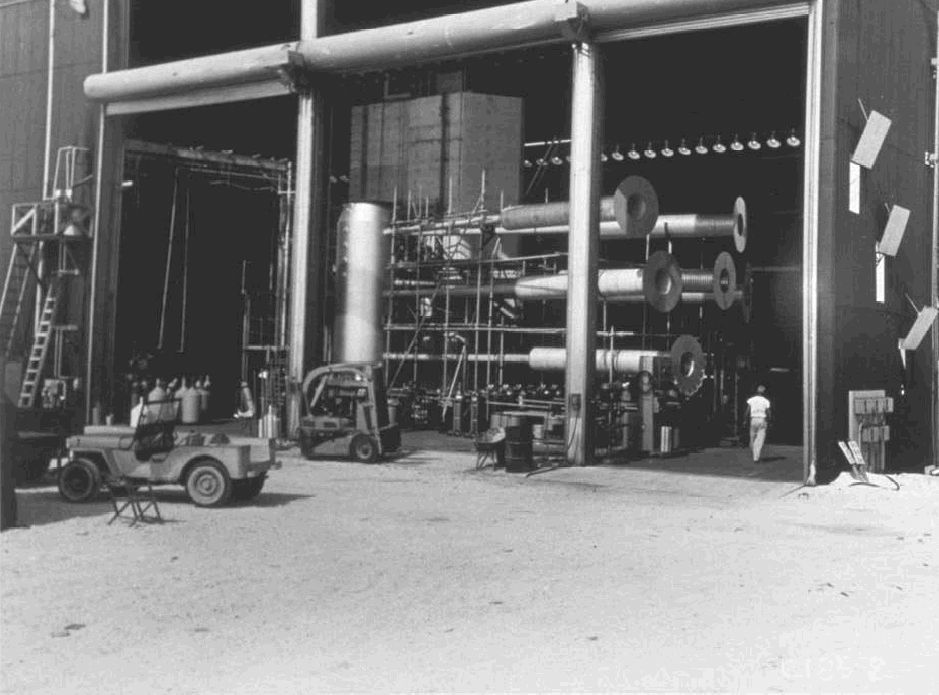
Though difficult to make, hydrogen bombs are attractive to nations and militaries because their fuel is relatively cheap. Inside a thick metal casing, the weapon relies on a small atom bomb that works like a match to ignite the hydrogen fuel. Today, Britain, China, France, Russia and the United States are the only declared members of the thermonuclear club, each possessing hundreds or thousands of hydrogen bombs. Military experts suspect that Israel has dozens of hydrogen bombs. India, Pakistan and North Korea are seen as interested in acquiring the potent weapon. The big secret the book discusses is thermal equilibrium, the discovery that the temperature of the hydrogen fuel and the radiation could match each other during the explosion (PDF). World Scientific, a publisher in Singapore, recently made Dr. Ford's book public in electronic form, with print versions to follow. Ford remains convinced the book "contains nothing whatsoever whose dissemination could, by any stretch of the imagination, damage the United States or help a country that is trying to build a hydrogen bomb." "Were I to follow all — or even most — of your suggestions," says Ford, "it would destroy the book."
That sort of censorship is just going to blow up in their face!
Years ago, I remember reading about some dude who designed an A-bomb for his senior thesis.
His last stumbling block was the proper explosives for the implosion. So he called up the sales arm of some manufacturer, said he was a building contractor, and that he would need an explosive with $CHARACTERISTICS.... and that he was ready to buy in quantity.
The sales guy fell all over himself providing the exact info the dude needed.
He turned in his thesis, and then when no grade was published, he went to see his professor, who told him that DOE was considering classifying it.
General Relativity: Space-time tells matter where to go; Matter tells space-time what shape to be.
Brief overview of this: http://www.universitypressclub.com/archive/2013/02/the-a-bomb-kid-and-hows-your-senior-thesis-going/
General Relativity: Space-time tells matter where to go; Matter tells space-time what shape to be.
Many feel the Japanese would have surrendered anyhow.
I call BS. Before the atomic bombs, Japan's strategy was to basically arm every citizen and make the invasion of the mainland such a bloody, costly quagmire for the Allies that they would negotiate favorable peace terms. Even the Wikipedia article on Surrender of Japan has a deeper understanding of the issue than whatever you're making up. Even after Hiroshima, the Supreme Council voted against surrender. They thought that maybe the U.S. only had one bomb, or that it lacked the will power to use it again. After Nagasaki (and the Soviet invasion), the Supreme Council still didn't want to surrender, so they tortured a captured U.S. P-51 pilot, and he told them that the U.S. had at least 100 atomic bombs (he was lying). But the cabinet still split on whether to surrender. It took the emperor basically begging the cabinet, for the sake of the millions who were about to be slaughtered, to persuade them to vote in favor of surrender.
Modern navel-gazing revisionist historians really don't appreciate how truly warlike and blood-soaked the entire Japanese culture was before 1945. They were obsessed with killing and torture. The Japanese surrender and subsequent disarmament fundamentally transformed the entire nation.
Today's Sesame Street was brought to you by the number e.