 Slashdot Mirror
Think Tanks: How a Bill [Gates Agenda] Becomes a Law
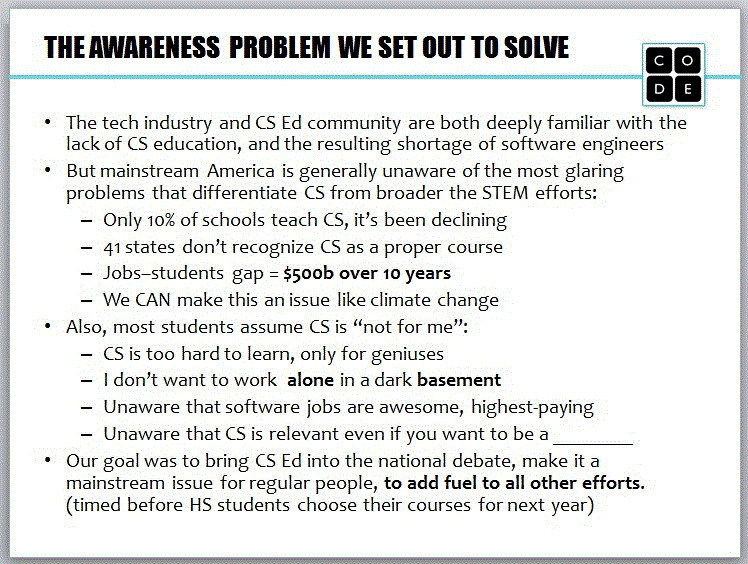
theodp writes: The NY Times' Eric Lipton was just awarded a 2015 Pulitzer Prize for investigative reporting that shed light on how foreign powers buy influence at think tanks. So, it probably bears mentioning that Microsoft's 'two-pronged' National Talent Strategy (PDF) to increase K-12 CS education and the number of H-1B visas — which is on the verge of being codified into laws — was hatched at an influential Microsoft and Gates Foundation-backed think tank mentioned in Lipton's reporting, the Brookings Institution. In 2012, the Center for Technology Innovation at Brookings hosted a forum on STEM education and immigration reforms, where fabricating a crisis was discussed as a strategy to succeed with Microsoft's agenda after earlier lobbying attempts by Bill Gates and Microsoft had failed. "So, Brad [Microsoft General Counsel Brad Smith]," asked the Brookings Institution's Darrell West at the event, "you're the only [one] who mentioned this topic of making the problem bigger. So, we galvanize action by really producing a crisis, I take it?" "Yeah," Smith replied (video). And, with the help of nonprofit organizations like Code.org and FWD.us that were founded shortly thereafter, a national K-12 CS and tech immigration crisis was indeed created.
He's giving 90% of his wealth away before he dies[1], feeds the hungry in Africa[2], vaccinates populations at risk who don't have access to vaccines[3][4]. How can you say anything bad about the man? He only wants the best for the next generation of Americans.
[1] .. to buy products from the very companies he owns which increases their value and dividends .. with GMO produce that sterilizes rats after a few generations, gives cows and pigs organ problems, etc. .. using live polio virus (unlike what we get here), causing almost 50,000 children to be paralysed leaving the population worse off than before brushing it off as a statistic, part of keeping our society safe from disease. .. giving only one half of the vaccine for free, requiring the governments to buy the other half from his company
[2]
[3]
[4]
The only way to get that is to fracture the system. You will never ever eliminate the power of money and charismatic personalities. No matter how much money someone has, barring very few people, everyone always wants more. And charisma is just one of those things that you can't account for. Even highly educated people have been taken in by a charismatic person with an agenda. The only way to make the system less easy to manipulate is to fracture the system into smaller more autonomous segments. A strong shift to a more anti-federalst system would do a lot of good on this front. Don't get me wrong, I am well aware of how corruptible small-town politics can be, but it's much easier to escape and route around the damage caused by small town corruption than the same damage caused by federal corruption. Yeah, it might cost someone millions of dollars to buy off a few congressmen, but those millions only have to be spent once or twice and you buy national power as opposed to spending thousands to buy off local politicians and having to spend those thousands in every city and every state across the nation to get national control. Worst of all, those millions are spent buying someone that takes millions of dollars to replace. It's a whole lot easier to beat out and replace an incumbent city council member than it is to beat out and replace an incumbent congressman.
We acknowledge the wisdom in reducing single points of failure in technology. Why don't we acknowledge the same in government?
The problem with that plan is that so many aspects of the way the system is designed give people with money and/or time an advantage that you'd basically have to scrap it.
For example, we have a bicameral Legislature and an independent Executive chosen via staggered elections. The Legislators are independent actors. That means policy-making tends to the crowd-sourced-cluster-fuck when things are going well. It also means intricate stratagems of getting Rep A to trade horses with Senator B, while bribing Subcommittee Chair C, etc. become possible. And Bill Gates is the guy who has the time/money/employees do engage in such stratagems. The staggered elections mean that the people in power are looking at vastly different electorates, which in turn means that the guy whose worried about being elected in a non-Presidential year has to worry more about older, whiter, more conservative voters who tend to vote every time; whereas the guy whose next up in a Presidential year is going to be much more concerned with younger, browner, leftier voters who are much more likely to only show up once every four years. If you add in our campaign finance system, and large districts (our smallest House District is a half-million people), it just gets worse.
Compare this to Canada. They have a lot of the same trappings we do like a Senate, but their Senate is toothless. Half the bullshit that allows the wealthy to out-manuever the rest of us is gone because nobody gives two shits what a Senator says. One of their core principles is called "Responsible Government," which means the government is designed so that it's virtually impossible for anything of note to happen without everyone knowing precisely which two to three people to blame if it turns out to be invading-Iraq-level-dumb. See the Commons choose the Executive, the Prime Minister, chooses the Cabinet. If the Commons fail to agree with a PM they will vote against the bill they don't like, forcing a new election, and the next PM will agree with the next Parliament on that particular issue. That means that the only people who can really be blamed for fuck-ups are the PM, the relevant Minister, and possibly (but extremely rarely) somebody else for bullying them. There is very little space in the system for a clever person to game it by clever maneuvers, which means that clever people can't sell access to their clever plans to game the government.
Don't get me wrong. The wealthy will always have more influence then their numbers indicate because a) they vote, and b) many of the not-wealthy figure "a poor man never gave me a job" and out-source their policy preferences to rich-ass-mother-fuckers. But the system we got amplifies that a huge degree.
There isn't an US IT shortage, there is a shortage of US IT that will work for less then they are worth. Companies game H-1Bs and treat them more poorly than they could get away with. If one pushes laws to support this corruption don't be surprised when IT unions form to fight it.
People who complain about H-1B visas usually have a misguided view of what the real options are in this debate. They see an option where companies don't use H-1Bs and simply hire more US citizens instead. The reality, however, is that the real options for companies are:
1. Bring in H-1B visas so corporate IT teams stay in the US
2. Build corporate IT teams in other countries
Option #2 is essentially outsourcing, and it is not just some boogeyman intended to scare US workers. It really happens. Entire industries have already moved overseas in the past century, and the software developer and other engineering industries are not immune to it.
If US citizens cannot compete with foreign labor that live in the US, with a similar cost of living as US citizens, we have no hope of competing with foreign labor abroad with a much lower cost of living. There has been a push back against outsourcing software development jobs in the past decade, but if we start practicing protectionism the trend can easily start moving in the other direction again.
-- All that is necessary for the triumph of evil is that good men do nothing. -- Edmund Burke
In fact, Phillips runs Phillips Electronics out of Andover Mass, presumably for American talent
Philips runs 59 R&D facilities across 26 countries. It takes advantage of talent in all of these countries, including the US. The fact that two of its many subsidiaries are headquartered in the US is no indication that Philips is a US company at heart (like you insinuate in the last statement of your post).
Sony runs Sony Entertainment out of Los Angeles, again for that 'American cool'
Sony also has various headquarters in many different countries. It is no surprise that its movie and music subsidiaries are headquartered in the US, but that is no indication that Sony is a US company that just happens to be headquartered in Japan.
-- All that is necessary for the triumph of evil is that good men do nothing. -- Edmund Burke
. . . only really works in the labor market we are told, since it is completely inoperative everywhere else!!!!!
And taken a bit further, with a bit more modern historical research, NAFTA was about the same thing: new regs allowing for foreign ownership of Mexican banks (within one year of the passage of NAFTA, or signing by Mexico, 90% of their banks became foreign owned), when then favor Big Agra, which speedily moves in to take over the agriculture industry, while payouts go to Mexican politicians favoring the privatizing of those farmlands occupied by Mexican subsistance farmers, who are then forced off their lands, and thus journey north to America, to continue the downward trend on wages at the lower levels, etc., etc., etc.