 Slashdot Mirror
Opportunity Rover Reaches Martian Day 4,000 of Its 90-Day Mission
An anonymous reader writes: Let's take a moment to appreciate the incredible engineering, scientific, and planning skill that went into the construction and deployment of the Opportunity rover. It landed on Mars with the goal of surviving 90 sols (Martian days), and it has just logged its 4,000th sol of harvesting valuable data and sending it back to us. The Planetary Society blog has posted a detailed update on Opportunity's status, and its team's plans for the future. The rover's hardware, though incredibly resilient, is wearing down. They reformatted its flash drive to block off a corrupted sector, and that solved some software problems that had cropped up. They're currently trying to figure out why the rover unexpectedly rebooted itself. Those events are incredibly dangerous to the rover's survival, so their highest priority right now is diagnosing that issue.
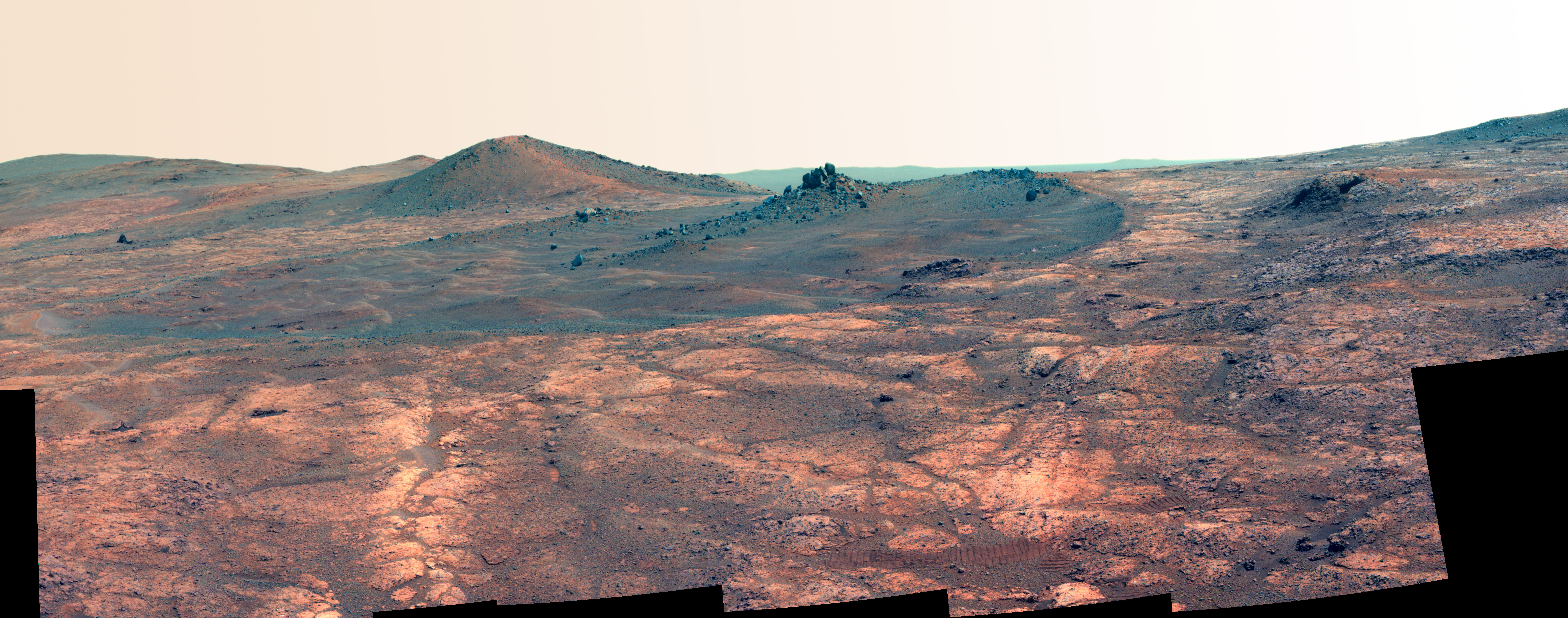
Fortunately, weather on Mars is good where the rover is, and it's still able to harvest upwards of 500 Watt-hours of energy from its solar panels. Opportunity recently completed a marathon on Mars and took an impressive picture of the Spirit of St. Louis crater, and the rover will soon be on its way to enormous clay deposits that could provide valuable information about where we can look for water when we eventually put people on Mars. As always, you can look through Opportunity's images at the official website.
Fortunately, weather on Mars is good where the rover is, and it's still able to harvest upwards of 500 Watt-hours of energy from its solar panels. Opportunity recently completed a marathon on Mars and took an impressive picture of the Spirit of St. Louis crater, and the rover will soon be on its way to enormous clay deposits that could provide valuable information about where we can look for water when we eventually put people on Mars. As always, you can look through Opportunity's images at the official website.
Here's proof that we are capable of great civilian technology achievements when we have the will and the desire to invest in science and engineering instead of yet another boondoggle.
It's kind of interesting.
One of the big reasons that they thought it would be limited to 90 days is that the solar panels get covered in dust, and as that happens the amount of energy collected diminishes. They figured in about 90 days, based on previous missions to Mars, they'd be out of juice.
And...for the first 50 days or so, it was going that way. And then, a whirlwind came by, and scrubbed the rover clean. This has happened many many times since. An unexpected good fortune.
I love Mondays. On a Monday, anything is possible.
Bah! For a cheaper, faster, better mission with a modest initial budget it's been an amazing success. NASA put two functioning units on Mars for not all that much money (in relative terms) .. around $820 million dollars for the initial 90 days. Compared to military and other expenses ... that's chump change.
The on-board computers are tiny by most standards:
Operating from -40C to +40C is absolutely not a "cool dry place"; it's a hostile environment. Did we mention the dust storms? And the radiation?
We're talking about something which had to travel millions of miles, not miss the planet, not get destroyed on landing, and which has been there for 11 years and is still (to some degree) an operational unit. It's sibling keeled over five years ago.
You go ahead and wait for something else to be impressed with, me, I'll be impressed right now.
Because there simply isn't another thing which has ever existed which humans have made which has operated and traveled on the surface of another planet for anywhere near as long as this thing has.
Opportunity needs to be recognized as an absolutely amazing achievement, because it absolutely is.
Lost at C:>. Found at C.